Most of the press on GLP-1 drugs lands in one of two camps. Either they’re the miracle of the decade, or they’re melting people’s muscle off and leaving them skinny-fat and weak. I coach a fair few people on Ozempic, Wegovy and Mounjaro out of my gym in South East London, and how to keep muscle on Ozempic is the question that comes up first. Honestly, the day-to-day reality is a lot duller than either headline take. Most of the muscle loss is preventable, and the bit that isn’t usually comes down to people losing weight faster than their training and eating can keep pace with.
How Much Muscle Do You Actually Lose on Ozempic?
The headline figure that keeps getting quoted is that GLP-1 users lose "up to 40% of their weight loss as muscle." That number’s real, you can find it in the literature, but it isn’t what the average person actually loses.
The best data we’ve got comes from the SURMOUNT-1 sub-study on tirzepatide from 2025, which used DXA scans to actually measure muscle versus fat properly. People lost about a quarter of their total weight as muscle and three-quarters as fat. That’s pretty close to what you’d see from bariatric surgery, or from a well-run diet and training programme without any drug at all. GLP-1 drugs make a lot of weight come off in a short window, so the absolute amount of muscle lost looks big, but the proportion of muscle to fat coming off is roughly the split you’d expect for a normal weight loss programme.
The bigger review by Neeland and colleagues (2024) puts the range across studies at anywhere between 15% and 60% of total weight loss being muscle. Where you land in that range basically comes down to two things: whether you’re eating enough protein, and whether you’re doing resistance training. The people up at the 40%+ end aren’t usually doing either.
What I tell clients on day one is that the drug’s the bit creating the weight loss, and my job’s to make sure most of what comes off is fat rather than muscle.
Your Protein Target: 1.6g per kg of Lean Mass
Most people on these drugs aren’t getting nearly enough protein, and a lot of the time they’re not even close.
GLP-1 drugs cut how much you eat by somewhere between 15 and 40%, depending on the dose and how you respond to it. I’ve had clients unwittingly drop below 800 calories a day while titrating up the dose. When the total amount of food someone eats collapses like that, their protein collapses with it unless they’re paying close attention.
What I aim for is 1.6 grams of protein per kg of lean body mass per day. The research on holding onto muscle in a calorie deficit puts the useful range at 1.2 to 2.0g/kg, and 1.6 sits roughly in the middle. For most adults that lands somewhere between 100 and 150g of protein a day. For a deconditioned 95kg client just starting on Mounjaro, it’s usually around 120g.
Hitting 120g of protein when your appetite has been chemically switched off is harder than it sounds. A chicken breast, a Greek yoghurt and a protein shake across a day is about 90g. You have to be deliberate about it, and you have to front-load. I get clients to aim for 40g at the first meal of the day, before the afternoon nausea dip kicks in.
On injection day and the day after, switch to easy-to-eat stuff: Greek yoghurt, cottage cheese, eggs, shakes. A big steak dinner’s a bad idea when your stomach’s already emptying slowly and the nausea’s peaking. None of this is rocket science, but it’s the bit clients most commonly get wrong.
If you want the underlying case for the target before the GLP-1 context, here’s the full guide to protein.
The Training Floor: Ten Sets, Three Sessions
Cardio and walking are both useful for various things, but they won’t protect your muscle when you’re losing weight at 1.5kg a week. For that you need resistance training, and you need a certain minimum amount of it.
The number that keeps coming up in the research is at least 10 hard sets per muscle group per week, spread across three or more sessions, kept up for 10 weeks or more. Drop below that and you’ll lose muscle no matter how much protein you’re eating. Roth and colleagues (2022) showed this in athletes cutting weight, and Locatelli and colleagues (2024) showed the same pattern specifically in people on GLP-1. The Locatelli one’s worth pulling out because their training programme actually put about 3kg of muscle back on people who were on the drugs, and got their strength up by 25% on top.
For someone who’s deconditioned and just starting out, the volume actually looks fairly modest on paper: three full-body sessions a week, three or four working sets per movement, one exercise per major muscle group per session. Machines and supported compound movements for the first eight weeks or so, because joint tolerance is low and coordination hasn’t been built yet. So leg press rather than free squat, chest press rather than barbell bench, lat pulldown rather than starting on pull-ups.
The mistake people often make is to drop the volume when they feel tired, which is the wrong way round. If recovery’s struggling, the thing to dial back is intensity (how hard each set feels), not volume (how many sets you do). Frequency and volume are what protect the muscle, and load is the bit that can sit a bit lower for a while; it’ll come back up once the drug effects settle anyway.
The 500-Calorie Deficit Ceiling
There’s also a calorie deficit ceiling beyond which training just can’t hold onto muscle, no matter how much protein someone’s eating. Almost nobody on a private prescription is keeping an eye on this.
The 2022 meta-analysis by Murphy and colleagues found that once you’re past about a 500-calorie deficit a day, you stop being able to build muscle while resistance training, even with plenty of protein. Strength tends to hold up better than muscle in a deficit, which is why clients on GLP-1 can often keep getting stronger even while the scale’s dropping.
Most private-prescription GLP-1 users are well past a 500-calorie deficit without realising. When a client tells me they’re eating "a bit less" and weight’s falling 1.5kg a week, that’s a deficit of around 1,500 calories a day, almost entirely created by the drug rather than by anything they’re choosing to do. At a deficit that big, you can do everything else right with protein and training and you’re still going to lose muscle.
So rather than pushing them to eat less, I’ll often push them to eat a bit more for a week and we’ll see what happens on the scale. Slowing the rate of loss is how you tilt things back towards more fat coming off and less muscle.
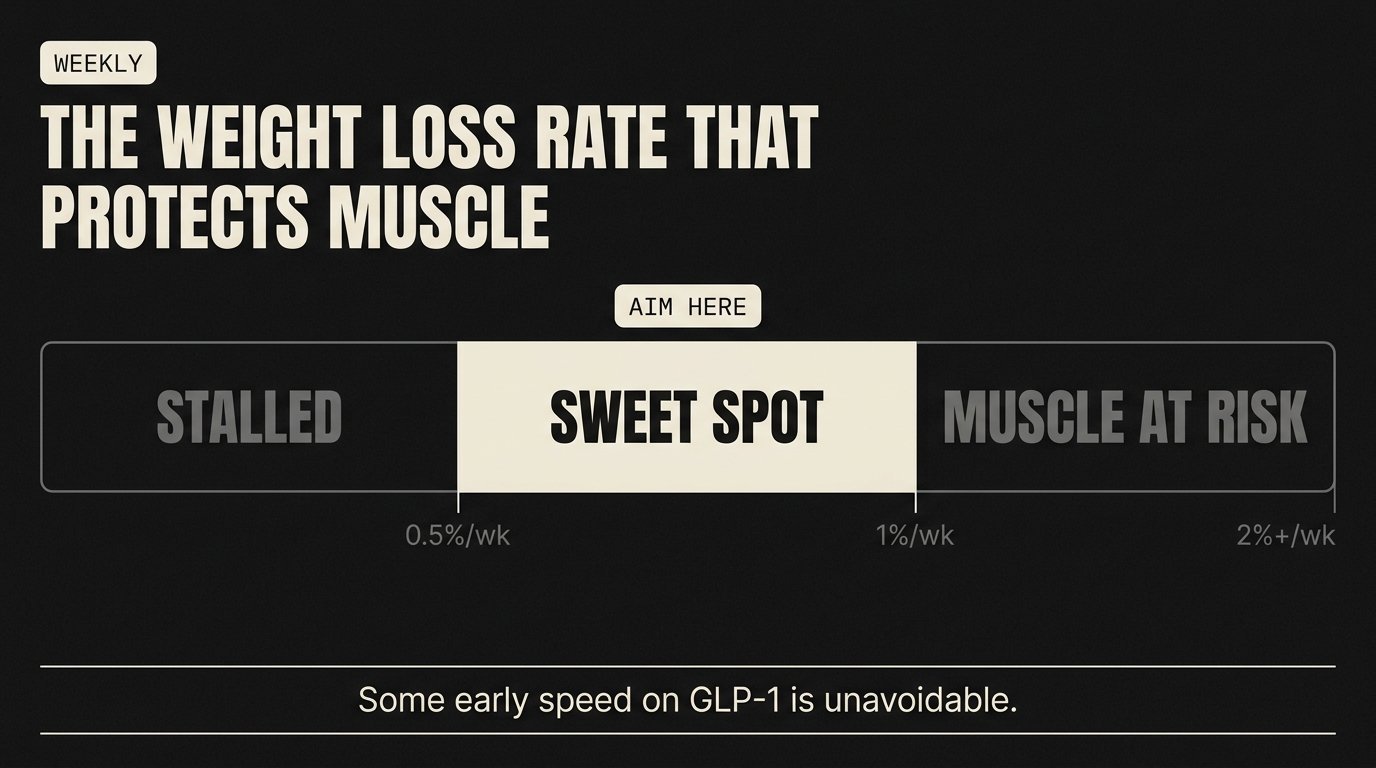
The wider weight-loss research points to a sweet spot of about 0.5 to 1% of bodyweight a week for holding onto muscle while losing fat. At that pace there’s time for fat to come off properly without much muscle being pulled with it. On GLP-1 drugs while you’re titrating up the dose, losing 1.5 to 2% of bodyweight a week is fairly common, and that’s the phase where muscle loss risk is highest. Some of that early speed is unavoidable. But if a client keeps losing more than 1% of bodyweight a week for three or four weeks running, I’ll flag it, look at how much protein they’re actually getting in, look at total food intake, and we’ll have a proper conversation about whether going faster’s doing them any favours. Because if you lose weight faster than your habits can keep up with, it tends to come straight back on once you stop the medication.
The four things that protect muscle on any weight loss programme are the same on GLP-1: enough protein, enough resistance training, a sensible calorie deficit, and a sensible rate of loss. The thing about being on the drug is that the deficit happens automatically, so the other three tend to get forgotten about. If you want those four levers turned into a first week you can actually run, the free 5-day GLP-1 course walks through one a day.
The easiest day-to-day signal that you’re keeping muscle on Ozempic is your main lifts. If your strength’s holding steady or going up while your bodyweight’s coming down, you’re in pretty good shape. The moment your strength starts dropping alongside the scale though, one of those four levers is off, and it’s worth working out which. None of that’s what you’ll get from a private prescription platform that sends you a 20-minute bodyweight video and a recipe for a chicken salad.
If you’re on Ozempic, Wegovy or Mounjaro in London or anywhere in the UK, and you want training and nutrition built around the drug rather than around generic fat loss advice, I can help. That’s exactly what the online coaching is set up for, and it runs wherever you train.