GLP-1 quickstart · Peak Body Coach
Starting Ozempic, Wegovy or Mounjaro?
The medication will take care of the weight loss, and this page covers the part it won’t: making sure what comes off is fat rather than muscle.
There’s a free 5-day muscle-protection course at the bottom of this page. One email a day, one thing to set up each day.
You’ve probably already read the alarming stuff: people on these medications losing muscle along with the fat, faces going gaunt, ending up lighter but weaker than when they started. If you’re starting Ozempic, Wegovy or Mounjaro, or you’re a few weeks in and the appetite has properly gone, it’s a reasonable thing to worry about, and I’d rather you took it seriously than brushed it off.
Here’s the picture as I see it from coaching people on these medications. Some muscle loss comes with any large weight loss, medicated or not. How much is mostly decided by three things you control: how much protein you eat, whether you do any resistance training, and how fast the weight comes off. The medication decides none of those for you. And if you’re on a private prescription, honestly, nobody else is deciding them either. The service that sends your pens might send a recipe email and a 20-minute workout video, and that’s usually where the support ends.
I’m Tom Rawcliffe, a personal trainer and AfN-certified nutritionist, and I coach people on Ozempic, Wegovy and Mounjaro out of my gym in South East London. What follows is the plan I take new clients through in their first weeks on the medication. One boundary before we start: nothing on this page is medical advice. Dosing, side effects and whether the drug suits you are conversations for your prescriber. My lane is the eating and training around the prescription.

Aim for 1.6g per kilo of lean body mass. It’s a floor, not a ceiling.
Spread over three or so sessions. One hard set twice a week still counts.
The sweet spot for losing fat while keeping the muscle.
How much muscle do you actually lose?
The scariest number in circulation is that up to 40% of what you lose on these drugs is muscle. That figure exists in the research, but it describes people at the bad end of the range, and almost none of them were eating enough protein or lifting anything.
- In the SURMOUNT-1 body composition sub-study (tirzepatide, the drug in Mounjaro, measured properly with DXA scans), roughly 25% of the weight lost was lean tissue and 75% was fat. That’s about the same split you’d get from a well-run diet and training programme without any medication.
- Across all the studies, the range runs from about 15% to 60% of weight lost as lean mass (Neeland 2024). Protein intake and resistance training are the main things separating the two ends.
- In people already taking GLP-1s, a supervised resistance training programme running longer than 10 weeks added around 3kg of lean mass back and improved strength by about 25% (Locatelli 2024).
So the muscle question has a fairly settled answer: the loss is real, and it’s also mostly preventable with unglamorous basics. I’ve written the full evidence up, with the study links, in how to keep muscle on Ozempic, Wegovy and Mounjaro, and the wider picture in the complete guide to training and eating on GLP-1s. The rest of this page is the short version you can act on this week.
Protein comes first, because it’s the first thing to go
These medications cut how much you eat by somewhere between 15 and 40%. That’s the point of them. The problem is that your protein falls with everything else, and during the dose-escalation months I’ve seen people drift under 800 calories a day without noticing, because nothing about that feels wrong when the hunger’s been switched off.
The target I set clients is 1.6 grams of protein per kilo of lean body mass per day. If you don’t know your lean mass, a decent shortcut is 0.7 to 1 gram per pound of your goal weight. Either route lands most adults somewhere between 100 and 150 grams a day. Two refinements from coaching this in practice: if you’re a smaller woman and the maths gives you less than about 90 grams, use 90 to 100 grams anyway, because calculated targets that low undershoot what actually protects muscle. And the number’s a floor, not a ceiling. The odd short day is nothing, but a regular pattern of coming in under it is exactly how muscle gets lost. The full reasoning is in the practical guide to protein.
Getting there on a suppressed appetite takes deliberate structure rather than willpower.
Front-load the first meal
40 grams of protein at your first meal, before the day’s appetite dip arrives.
Meals, not grazing
Keep three to five structured meals and let the medication kill the snacking in between, not the meals themselves.
Easy formats on injection day
On injection day and the day after, switch to protein that goes down easily: Greek yoghurt, eggs, cottage cheese, shakes. A big steak dinner is a bad idea when your stomach’s emptying slowly and the nausea’s peaking.
The minimum training that protects muscle
Walking is worth doing for plenty of reasons, but it won’t protect your muscle while you’re losing a kilo or more a week. For that you need resistance training, and the research floor is fairly consistent: around 10 working sets per muscle group per week, spread over three or so sessions, kept up for 10 weeks and beyond.
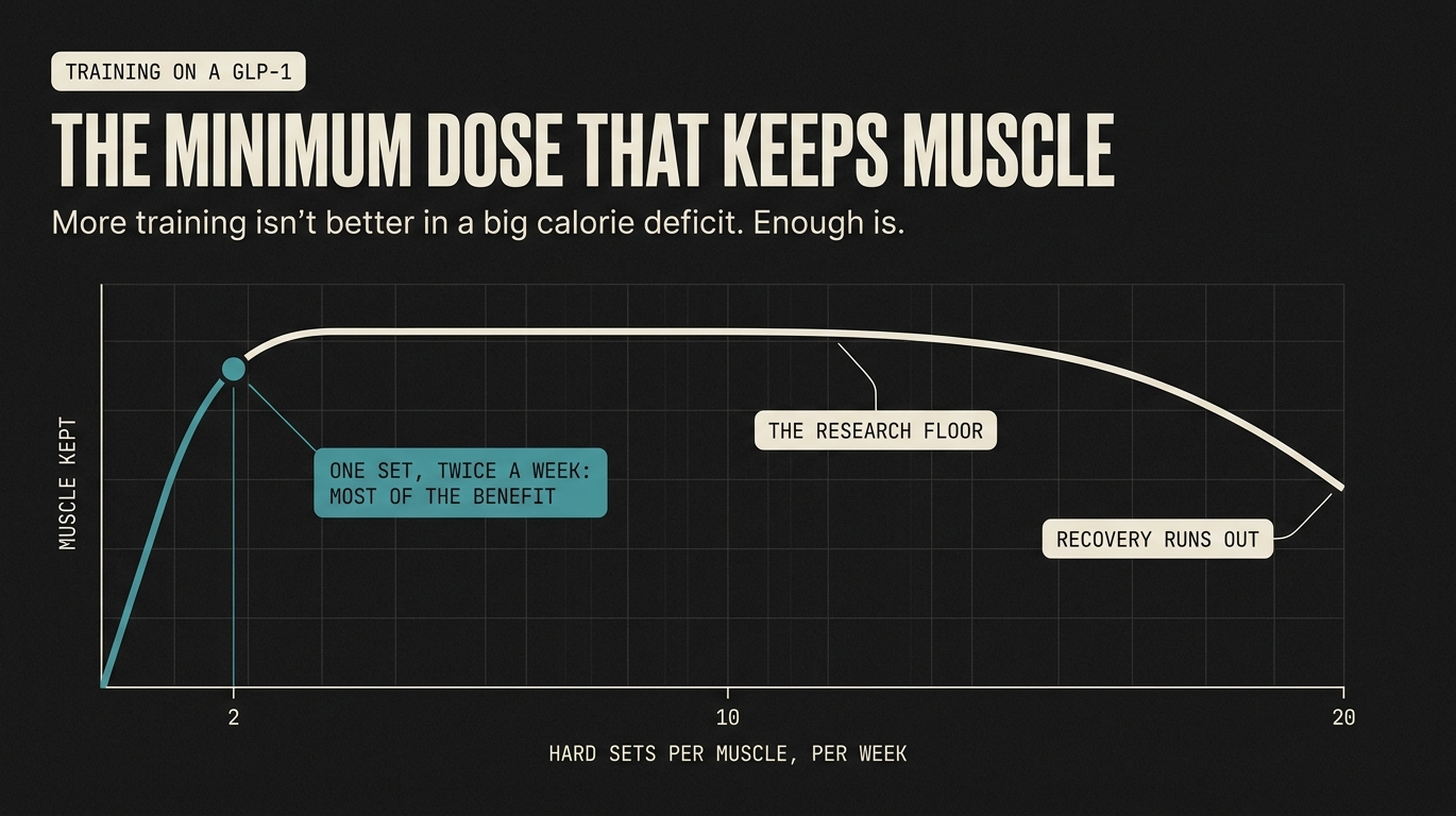
If you’re new to lifting, or coming back after years away, that’s smaller than it sounds. Three full-body sessions a week, mostly machines to start, three or four sets per movement: leg press, chest press, lat pulldown, a row, and you’re done in about 45 minutes. And if even that’s more than you can face this month, start smaller rather than not starting. The minimum-dose research shows one hard set per exercise, twice a week, captures most of the benefit of three sets, and a session like that takes about ten minutes. It still counts, and you can build from there.
The counterintuitive part is that more isn’t better here. The medication has already created a large calorie deficit, so piling extra training volume on top pushes you further into an environment your muscle can’t recover in. On the weeks the energy just isn’t there, drop the weight on the bar rather than the sessions, and on the genuinely bad weeks, 15 minutes of two compound exercises still sends the keep-the-muscle signal. It’s a lot better than skipping.
The aim of training on a GLP-1 is to signal your body to keep the muscle, not to burn extra calories.
Get this as a 5-day course
One email a day for five days, each with one thing to set up: your protein number, the injection-day eating plan, the minimum training dose, the right rate of weight loss, and how to keep the results if you ever stop the medication. It’s free, and it’s written by a coach who works with people on these medications every week.
Losing slower, on purpose
The sweet spot for keeping muscle while losing fat is around 0.5 to 1% of your bodyweight per week. While your dose is escalating, 1.5 to 2% a week is common, and that’s the window where most of the muscle risk lives.
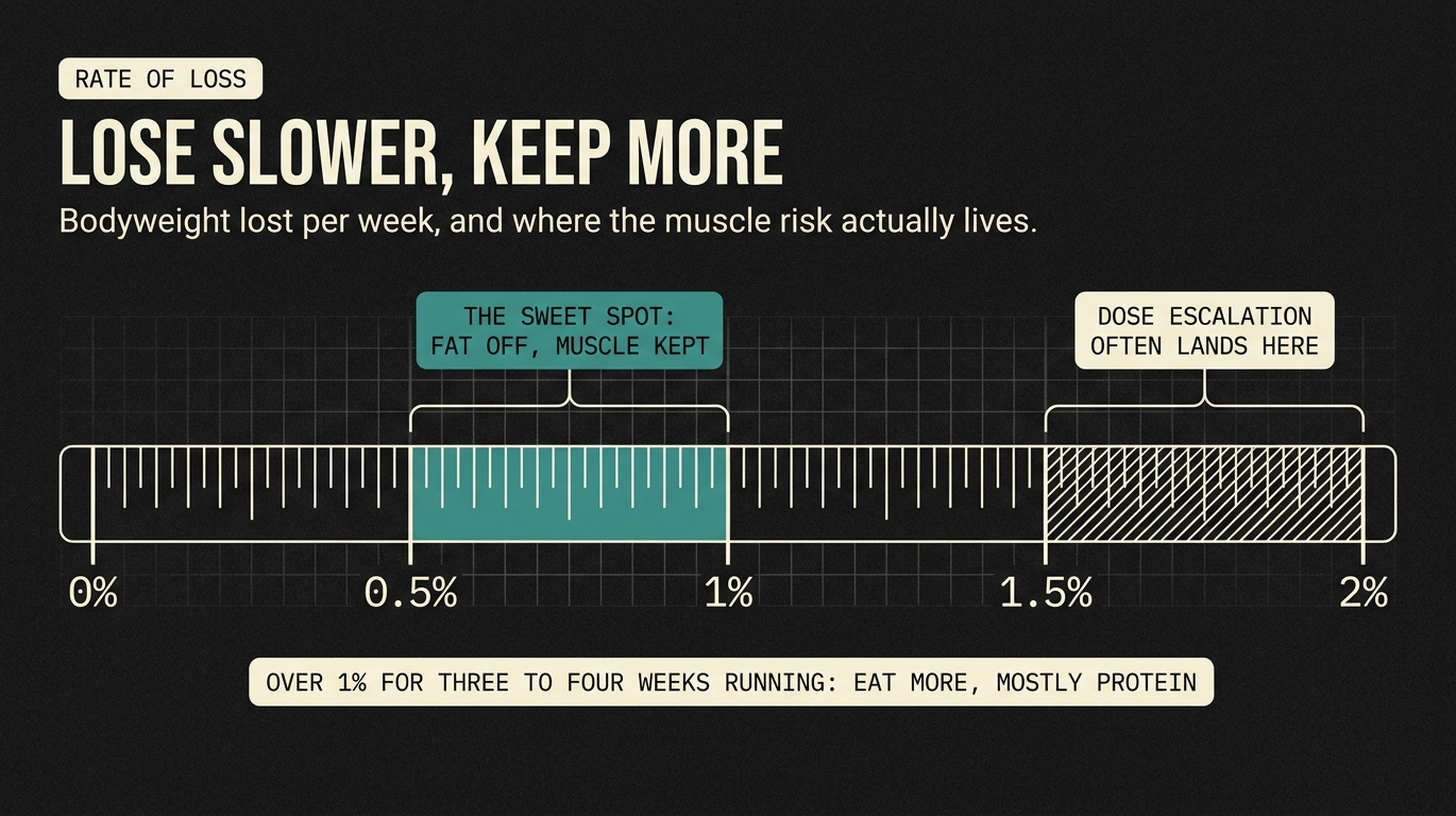
You can’t always control the early speed, and some of it’s fine. What I watch for is a sustained pattern: if you’re losing more than 1% a week for three or four weeks running, the fix is usually to eat a bit more, mostly protein, and let the rate settle. That feels wrong to almost everyone, because the speed is the exciting part. But weight lost faster than your eating and training can keep up with is disproportionately muscle, and it’s also the weight most likely to come back. In the follow-up to the big semaglutide trial, people who stopped the medication regained around two thirds of the lost weight within a year.
The day-to-day signal that you’re getting this right is your strength. If your main lifts are holding steady or creeping up while the scale comes down, what you’re losing is mostly fat. If your strength starts sliding alongside the weight, one of the three levers has slipped, and it’s worth working out which before another month passes.
The first month, specifically
Most of what goes wrong happens during dose escalation, so a few specifics for the early weeks.
Plan around the injection-day dip
Expect a 24-to-48-hour appetite dip after each injection, and plan protein around it rather than fighting it: eat well the day before, easy formats on the day. Don’t skip meals to ride the suppression, because the protein target still has to be met from food you can face.
The nausea toolkit
The low-tech fixes work more often than you’d expect: ginger or peppermint tea, fresh air, a short walk, and a few crackers if the nausea arrives with shakiness, because that one’s usually a blood-sugar dip rather than the drug.
Two litres of fluid a day
These drugs blunt thirst as well as hunger, and mild dehydration makes everything feel worse, training included. Tea and coffee count, and the practical check is urine colour: pale is fine, dark means drink more. If your eating shifts away from processed food, some added salt, potassium and magnesium stops the flat, crampy feeling that often gets blamed on the drug itself.
Drop intensity, not sessions
During titration I have clients keep the same sessions with everything at a 6 or 7 out of 10 effort. Strength holds, and it comes back up quickly once the dose settles.
If you’d rather do this with someone
I coach a small number of people on GLP-1 medications, in person at my gym in South East London and online. It’s the training, protein structure and week-to-week judgement calls this page can only gesture at, built around your dose schedule rather than around generic fat-loss advice. If that’s the kind of help you’re after, the details are on the GLP-1 coaching page.
And if you’re not there yet, or you’d rather do it yourself first, that’s exactly what the course below is for.
The 5-day GLP-1 muscle-protection course
Day one is your protein number, and it takes about five minutes to set. The rest follows one day at a time: injection-day eating, the minimum training dose, rate of loss, and keeping the results for good. It’s free, one email a day, and you can unsubscribe whenever you like.