Before I specialised in fat loss for busy professionals, plenty of whom now train on Mounjaro, most of my work was strength and conditioning and nutrition for combat sports. Fighters have to make weight, and they’ll do it no matter what, because the weigh-in doesn’t negotiate. What I learned coaching them is that the losing was never the hard part. The accountability took care of that. The hard part was everything around it: making sensible food choices under pressure, building habits that held, and having a proper plan for the days after the weigh-in. Get that wrong and the weight came straight back. I found myself saying the same thing to fighters over and over. You don’t have a weight loss problem, you have a weight management problem.
I see almost exactly the same picture now with clients on a GLP-1 like Mounjaro, Wegovy or Ozempic. The drug is the weigh-in. It guarantees the weight comes off whether you do everything else right or not. So the question worth asking was never whether you’ll lose weight on Mounjaro, because you will. It’s what you’ll lose, and whether it stays gone. That is where exercise on Mounjaro, and what you eat while you’re on it, do all the work the drug can’t.
This is the guide I wish my clients had found before they started. It links out to the deeper pieces on each part, but read this first, because it’s the map. And if you’d rather have it drip-fed, the free 5-day course sends one step a day to your inbox.
One line before we go further. I coach around these medications, I don’t prescribe them or advise on the dose. That’s your prescriber’s job, and there’s a section near the end on where their work ends and mine starts.
The Drug Guarantees the Loss, Not What You Lose
Most of the marketing you’ll read treats exercise on Mounjaro as a nice bonus, something to "boost your results". It’s the wrong way round. The jab is the part that just happens. It switches your appetite down, the deficit runs itself, and the weight falls off with less effort than you’ve probably ever felt. Training and protein are the bits that actually decide what you look like when the weight’s gone.
A GLP-1 works in a fairly simple way. It acts on the appetite centres in your brain and slows how fast your stomach empties, so you feel full sooner and stay full longer. Eat less without white-knuckling it and you lose weight. That’s the whole trick, and it’s a good one. For the first time, a lot of people find the eating-less part effortless.
The catch is that your body doesn’t only burn fat in a deficit. Left to its own devices it’ll fund some of that weight loss by breaking down muscle too, and it’s happy to, because muscle is expensive to keep. In the big Mounjaro trials, when researchers measured body composition, roughly a quarter of the total weight lost was lean mass rather than fat. Do nothing about it and that figure climbs towards a third or more. Get the training and protein right and you can pull it down to more like 15 to 20 percent.
The Muscle Loss Is Real, but the Panic Is Misplaced
The scary headlines about GLP-1s "eating your muscle" get one thing right and one thing badly wrong. They’re right that lean mass comes off, but wrong to make it sound like a disease.
The first thing to understand is that the "lean mass" figure from those trials isn’t pure muscle. The scan technology lumps in organs, bone, connective tissue and water, so some of what shows up as lean loss is fluid and glycogen shifting rather than contractile muscle disappearing. When researchers use more precise MRI imaging, the muscle change looks like proportional, adaptive down-sizing for a smaller body, not wasting. There’s an odder finding on top of that, one most people don’t expect: someone eating very little on a GLP-1 may actually hold onto slightly more muscle than someone doing the identical deficit on willpower alone, because the drug improves how your body handles insulin. The medication isn’t purely a threat to your muscle.
None of that means you can ignore it. It means the panic is aimed at the wrong thing, and the response, protein and lifting, is right regardless. I go into the muscle side properly in the deep dive on keeping muscle on Ozempic and Mounjaro, and into the fuller cost of getting it wrong in the hidden cost of weight loss drugs.
What Should You Eat on Mounjaro?
The first thing you notice coaching people through this is that they forget to eat. Not skip a meal on purpose, forget. A whole day goes patchy without them clocking it. One client, juggling young kids, told me his day had been a protein shake at lunch and a plate of pasta at dinner, and that was it. He wasn’t dieting hard. He just wasn’t hungry, and the day ran away with him.
That patchiness shows up fast in training. The first working set looks as strong as ever, then the reps and the weight fall off a cliff on the second and third sets. That’s glycogen depletion, your muscles running out of their stored fuel because you haven’t eaten enough to top them up. Early on it’s made worse by the queasiness a lot of people get in the first weeks, which makes eating even less appealing right when you need to be deliberate about it. Then, further down the line, the ordinary symptoms of a big calorie deficit turn up, the broken sleep, the extra stress, the flat workouts, just without the hunger that would normally flag any of it, so the whole thing lands as a vague, hard-to-place feeling of being run down.
The fix I come back to with almost every client is one rule: make easy-to-digest protein your only real eating priority. Carbohydrates will find you. There’s bread, pasta, rice and cereal in every cupboard, and nobody drifts through a busy day and accidentally forgets to eat carbs. Protein is the thing that gets missed, and it’s the thing that protects your muscle. So that’s what you plan for, and on the bad days, what you drink. Protein yoghurt pouches, clear whey that goes down like a squash rather than a milkshake, ready-made shakes. Whole-food protein is often physically impossible to get enough of when your appetite’s switched off, so liquid sources aren’t a cop-out, they’re the bridge.
As a rough target, aim for around 1.6 grams of protein per kilo of your lean body mass per day, protein first at every meal, and front-load it at breakfast while your appetite is at its best for the day. Add electrolytes and at least a couple of litres of water from the start of your dose titration, because the drug blunts thirst the same way it blunts hunger, and dehydration quietly makes everything worse. The foods you used to love can start to turn your stomach on a GLP-1, and it’s often the dense protein sources that go first, exactly when you need them most.
The Minimum Training That Keeps Muscle on Mounjaro
You can’t preserve muscle without resistance training. Cardio is good for your heart, your energy and your blood sugar, and it’s worth doing, but it does almost nothing to tell your body to hold onto muscle in a deficit. Lifting is the signal. Take it away and the muscle goes, because your body has no reason to keep tissue it isn’t being asked to use.
The good news is that the dose needed is smaller than most people fear. The research points to roughly ten hard sets per muscle group per week, spread across about three sessions, kept up for longer than ten weeks or so. That’s it. Full-body, compound-led, three times a week will cover it for most people. In supervised programmes, people on these drugs who lifted didn’t just slow their muscle loss, some gained a few kilos of lean mass and meaningfully more strength while the fat kept coming off.
Two things I’d tell you that the pharmacy blogs won’t. The first is counterintuitive: don’t add loads of extra training volume because you’re "on a diet". Normally, fat loss means grinding out more work to widen the deficit. On a GLP-1 the drug already owns the deficit, so piling on high-volume sessions on top of very low calories just digs a deeper hole your body has to climb out of, and it can cost you the muscle you’re trying to save. Do enough to signal, not enough to punish. The second is timing. The day of your injection and the day after tend to be the worst for nausea and energy, so treat them as recovery, and aim your proper sessions at the back half of the week when you feel more human.
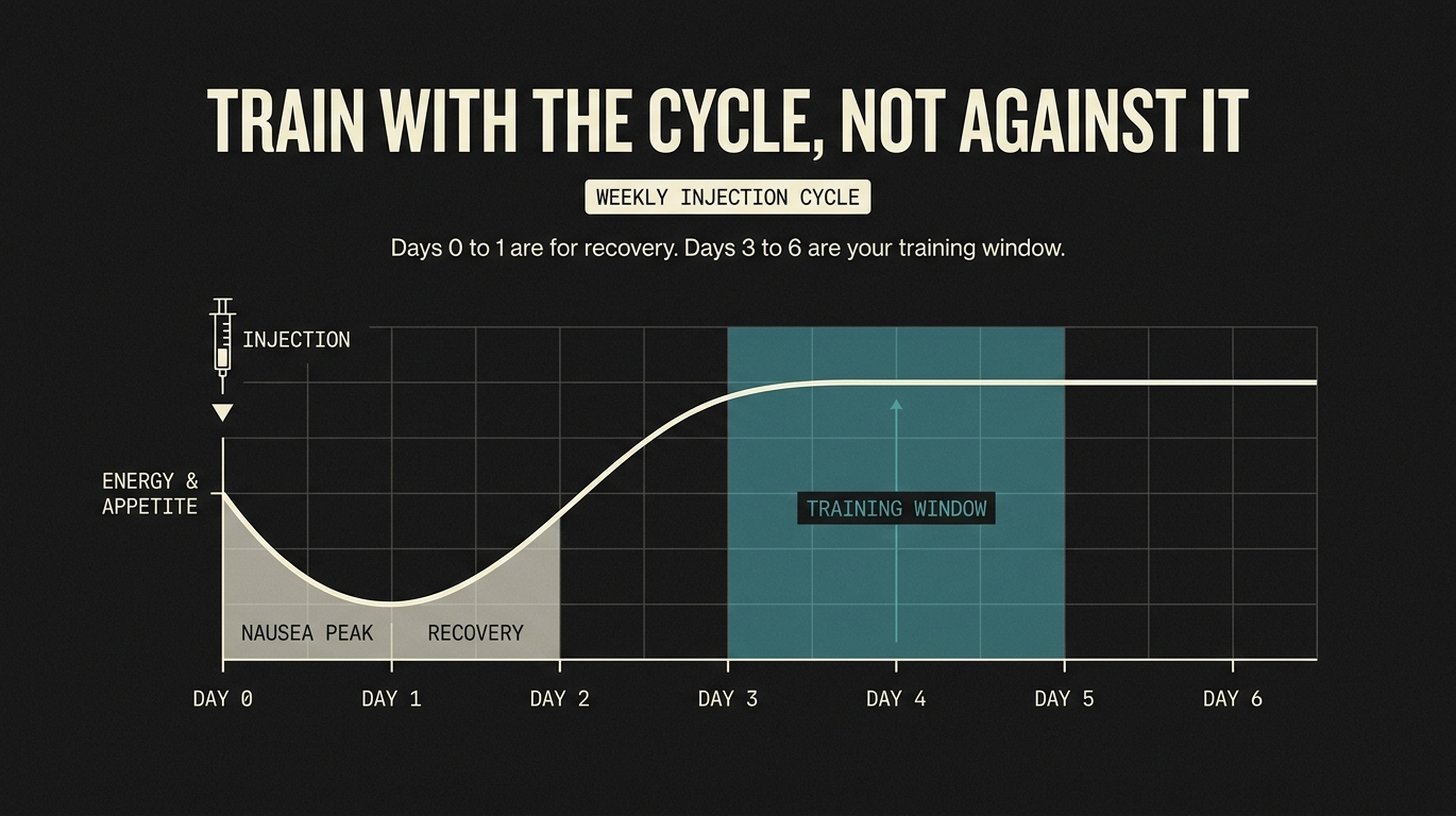
On the low days, when a full session genuinely isn’t happening, don’t write the whole day off. Fifteen minutes on a couple of compound lifts still sends the keep-my-muscle signal, and it beats nothing. The diagram above maps that training window across the injection week, and the "why do I feel so weak" question gets its own piece in feeling weak on Mounjaro.
Don’t Chase the Fastest Number
The scale can become a bit of a drug of its own on these medications, because it moves so reliably. But faster isn’t better for your body composition. Once you start losing much more than about one percent of your body weight a week, the share coming from muscle climbs. Half a percent to one percent a week is the range you want. If you’re dropping quicker than that, especially during a dose increase, the right response is usually to eat a bit more, not to feel pleased about it.
This is the point where I spend most of my coaching breath, and it’s the exact opposite of what the number on the scale is telling you to do. Slower, with your protein and your lifting in place, is what leaves you lean and strong instead of smaller and soft. The hollow, drawn look people call "Ozempic face" is, more often than not, a sign of losing too fast with too little protein and too little muscle underneath.
Weight Management, Not Weight Loss
Remember the fighters. The weigh-in was never the problem, the bounce-back afterwards was, and it came down to no plan for the phase that followed. GLP-1 clients are the same story. The trials are blunt about it: stop the drug without having changed anything underneath, and about two-thirds of the weight comes back within a year. The appetite suppression was doing the holding, and once it’s gone, the old patterns are still there waiting.
That’s why I coach for the day you come off from the very first week. The muscle you build now is metabolic insurance. The eating habits you practise while the drug makes them easy are the ones you’ll lean on when it isn’t. The goal isn’t just to lose weight on Mounjaro, it’s to become someone who doesn’t need it to keep the weight off. Tapering off without the rebound is its own piece of work, and so is what to do with the sudden drop in food noise these drugs create, that welcome calm you didn’t expect.
Where Your Prescriber Ends and I Begin
A quick, honest word on scope, because it matters. In the UK there’s no formal pathway handing GLP-1 patients from a prescriber to a coach, and the line between the two jobs is real. Your prescriber handles the drug: the dose, the titration, the side effects, whether it’s right for you at all. I don’t touch any of that, and no coach should.
What NICE actually asks for alongside these medications is a reduced-calorie diet and more physical activity, with proper behavioural support around it. That support is exactly the bit the prescription can’t deliver on its own, and it’s the bit that decides your result. So the split is simple. Anything about the medication goes to your prescriber. Anything sharp and sudden, severe stomach pain, vomiting that won’t stop, sudden vision changes, goes to them or to A&E straight away, not to me. The training, the protein, the habits and the plan for coming off, that’s my end, and it’s the 80 percent of the outcome the drug was never going to handle by itself.
If you’re on a GLP-1 and you want to come out the other side leaner and stronger rather than just lighter, that’s the whole job I do, and you can see how the coaching works here. If you’re not in London, the online coaching runs the whole thing through your phone.