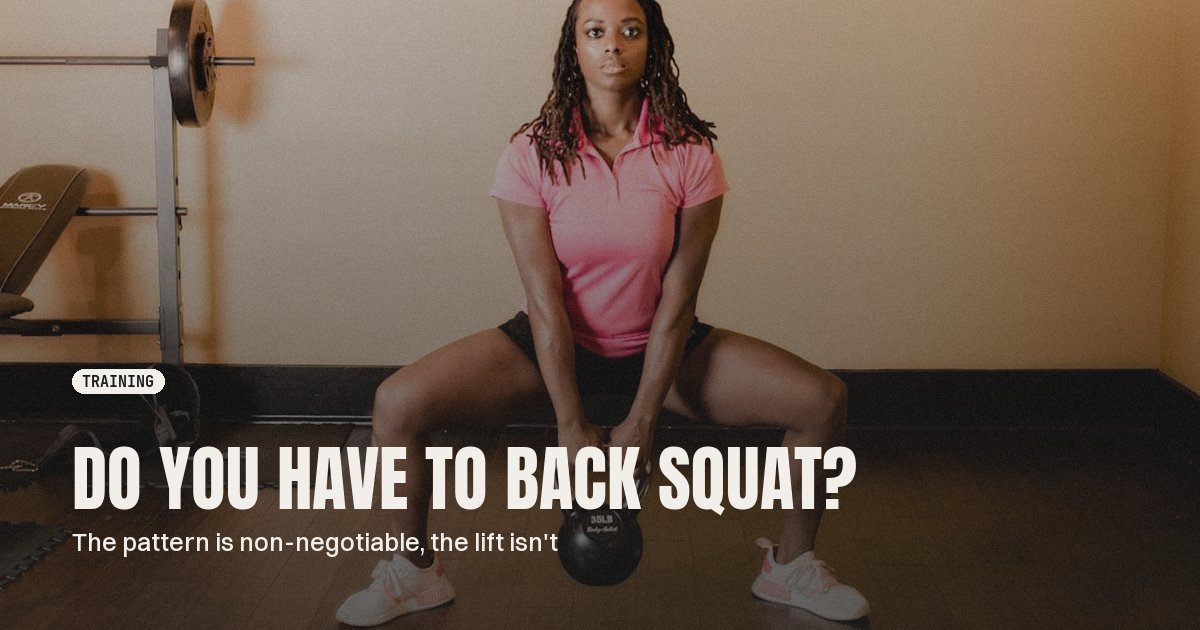
Do you have to back squat? For a long time my answer was basically yes. Most of my early work was with combat sports athletes, people with the coordination and motor control to step under a bar and squat well within a session or two. If you wanted to develop the squat, you back squatted. Pressing meant the barbell bench, and hinging meant the conventional deadlift. There wasn’t much to debate.
Working with untrained beginners changed my view. Most people who walk into a gym for the first time have never put a bar on their back. They don’t have the motor pattern yet, and pushing them straight onto a barbell adds complexity they can’t handle. That’s just gatekeeping with a clipboard.
What’s actually non-negotiable is the pattern: squatting, pressing, and hinging. The barbell back squat, barbell bench, and conventional deadlift are just three ways of expressing those patterns.
Six Patterns, Hundreds of Variations
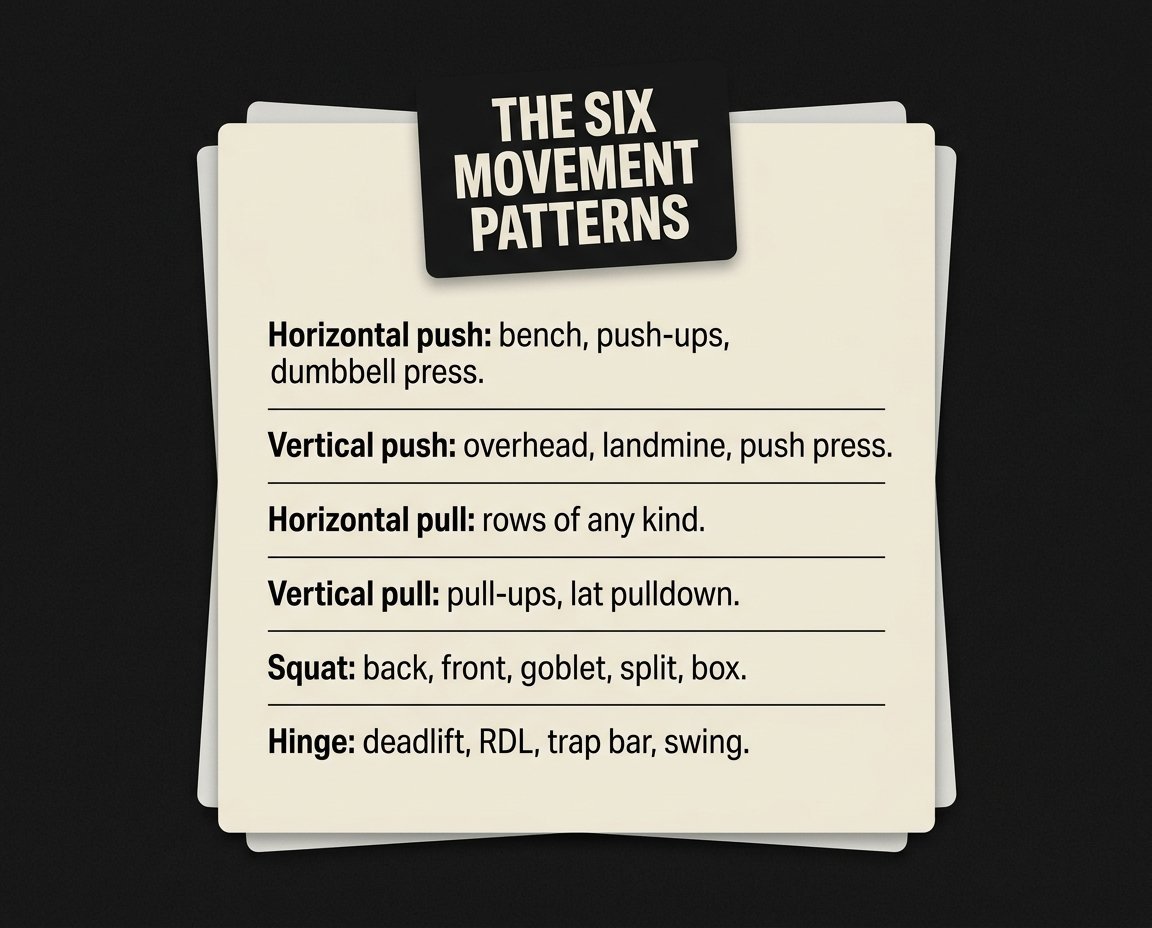
There are six fundamental movement patterns: horizontal push, vertical push, horizontal pull, vertical pull, squat, and hinge. Almost every useful exercise in a gym is an expression of one of these. The pattern is the foundation; the exercise is your way of loading it.
Take the squat. Whether you do a goblet squat, a box squat, a Bulgarian split squat, or a back squat, the pattern’s the same; only the equipment and the position change. Horizontal pressing covers a similar range, from push-ups through landmine and dumbbell presses to the barbell bench. So does the hinge, where a trap bar deadlift, a Romanian deadlift, a kettlebell swing, and a conventional pull all train the pattern with different demands on coordination, mobility, and bar control.
The mistake gym culture has made is treating one variation of each pattern as the variation, and the rest as lesser substitutes you do until you’re "ready" for the real thing. That isn’t how it works. Studies comparing squat variations find similar muscle growth across them when the training’s properly matched. The right variation is the one that fits your body, your injury history, and where you are in your training, full stop.
Why "the Big Three" Got Universalised
The barbell back squat, barbell bench, and conventional deadlift are the gold standard in powerlifting. They’re three of the most studied lifts in strength science, and they’re brilliant exercises if you’re suited to them and have the base to do them safely. None of that is in dispute.
Gym culture, though, has taken what’s optimal for a strength sport and generalised it to general training. The powerlifting community has had a disproportionate influence on how everyone else trains, and a rule that’s genuinely non-negotiable for competitive powerlifters has ended up applied wholesale to people who’ll never compete in anything. The claim got accidentally universalised from a specific sporting context.
If you’re training to powerlift, yes, you need to back squat, bench press, and pull conventional. Those are the lifts you’ll be tested on. For everyone else, they’re three options out of several hundred valid expressions of the same patterns.
"Just Fix Your Mobility"
The other thing you’ll hear a lot is this: if you can’t back squat, you need to fix your mobility until you can.
Sometimes that’s right. Some squat limitations are genuinely mobility-related and do improve with consistent work on ankle range, mid-back mobility, or hip flexor length. Worth doing regardless.
A lot of the time, though, what’s limiting the squat isn’t mobility, it’s structure. Hip socket anatomy determines squat stance width independently of any coaching cue or amount of stretching. Some people will always squat with a wider or narrower stance than the textbook diagram because of how their bones are shaped, not because they’re tight. Long femurs change the geometry of the lift at the hip in a way no amount of stretching changes.
The same is true for the overhead press. Some clients’ shoulders impinge under load no matter how clean their technique is, because of how the bony arch above the shoulder (the acromion) is shaped. Acromion shape varies enough between people to make a strict barbell press uncomfortable for some lifters, even with perfect form. For those clients, the pressing pattern stays in the programme through landmine pressing or cable variations, and the strict overhead press becomes a long-term goal rather than a starting requirement.
Telling someone with long femurs to "fix their mobility" until they can low-bar squat the way the textbook diagram looks is selling them a problem they can’t solve. Different bones need different variations.
The Progression Before the Barbell
"Just do the thing" works for someone who already has the coordination to do the thing. For someone who hasn’t built that coordination yet, which is most people who come to me, it doesn’t.
Every client I’ve ever pushed into a back squat before they had the underlying coordination has needed more coaching time, not less. The exercise was adding complexity that wasn’t useful yet. Goblet squats, box squats, and split squat variations all build the squat pattern with much lower technical demands. They let the lifter focus on bracing, depth, and tempo without simultaneously trying to balance a loaded bar across their upper back. By the time they progress to a back squat, they’ve already drilled the squat pattern for months, and the bar is a small addition rather than a leap.
I’ve got clients who’ve been training with me for two years and still aren’t back squatting. Not because they’ve failed at it, but because their body suits a different variation better, or because the back squat is sitting on the to-do list while a couple of other things resolve. The squat pattern’s in their training every week, and which variation they use is just a programming detail.
So, do you have to back squat? No, but you do have to squat. Find the variation of each pattern that fits your body, your injuries, and where you are in your training, and master that one. Move up to a more demanding variation when you’re ready. The aim is to build toward foundational barbell competency over time, but that’s a destination, not a starting point.
For the right person at the right point in their training, the goblet squat is the right exercise. Doesn’t matter what anyone else in the gym thinks of it; the squat pattern’s getting trained either way.
If you’re in South East London and want a programme built around the variations your body actually fits, rather than a one-size-fits-all big-three template, I can help.