In the same week recently, I had two clients who couldn’t have disagreed more about what makes a good exercise. One, a younger lad new to lifting, didn’t rate low bar squats because he couldn’t feel his quads, but he loved leg extensions where he felt every rep. The other, an older client with years behind him, felt the opposite: leg extensions were pointless baby weight, while a heavy squat felt like he was actually shifting something. Both were partly right, and both made the same mistake. It’s the most common confusion I see in how people train compound and isolation exercises, and it’s barely about the exercises themselves.
Two Camps, Both Half Right
The mistake usually comes down to who you follow rather than anything you’ve reasoned through yourself. Most people pick a creator whose vibe they like and absorb that person’s rules wholesale, then apply them to everything they do in the gym.
Follow the technical, biomechanics-obsessed corner of the internet and you’ll end up scrutinising every detail, from the exact angle of a cable to whether your elbow’s tracking perfectly, right down to which version of an exercise is "optimal" and which one’s supposedly killing your progress. Follow the heavy, no-nonsense, big-lifts crowd and you’ll do the opposite, throwing weight around with very little care for precision and treating anything that isn’t a barbell as a waste of time.
Both crowds are onto something real. The biomechanics people worked out how to get the most out of isolation exercises, the small, single-muscle movements where precision is the whole point. The big-lifts people understand compound movements, the squats, presses, rows and deadlifts where the job is moving serious load well. Where it goes wrong is that each crowd took what works brilliantly in their half of the gym and decided it must apply to the whole thing. So you get people trying to feel their quads on a heavy squat, and people grinding a leg extension like it’s a max-effort deadlift, and neither exercise ends up doing what it’s actually good for.
Compound and Isolation Exercises Do Different Jobs
Once you see them as two different tools with two different jobs, most of the arguing falls away.
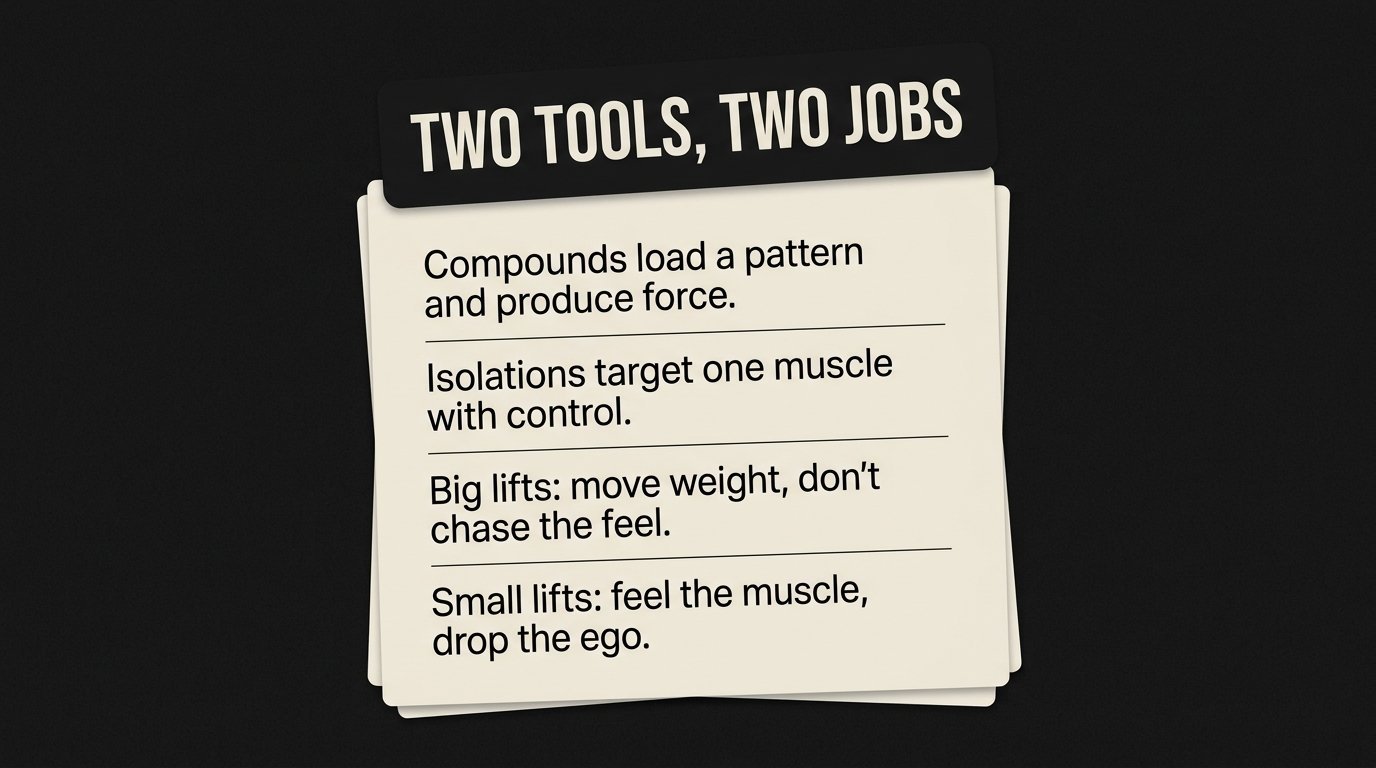
A compound movement’s job is to load a pattern and produce force. You’re moving a meaningful weight through a full, competent range, with real intent behind it. Whether you can feel one particular muscle working isn’t the goal, and chasing that feeling tends to make the lift worse. What usually happens when you try to isolate a muscle on a compound is that you drop the weight and shorten the range to chase the sensation, so you finish up with a watered-down squat and still not a proper isolation. On a big squat or a row, a bit of whole-body effort and even a touch of ego is part of what makes it work.
An isolation movement has the opposite job: load one specific muscle as precisely as you can, through its full range, with control. The weight on the machine matters far less than whether the target muscle is actually doing the work. This is where all that biomechanics detail earns its place, because the exact angle and how the resistance loads through the range really do change how well you hit the muscle you’re aiming at.
It helps to think of your programme as a toolkit. Every decent toolbox has a hammer for driving force and a chisel for precise, controlled shaping. You wouldn’t do fine detail work with the hammer or drive a big nail with the chisel, and you’d never bin one for not being the other. Your compounds are the hammer and your isolations are the chisel, and a complete kit needs both, each used for what it’s built for.
This also settles the endless argument about form. People tend to fall into one of two ditches, either form matters so much that you should drop the weight right down and keep everything slow and perfect, or form barely matters next to load so you should just get the thing up however you can. The honest answer depends on the job. On an isolation, protecting your form and keeping tension on the target muscle is worth giving up some weight for. On a compound, chasing a bit more load with form that’s good rather than flawless is often the entire point.
You’ll see the mind-muscle connection brought up here a lot, the idea that deliberately focusing on feeling a muscle work helps it grow. There’s research behind it, but look closely and the main attentional-focus study by Schoenfeld and colleagues used curls and leg extensions, not heavy compounds. So the advice to feel the muscle is sound, but only in the place it came from. Lift it out of that context and staple it onto your squats and it mostly gets in the way.
Be a bit wary of the word "optimal" as well. Even within isolation work, there’s no single best exercise for everyone. The right version for your body depends on your leverages, limb lengths and build, so the perfect movement for one person can be a poor fit for the next.
Big Lifts Move Weight, Small Lifts Feel the Muscle
You don’t need to audit your whole programme like a coach to use any of this. The shortcut more or less fits into one line: on the big lifts, move weight; on the small lifts, feel the muscle. On your squats, presses, rows and deadlifts, focus on moving good weight well, through a full range, with real effort, and stop worrying about whether you can feel one specific muscle. On your curls, raises, extensions and leg curls, drop the ego, slow down and actually feel the target muscle do the work, because heaving heavier and heavier on the small stuff mostly just buys you a higher injury risk for no real payoff.
Which brings me back to my two clients. The younger lad needs to stop judging his squat by whether he can feel his quads and let it be what it is, a heavy pattern that builds size and strength across his whole lower body, while keeping his beloved leg extensions for the precise quad work they’re good at. The older client needs to carry on loving his heavy squats, but stop writing off leg extensions, because for targeting a muscle through its full range, that "baby weight" does a job his squat can’t.
Same gym, same week, and the change both of them needed was the same: use each exercise for the job it’s good at, and stop judging it by the wrong measure.
If you’d rather train your compound and isolation exercises using each one for the job it’s actually built for, instead of forcing the same rules onto everything, that’s what I do with clients, both in person in South East London and online.