We’ve all had that Monday. You step on the scale and you’re somehow up nearly two kilos from Friday, even though you didn’t do anything wild over the weekend. Just a normal dinner out, a couple of drinks, maybe a pizza, nothing that comes close to explaining two kilos of actual fat. But there it is on the display, and just like that it’s set the tone for your whole week, before you’ve even had your morning coffee. If you weigh yourself every day, you’ll know the exact moment I mean.
So maybe you keep at it for a while, until another bad Monday tips you over and you stop looking. Around the same time, an influencer or a wellness post tells you that weighing yourself every day is obsessive and bad for your relationship with your body, and that the healthy move is to bin the scale and learn to feel good without it. Honestly, that comes as a relief. It feels like permission to stop being judged by a lump of glass and plastic first thing every morning.
I understand why that lands. The number has messed with your head before, so the idea that the scale itself is the problem feels obviously true. And if you’ve got a history of disordered eating, where a bad reading can tip you into a really bad place, then throwing the scale out can be exactly the right call and I won’t argue with it. For most people though, the advice has cause and effect backwards.
Will Weighing Yourself Every Day Wreck Your Head?
The research points the other way. In a randomised controlled trial of daily self-weighing, the people weighing every day didn’t end up more anxious or more unhappy with their bodies. They felt better about their bodies, not worse, were less likely to feel low, and they lost more weight than the people who weighed less often. The exact thing you’ve been warned about, that daily weighing breeds obsession and self-loathing, turned up as the opposite in the people actually doing it.
That probably sounds wrong if the scale has ruined a few of your weeks. But what actually hurt you on those Monday mornings was the story you ran in the three seconds after you saw the number. The scale never judged you, that was always your own internal monologue.

The reason daily weighing tends to calm that down rather than wind it up is that it teaches you what the number actually is.
The Scale Is Mostly Measuring Water
Before most of my work was with busy professionals, I spent years helping combat sports athletes make weight. A big part of that job was changing the figure on the scale using everything except the one thing most people step on a scale to find out about. We’d move food volume, the water and glycogen stored in their muscles, the contents of their gut, sweat, all of it. I could shift someone several kilos in a couple of days without them losing any meaningful amount of fat at all.
That changes how you read your own bodyweight. I’ve weighed myself most mornings for years, and when you do that for long enough you stop seeing single numbers and start seeing patterns.
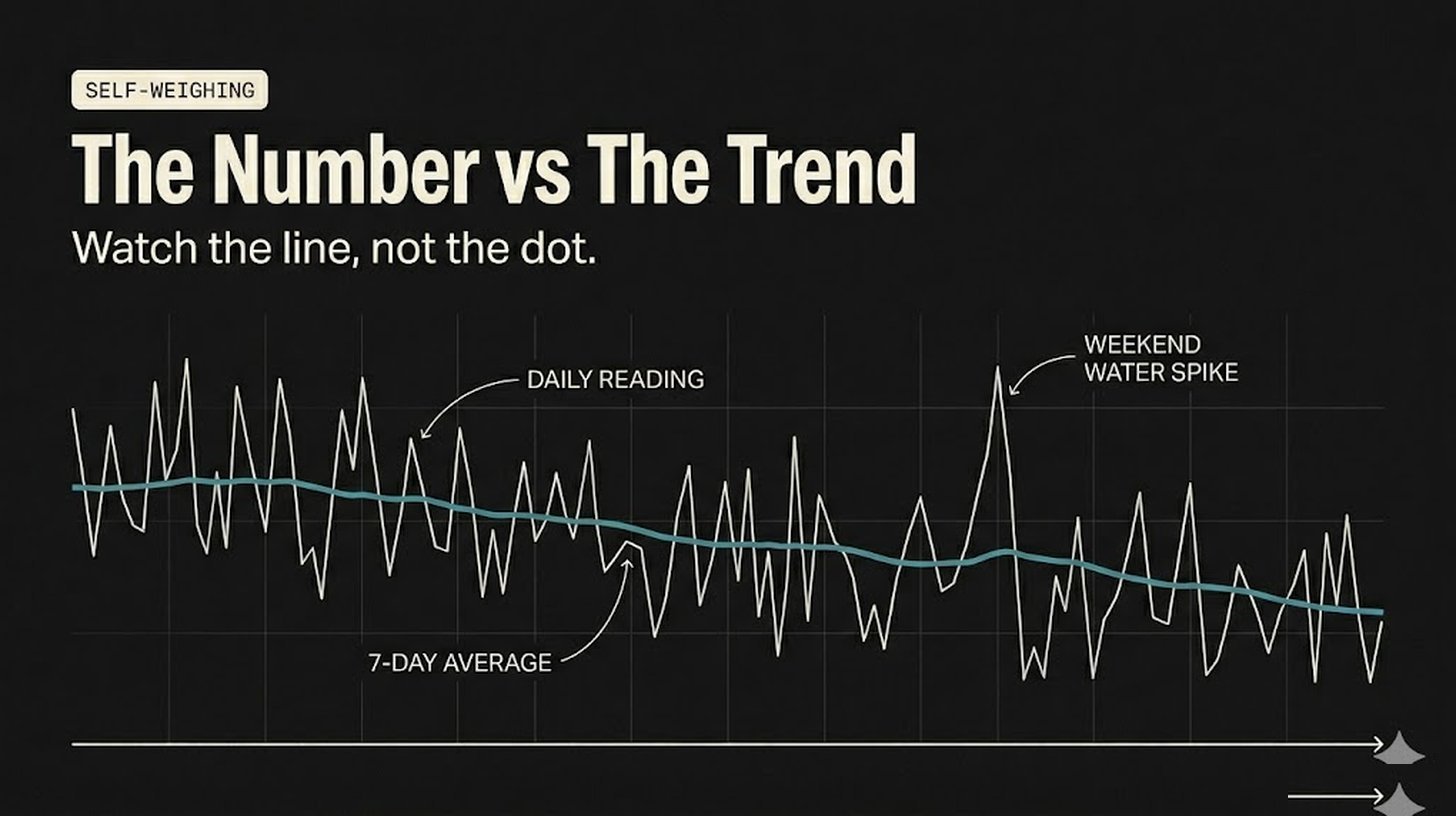
The most reliable one is the weekend spike. Your weight climbs on a Sunday or a Monday, often by a kilo or two, whether or not you actually overate. Slightly different food, more salt, eating out, a bit more carbohydrate, and your body holds more water. In pure calorie terms a two-kilo fat gain across a weekend is close to impossible, so what you’re looking at is water, and it’s usually gone again by Wednesday.
The same thing happens across a single day. The number can swing a kilo either way depending on when and how you weigh, so if you want a reading you can actually trust, keep it consistent:
- Same time every day, first thing in the morning.
- After you’ve been to the toilet, before you eat or drink anything.
- Naked, or in the same light clothing each time.
- Not straight after training, when you’re full of water and sweat.
That last one catches people out. Training tends to leave the number reading lower than your true weight and tricks you into thinking you’re doing better than you are.
Once you’ve seen those patterns enough times, a high Monday reading stops being a verdict and starts being what it is, just the weather. You note it, you know why it’s there, and you wait for the trend to tell you the real story. That’s the whole skill, and you only build it by weighing often enough to see the noise for what it is. Weighing once a week gives you the opposite, a single high-stakes number with no surrounding context, so every wobble lands like it means something.
The People Who Stop Weighing Are the Ones Regaining
The “throw your scale away” crowd never mention what happens next. When researchers tracked 10,000 smart-scale users over time, nearly three quarters of them went more than 30 days without weighing at some point. During those gaps their weight crept up, and it crept up more for the people who had more to lose.
What’s actually going on is subtler than people stopping and then regaining by chance. They stop weighing because they can sense it’s drifting the wrong way and they don’t want to see it confirmed. That blank patch in the data is the regain happening where you can’t see it. That’s the real risk of binning the scale, it doesn’t stop the weight coming back, it just hides it from you until it’s a much bigger problem to deal with.
Which means the moment you least want to step on the scale is usually the exact moment the information is most useful. Avoiding it feels like you’re protecting yourself, but it’s closer to muting the smoke alarm because you don’t like the noise.
Weighing Alone Won’t Make You Lose Weight
I need to be fully honest here though, because this next bit cuts against everything I’ve just said if I’m not careful. Weighing yourself doesn’t, on its own, make you lose weight. When researchers took a group of people and just told them to weigh daily with no other support, they lost half a kilo more than the people who didn’t weigh at all, which is statistically nothing. Daily weighing isn’t a weight-loss method, and anyone selling it as one is wrong.
What the scale gives you is information, and information only does anything if you act on it. The scale is the thermometer, the things you actually change are the medicine. A thermometer never cured anyone, but you’d be daft to treat a fever without one. The reading tells you where you are and roughly which way you’re heading, and what you do next is the part that moves the weight.
In practice that means weighing every morning under the same conditions, ignoring the daily figure, and watching the seven-day average instead. When the trend actually drifts up, past the usual weekend noise, you don’t panic, and you don’t look away from it either. You ask one question, what’s the one thing I’ll do differently today. That might be a slightly smaller dinner, a walk, or a bit more protein so you’re fuller for longer. Then you let the number go until tomorrow.
That’s all daily weighing is really for. It gives you honest information early, while the corrections you need are still small ones. It was never there to pass judgement on you. Get used to reading it like a forecast, and that high number on a Monday morning stops being able to set the tone for your whole week.
If you want a hand setting this up for yourself, building the habit and the feedback loop that uses the number instead of fearing it, message me for a free consultation.