ARTICLE: How to Stop Counting Calories (Without It All Falling Apart)
Target keyword: how to stop counting calories
Word count: ~1,470
You’re out for dinner and the menu may as well have the macros printed next to each dish, because you’re running the numbers anyway. Chicken, probably fine. That sauce, no idea, so you’re guessing high and feeling faintly guilty about it. You’ve done this for so long you don’t even notice you’re doing it, and on the rare day you don’t log anything, there’s a low-level unease, like you’ve left the house without your keys.
If that’s you, you already know how to count calories, probably have for years. What you actually want to know is how to stop counting calories without the thing you built coming apart.
Almost nobody talks about that part. There’s endless advice on how to start tracking and next to none on how to finish, as if logging your food were something you’re meant to do forever.
To be fair, tracking earned its place. For most people who count calories there was a messy "before", and learning to track is what sorted it out. It teaches you what’s actually in your food and what you’re really eating across a day, which is the single most useful nutrition skill most people ever build. So the instinct to keep doing the thing that worked is completely understandable.
The fear sitting under "how to stop counting calories" is usually specific: that the logbook is the only thing between you and chaos. And if you’ve stopped before and watched things drift, that fear feels earned.
Tracking Was Always Meant to Be Temporary
But it’s a teacher, and teachers are meant to work themselves out of a job. You log your food to learn what’s in it, and once you’ve learned that, the knowledge doesn’t evaporate when you close the app. You’ve spent years building an internal database of your own eating. Keeping the spreadsheet running on top of it mostly just adds effort for very little in return.
Clinging on isn’t the safe, steady choice it feels like, either. In one study of 382 adults, researchers compared intuitive eating against two kinds of dieting control, the rigid kind and the relaxed "flexible" kind, and looked at whose weight had stayed steady over the past year versus who’d been losing, gaining, or cycling up and down. Intuitive eating was the one tied to steady weight. Both types of control sat with the up-and-down group. It’s self-reported and it only shows an association rather than proof that tracking causes the wobble, but it does dent the idea that staying in control mode forever is the stable option. Being a relaxed, flexible tracker is still tracking, and it still sat on the unstable side.
How Do You Know You’re Ready to Stop?
The honest test is whether you’ve actually learned what tracking was teaching, and there are a few practical signs. You can look at a plate and roughly guess the portions without weighing them, you can predict what a normal day of your eating adds up to before you’ve logged a bite, and you can tell the difference between real hunger and just fancying something most of the time. If you can do those, the logbook isn’t teaching you much any more, it’s mostly just reassuring you.
If you can’t do them yet, that’s worth knowing too, and it might mean you’re earlier in the process than your years of tracking suggest. Coming off tracking assumes the learning has actually happened. It usually has, for anyone who’s tracked seriously for a long time, but it’s worth checking rather than taking on faith. The goal of all that tracking was to reach the point where you don’t need it, and most people never notice they’ve arrived.
Come Off It in Stages, Not All at Once
The mistake most people make is quitting cold. They get fed up, delete the app, and hope for the best, which pulls out the entire safety net in one go and more or less guarantees a drift. A better way is to lift it off gradually, the way you’d wean yourself off any training aid. You don’t lift in a belt and straps forever, but you don’t rip them all off mid-session either. You drop them one at a time, as your own strength proves it can take the load.
I did exactly this with my own eating. Tracking gave me years of my best results, but it eventually became exhausting and tipped into real diet fatigue. So I came off it in stages. The first thing to go was the calorie-output number off my watch, the daily "you burned this much" figure, which is the least reliable number in the whole system anyway. Then I simplified the food logging. Then, over a long stretch, I dropped it altogether. There was never a single day where I quit, it just faded out as I trusted my own read more.
A phase-out usually goes in this order:
- Drop the least reliable number first. For most people that’s the calorie-burn figure off a watch or tracker, which is little more than a guess anyway.
- Simplify the logging. Track only your main meals, or only roughly, instead of weighing everything.
- Stop logging altogether once your eating holds steady without it.
- Keep an occasional check-in. A few tracked days every so often, to catch any drift early.
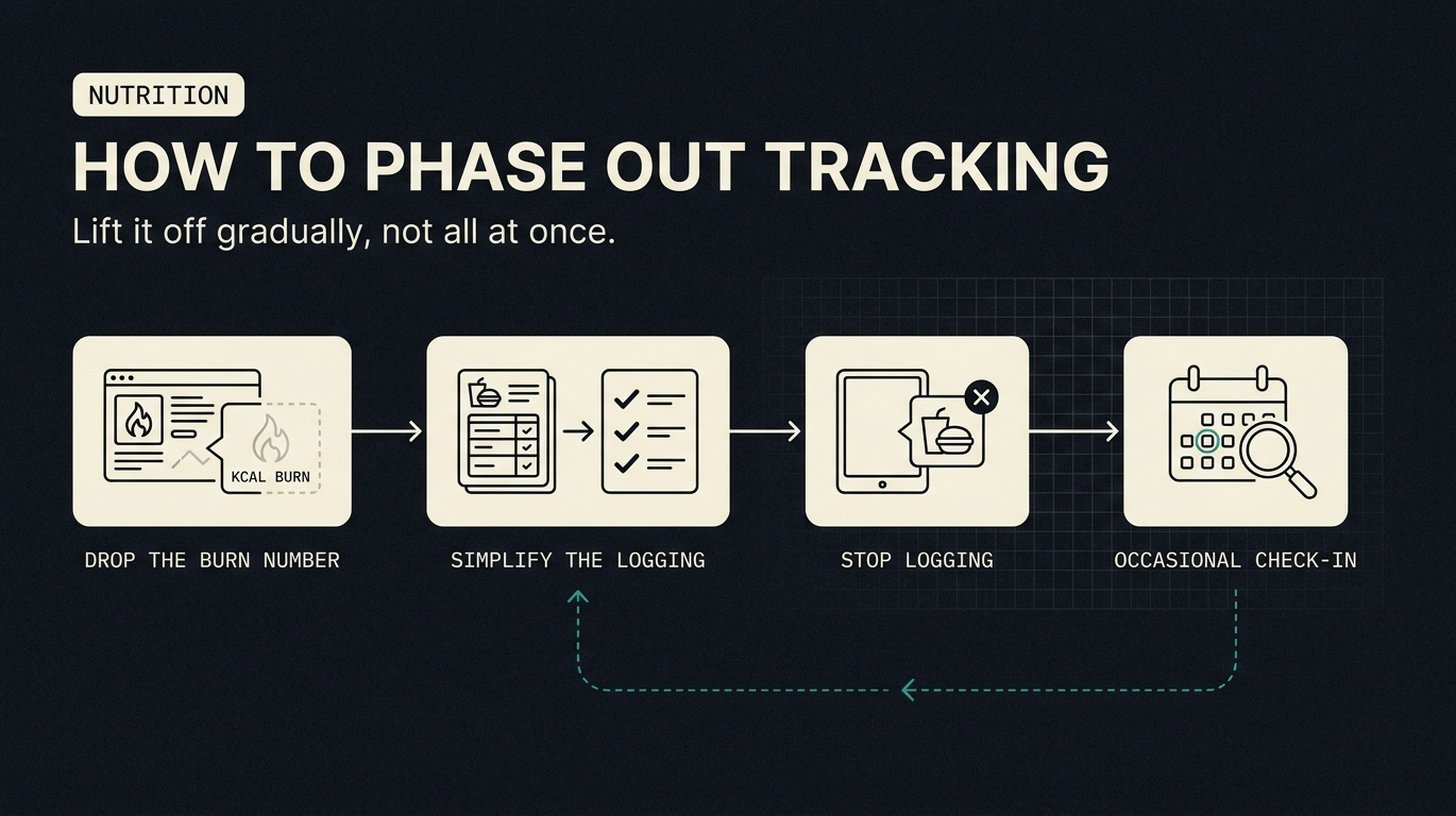
Stopping doesn’t have to be permanent to count, either. I still track a few days here and there, every so often, purely to check my baselines haven’t drifted. That’s a recalibration rather than a relapse, the same way you’d glance at a map on a route you know well if a junction felt off. Treating any tracking at all as backsliding is what keeps people stuck, either logging forever or too scared to ever check in.
Letting Go Isn’t Eating Whatever You Want
One version of stopping doesn’t work at all, and it’s the one intuitive eating often gets sold as. "Stop counting and just eat whatever your body wants" treats letting go as switching your judgement off entirely, which is just a different way to drift.
When researchers reviewed the standard questionnaire used to measure intuitive eating in 2026, the principle that held up worst was "unconditional permission to eat", the eat-anything-anytime idea. It performed so poorly that a version of the scale dropping it altogether worked better. In plain terms, even the people who study intuitive eating for a living are backing away from "eat whatever you want". Graduating doesn’t mean forgetting everything tracking taught you, it means using it without the app. The numbers move from the screen into your head, they don’t disappear.
Done that way, the payoff is real. In a study following nearly 1,500 people for eight years, those whose intuitive-eating scores rose over time had far lower odds of binge eating, around 70% lower for a meaningful improvement. That restrict-then-blowout swing is the thing tracking forever rarely fixes and often feeds. Learning to eat without the scorecard is what settles it.
If your own experience is that every time you’ve stopped tracking you’ve slowly regained, take that seriously, but look at how you stopped. If it was cold turkey, you removed the safety net all at once instead of testing your judgement in stages, so a drift was almost inevitable. Drifting a little when you first loosen isn’t proof you can never stop, it’s information about which signals you haven’t rebuilt trust in yet. The fix is a slower handoff and the occasional check-in, so you catch drift early without living in the app.
And to be clear, none of this is about the scale. Coming off tracking done well tends to keep your weight steady rather than change it, so the win here is a calmer, less consuming relationship with food and less of the binge-restrict swing, not faster fat loss. If you like tracking and it isn’t costing you anything, there’s no prize for stopping, so carry on. This is for the people it’s costing more than it gives back.
If you’ve landed here but you’ve never actually tracked, this probably isn’t your next step, and it’s worth reading why beginners shouldn’t eat intuitively yet first, because the skill you’d be graduating from isn’t built yet. And if you want the bigger picture of where tracking and intuitive eating each fit, that’s the whole argument in does intuitive eating work.
If you’ve been tracking for years and you’re not sure whether you’re ready to loosen off or how to do it without it unravelling, message me below and I’ll help you map out a phase-out that fits you.