ARTICLE: Does Intuitive Eating Work? Only Sometimes, and Rarely for Beginners
Target keyword: does intuitive eating work
Word count: ~1,450
You might have seen a lot of people online talking about intuitive eating. The idea is that instead of counting calories or weighing your food, you eat based on your body’s own signals, your hunger, your fullness, and how different foods actually make you feel. No tracking and no rules, just paying attention and trusting yourself to eat the right amount.
It’s a real thing, and a perfectly valid way to eat. But does intuitive eating work for everyone, at any point? It doesn’t, no more than any single approach in nutrition does. Like most things, it has its actual applications, the situations where it’s genuinely useful and the ones where it’s less so.
That’s the part that usually gets left out. The same basic advice, eat intuitively and drop the tracking, can work brilliantly for one person and come apart completely for another. Which one you turn out to be comes down to where you’re starting from.
Yes, It Works, for the Right Person
For some people, eating intuitively genuinely is the better way to do it. If you’ve already got a decent sense of what’s in your food, and your hunger and fullness signals roughly work, eating by feel beats logging every gram. The research on what it actually changes is solid too. People who score higher on intuitive eating tend to binge less and have a steadier, less stressful relationship with food.
That part is real, and I’m not going to pretend otherwise. The mistake is reading "it works" and assuming it works for everyone, at any stage, starting today.
Does Intuitive Eating Work for Weight Loss?
Not really, and that’s the first thing to be honest about. People reach for intuitive eating hoping it’ll help them lose weight, and on that measure it doesn’t beat dieting at all. A meta-analysis of ten randomised trials comparing no-diet and mindful-eating approaches against conventional dieting found no meaningful difference in weight loss between them. The two approaches came out the same.
That isn’t a strike against intuitive eating. It just tells you what it’s actually for. What it changes is your relationship with food, not the speed you lose weight, and the people selling it as a fat-loss hack have oversold it. Judge it by the scale and you’re marking it on the wrong exam.
Intuitive Eating Is Autoregulation for Your Diet
The training world has the cleaner language for what’s going on here.
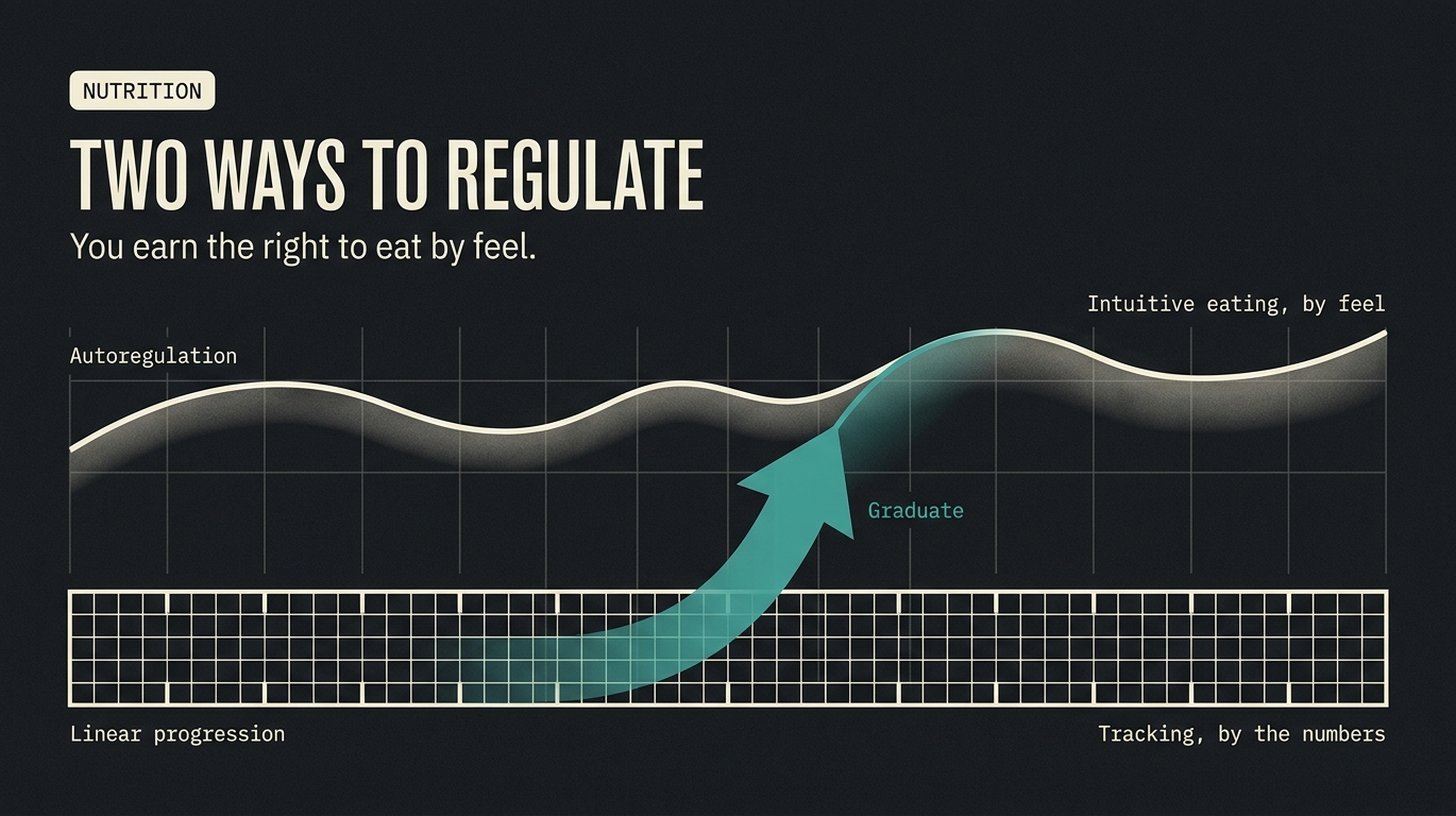
In the gym you can progress two ways. Linear progression is external and rigid: the programme says add 2.5kg this week, so you add 2.5kg, whether or not it feels right that day. Autoregulation is internal: you push a hard set to something like an RPE 8 and let how you feel on the day set the load. Autoregulation is the better method, but only once you’re experienced enough to read the signal. Tell a complete beginner to train by RPE and they’re just guessing, because they’ve got no real idea yet what a genuine 8-out-of-10 effort feels like.
Eating works the same way. Tracking calories and macros is your linear progression. It’s external, a bit blunt, and it doesn’t care how you feel, but it’s objective and it teaches you the one thing nothing else does, which is what’s actually in your food. Intuitive eating is the autoregulation. It’s the better long-term method, but only once you’ve built enough food literacy to read your own signals. Eat by feel before that and you’re regulating off cues you can’t yet trust.
Intuitive eating doesn’t fail because it’s wrong, it fails because people try it before they’ve earned it.
I Earned My Way Off Tracking
I didn’t start anywhere near here. For years my eating was all arbitrary rules, and my results were about as poor as those rules were strict. The biggest jump I ever made came from dropping the rules, learning calories and macros, and switching to a flexible way of eating. That bought me several years of my best results, including some of the leanest I’ve ever been.
But tracking everything gets exhausting, and eventually it tipped over into real diet fatigue. So I started phasing it out, the calorie-output number off my watch first, then the food logging, slowly, until it was gone altogether. For a long while I’d still track for a few days now and then just to check my baselines hadn’t drifted, and honestly I still do that occasionally now.
The real test came three months ago, when I became a dad. My eating has to be fast and simple now, a lot of packaged protein snacks and Tesco meal deals squeezed in around everything else. I’ve still managed to run a proper diet phase and get pretty lean through it, not because I’m unusually disciplined, but because nearly a decade of tracking first means I can read the boundaries by feel. A beginner dropped into the same food chaos with none of that literacy would just drift.
The Two Ways It Goes Wrong
If intuitive eating is a stage you graduate into, there are two ways to get the timing wrong, and they’re the two I see most often.
The first, and the most common, is trying to eat intuitively too early, before you’ve built any real sense of what you’re actually eating. If you’ve never tracked, your feel for portions and hunger hasn’t been calibrated yet, and it’s often thrown off further by ultra-processed food that’s designed to override your fullness signals. Eating purely on instinct at that point means guessing, and it usually drifts. That’s the whole subject of the first deep-dive in this series, why beginners shouldn’t eat intuitively yet.
The second is the opposite problem, and it tends to come later: sticking with tracking long after it’s done its job. Logging food is a great way to learn, but it’s meant to be temporary, and for some people it slowly turns rigid, then a bit obsessive, until they can’t eat a meal without quantifying it first. Knowing when you’ve learned enough to ease off, and how to actually do it, is the second deep-dive, how to graduate to intuitive eating and when to let go.
So the honest answer to whether intuitive eating works is that it depends almost entirely on where you are. If you’ve never built any food literacy, intuitive eating isn’t the shortcut past the boring part, it’s the destination, and tracking is how you get there. If you’ve been logging for years and it’s gone rigid, the skill to learn next is letting go. Work out which of those is you before you change anything, because the same move helps one person and sinks the other.
If you want a hand working out whether you’re ready to eat more intuitively, or whether you’d be better building the basics first, message me below.