ARTICLE: Is Intuitive Eating Good for Beginners? Not Until You Can Read the Signal
Target keyword: is intuitive eating good for beginners
Word count: ~1,430
Say you’ve decided you’re done with dieting. You’re sick of weighing food and logging every meal, or maybe you never started in the first place, and someone whose posts you trust has told you the answer is to eat intuitively. Stop counting, listen to your body, trust that it knows what it needs. After years of on-and-off dieting, that sounds less like a diet and more like a relief. But is intuitive eating good for beginners, or is that exactly the wrong time to try it?
So you give it a go. For a week or two it feels great. Then things slowly drift. You’re not sure whether you’re actually hungry or just a bit bored, portions start to creep up, and the scale moves in a direction you didn’t want. The conclusion you land on is that intuitive eating doesn’t work, or that you’ve got no willpower.
Neither of those is true. The advice itself wasn’t wrong, it was just handed to you at the wrong time.
Intuitive eating means eating based on your body’s own signals, your hunger, your fullness, and how food actually makes you feel, rather than counting calories or weighing portions. No tracking and no rules, just paying attention and trusting yourself to get it about right. It’s a real and valid way to eat, and people who eat this way tend to have a calmer, less stressful relationship with food. I’m not going to pretend otherwise.
It’s a different question from whether intuitive eating works in general, and the honest answer for a beginner is no, not yet. It’s one of the best ways to eat once you’ve earned it, which is exactly why it’s usually the wrong first move for someone just starting out.
Your Hunger Signals Aren’t Calibrated Yet
The whole approach rests on one assumption: that your internal signals are accurate. That when your body says it’s hungry you genuinely need food, and when it says it’s full you’ve had enough. For a lot of beginners that assumption doesn’t hold, for three reasons.
The first is simple. If you’ve never tracked, you’ve got no real reference for what a normal amount of food looks like. You don’t know what 200g of chicken is by eye, or how much rice is a sensible portion, or what a "handful" of nuts actually weighs. Eating by feel assumes you can judge these things roughly. Most beginners can’t yet, because nobody has ever shown them.
The second is that dieting itself dulls the signals. Years of restricting, skipping meals and overriding hunger teaches your body to stop sending clear messages. Someone who’s dieted on and off for a decade, which is exactly the person most likely to be tempted by intuitive eating, often has the least reliable hunger and fullness cues of anyone. It can take a lot of practice and a lot of meals before those signals come back clearly enough to trust. It’s why people with a history of dieting tend to score lower on intuitive eating than people who’ve never dieted, which is exactly what you’d expect if restriction slowly teaches you to stop listening.
The third is the food itself. A huge amount of what’s on the shelves is engineered specifically to get past your fullness. Food companies spend a fortune designing products to hit what they call a bliss point, the exact mix of taste and texture that keeps you eating past the point where you’d naturally stop. Whole foods trigger the signals that tell your brain you’ve had enough, whereas a lot of processed food is built to bypass those signals so you keep going. That isn’t a fringe claim: reviews of ultra-processed food and appetite describe how their texture, energy density and nutrient mix blunt normal fullness signalling and nudge your intake up. If most of your diet is that kind of food, "listen to your body" is advice given to a body that’s being lied to.
Tracking Is the Training Wheels
If you lift, there’s a version of this you already know. Ask an experienced lifter how heavy to go and a fair answer is to train by feel, taking a hard set to an RPE of 8 or so, a couple of reps shy of failure, and letting the day decide the weight. Ask a beginner to do the same and it falls apart, because they’ve never trained close to failure and have no reference for what two reps in reserve feels like. They’ll either sandbag it or grind themselves into the floor. So we give beginners numbers instead: this weight, this many reps, add a little each week. We use the numbers because they’re readable, even though feel is the better tool once it’s trained.
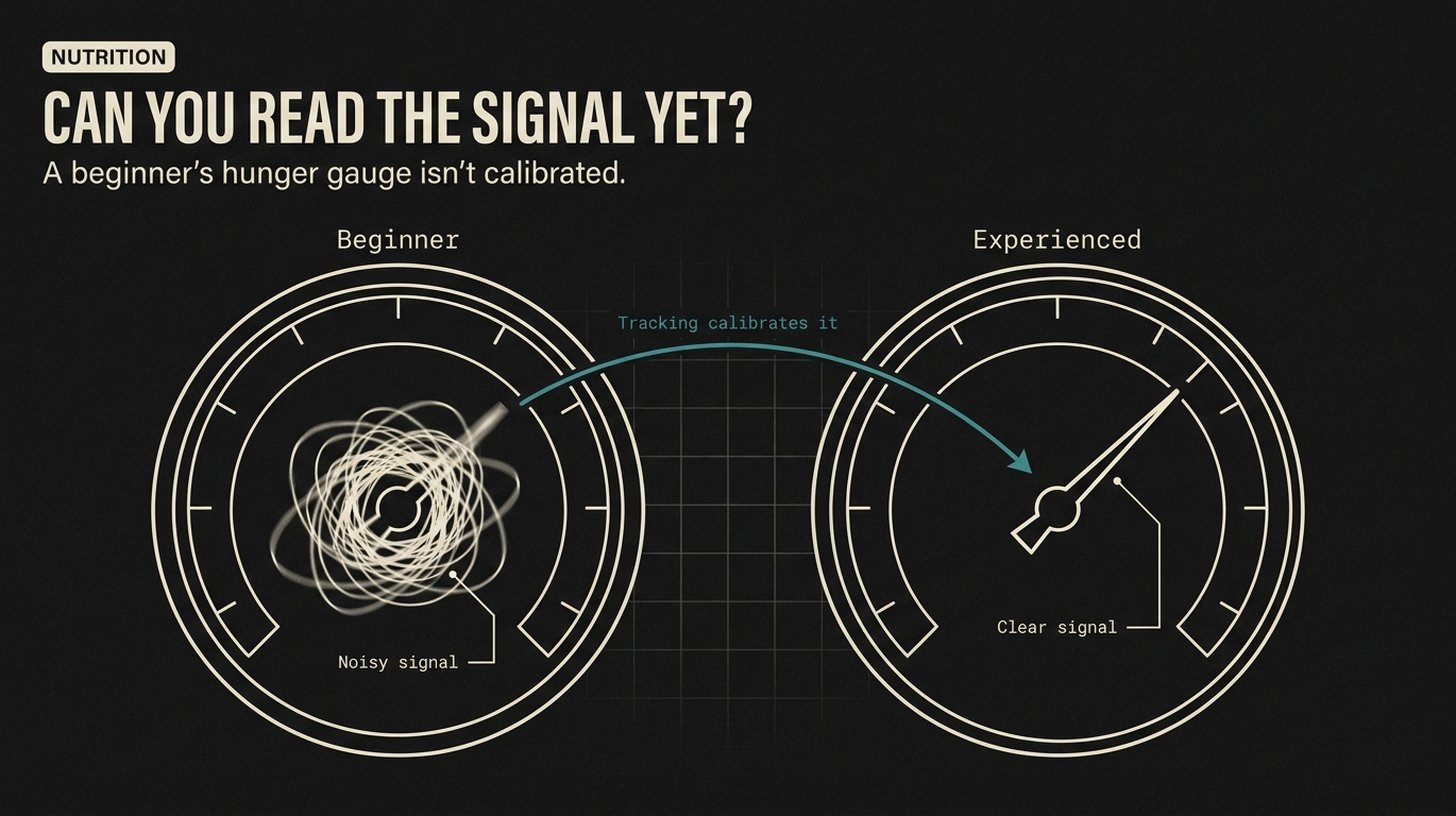
Food is the same. Tracking is the beginner’s version: a bit blunt and it doesn’t care how you feel, but it’s honest, and it teaches you the thing you can’t get any other way, which is what’s actually in front of you. Eating by feel is the advanced version, and it only works once that feel has something real behind it. Put a beginner on it too soon and there’s no signal to read, so they end up inventing one. Their "I think that’s about right" is really just a shrug, and over a week of shrugs the maths drifts without them ever noticing. A beginner eating by feel isn’t really eating intuitively, they’re guessing and calling the guess intuition.
This is why tracking matters for a beginner, and it’s got nothing to do with restriction. The point of tracking isn’t to eat less forever, it’s to learn. You weigh and log for a while so that you find out what a portion of chicken looks like, what a normal day of food adds up to, and how different meals leave you feeling. Do it for long enough and you stop needing the numbers, because you can see it without them. That’s the food literacy intuitive eating runs on, and tracking is the most reliable way most people build it.
The food environment sets one more trap for beginners specifically. If your diet has been built on processed, hyper-palatable food, your cravings have been trained to want more of exactly that. So when a beginner in that position is told to eat whatever they fancy, their instinct reliably points them straight back at the food that muted their signals in the first place. That instinct has been conditioned by the food itself, so following it just deepens the problem. You have to retrain it before it’s worth following, and you can’t retrain it by following it.
I know all this because it’s how my own eating went, just in the reverse order to what people expect. For years I ate by a set of arbitrary rules, and my results were about as good as those rules were sensible, which is to say not very. The biggest jump I ever made came when I dropped the rules and actually learned calories and macros. Tracking taught me what was really in my food, and that knowledge is the entire reason I can eat intuitively now without it all falling apart. I didn’t start out intuitive, I tracked my way to being able to eat that way.
So What Should Beginners Do Instead?
So if you’re new to this, the move isn’t to swear off tracking as some disordered thing you’re above. Treat it as a temporary teacher instead. Track for a defined stretch, long enough to genuinely learn what your food is and what a day that suits you feels like, and then start letting go.
The obvious objection is that plenty of people have never tracked a thing and eat perfectly well, so surely telling beginners to track first is just gatekeeping. That’s fair, up to a point. Some people arrive with the literacy already, from how they grew up, from a sport, from a parent who cooked everything from scratch. They did the learning without a logbook, and if their intuitive eating genuinely works there’s no reason on earth to start tracking now. The argument isn’t that everyone has to track. It’s that the knowledge has to come from somewhere, and if you don’t already have it, tracking is the most reliable way to get it. "I already eat fine" just means you’re not the beginner this is about.
One thing to hold onto here: none of this is about the scale. Intuitive eating done well tends to keep your weight steady rather than drive it down, so what we’re really talking about is accuracy and a calmer relationship with food, not a faster way to lose fat.
If you want the full picture of why the whole debate over whether intuitive eating "works" depends entirely on who’s asking, have a read of does intuitive eating work. And once you’ve built that literacy and you’re wondering when and how to actually put the tracking down, that’s the subject of how to graduate to intuitive eating and when to let go.
If you’re not sure whether you’re ready to eat more intuitively or you’d be better off learning the basics first, message me below and I’ll help you work out where you actually are.