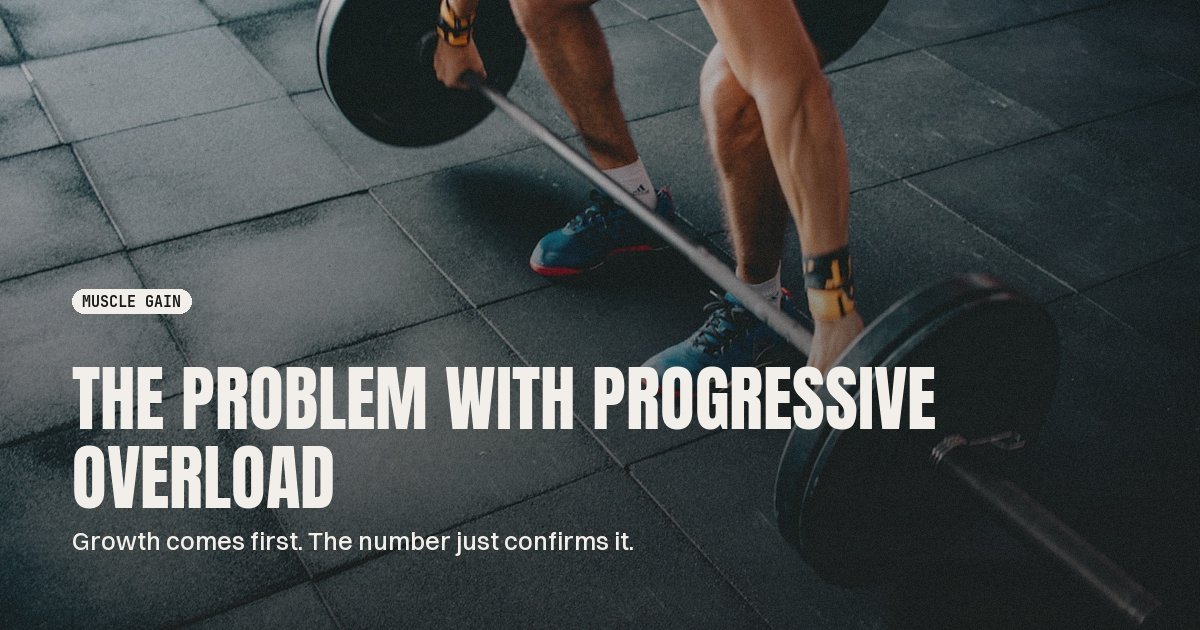
I coach at The Commando Temple, a strongman gym in London. A good chunk of the members and coaches there weigh between ninety and a hundred kilos and compete in powerlifting or strongman. I weigh sixty-five, I came up through MMA, and I’ve no business trying to move the most weight in the room. I’m the muscle gain and fat loss coach there, not the strength coach.
Watch me train and you’ll see slow reps, long ranges of motion, and high reps. The weights have gone up over the years, but only as a byproduct of training that way, never as the point. Nobody there expects me to lift the heaviest, so I’ve never had to sacrifice technique to chase a number. That freedom taught me something most lifters spend years getting wrong about progressive overload and muscle growth: the number on the bar is the receipt for muscle you’ve already built, not the thing that builds it.
Progressive Overload Turns Into a Trap
Progressive overload is real, and over the long run your muscles do need more challenge to keep growing. If you never ask more of them, they’ve no reason to change.
If you’re in your first couple of years of training, adding weight to the bar is a decent proxy for progress. Strength and size move together early on, because you’re getting better at the movement and building tissue at the same time. So when an experienced lifter tells me their best muscle growth came from chasing bigger lifts, I believe them. For most of their training life, the two were the same thing. weight training for muscle gain vs fat loss
The trouble starts later. In an intermediate or advanced lifter who’s deep into a muscle-building phase, strength and size stop moving together. Your nervous system can keep finding ways to grind out a heavier rep long after the muscle itself has stopped getting the message.
When the weight stalls, you panic. The app flags that you haven’t added load in three weeks, gym culture says heavier is always better, and your ego doesn’t fancy dropping the dumbbells in front of the people you train around. So you find the weight somewhere: you shorten the range of motion, let your tempo fall apart, add a bit of momentum, recruit muscles that were never meant to be in the lift. The number holds, and every one of those compensations has just shifted tension off the muscle you were trying to grow.
The Muscle Doesn’t Know What’s on the Bar
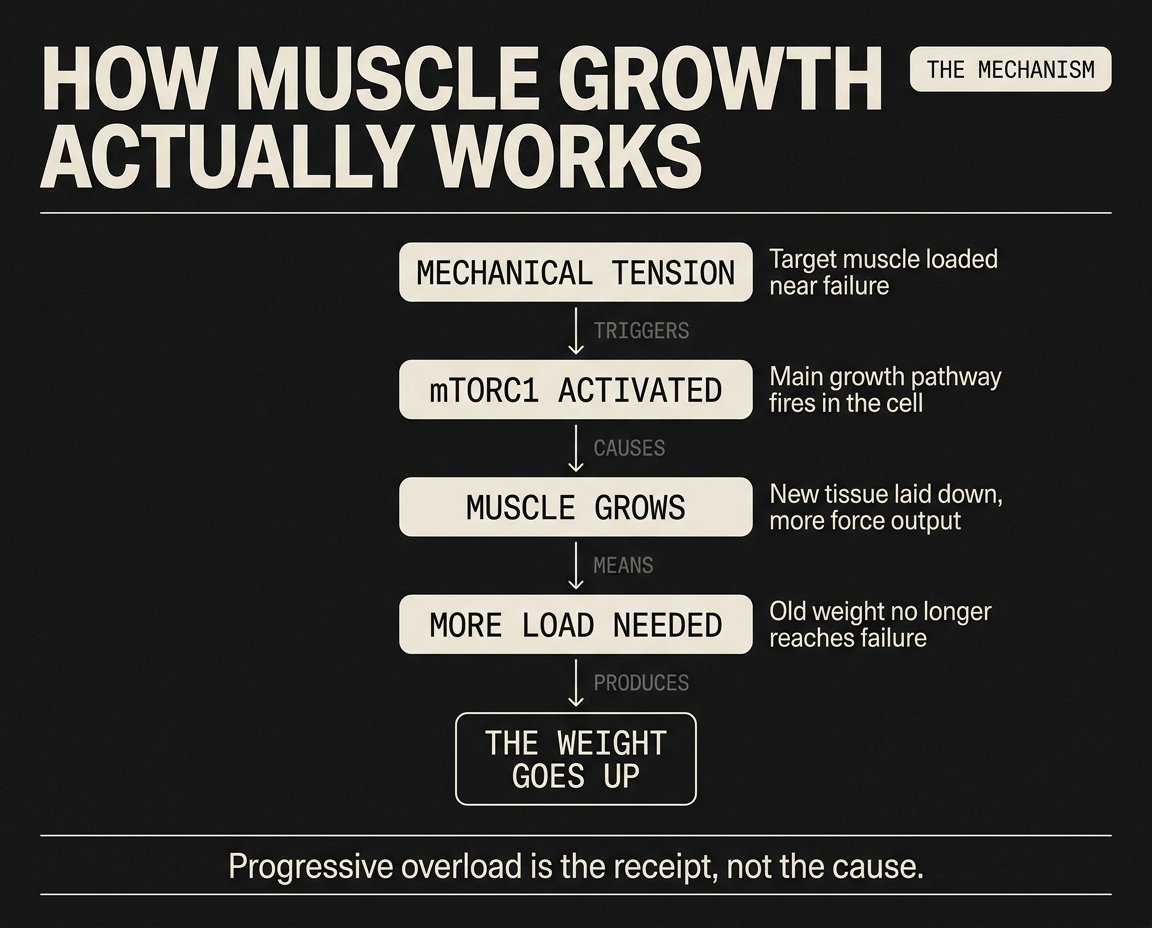
Muscle grows in response to mechanical tension on the fibres, delivered close to failure. The cell’s main growth pathway, mTORC1, responds to that tension and triggers muscle protein synthesis, the process that lays down new muscle tissue. Schoenfeld (2010), Journal of Strength and Conditioning Research It identified mechanical tension as the primary signal that activates the mTORC1 pathway, and the cell responds to load on the fibres, not load on the bar. That pathway has no idea what’s on the barbell, and it can’t read your training app. It just responds to the tension the fibres receive.
Picture a lifter moving from 22kg to 25kg on a dumbbell press by letting their elbows flare out, arching off the bench, and using body English to get the weight up. The app logs it as a new PR. Watch the actual set though: the chest barely changes shape through the rep, and the load has shifted onto the front delts and lats. The pec got cheated, whatever the app says.
Flip it the other way. Take a client who squats 140 kilos for ten reps fresh. Run them through leg extensions first and they might manage 100 kilos for eight. The number on the bar has dropped, but the growth signal to the quad fibres is the same, because the easier-to-recruit fibres are already fatigued and the body has to call on the big growth-prone ones from rep one. proximity to failure and effective reps
The muscle grows because it experienced sufficient tension, close to failure, in the right place. As it grows, it can produce more force, and eventually the old weight stops getting it anywhere near failure. More load is how you get back to that edge.
The weight going up is the receipt, not the purchase.
That heavier number confirms the last block of training worked. When coaches treat it as the cause rather than the confirmation, that’s where most muscle-building programmes go wrong.
Telling Clients No
The best example I have of this is a client who came to me after a string of serious shoulder injuries, all of them from pressing too much weight too soon, before he had the stabiliser strength or the coordination to support it. After surgery, his doctors told him to stop lifting altogether. I have Poland Syndrome and a long history of working around my own shoulder problems, so I went along to the clinic with him and agreed to take him on.
He presses more now than he ever thought he’d manage after surgery. Honestly, most of my job with him has been telling him no: no to adding weight before the movement is ready, no to shortening the range of motion to protect the number on the bar. We slowed the tempo down, drilled the technique, and built the stabiliser coordination underneath the lift first. The weight came back on its own schedule, not the one his ego wanted.
So I stopped scheduling weight increases, for him and for most of my hypertrophy clients. I judge every set on three things: is it close enough to failure, is the tension landing in the right muscle, and is the form clean enough to keep the stimulus honest. using RIR to gauge proximity to failure When those three are consistently right across a few sessions, the weight climbs on its own. When they’re not, dropping the load to restore those things isn’t going backwards, it’s often the best hypertrophy stimulus they’ve had in months.
A Stalling Number Doesn’t Mean a Stalling Muscle
Every coach already says “technique matters.” The shift here is in which direction cause and effect run. Once you understand that growth creates the capacity to lift heavier, and not the reverse, you stop panicking when a client’s weight stalls mid-cycle. You stop asking “did the weight go up?” and start asking “did the target muscle get close to failure, with real tension and clean technique?” Change that one question and the whole way you coach changes with it.
To be fair, none of this means progressive overload is a myth or that you should stop tracking your lifts. The load still matters. Over months and years, it should keep climbing. But in a muscle-building phase, the number on the bar is a result you read, not a target you set. Get the tension right and keep it honest, and over time the weight takes care of itself.
If you want a training phase built around putting tension where it counts instead of chasing the number on the bar, that’s what my coaching is for.