How much protein on Mounjaro should you eat? The usual advice multiplies your current bodyweight, which overshoots when a lot of that weight is fat. Work it from lean mass instead, treat the answer as a floor, and know that nobody has settled the exact number for people on these drugs.
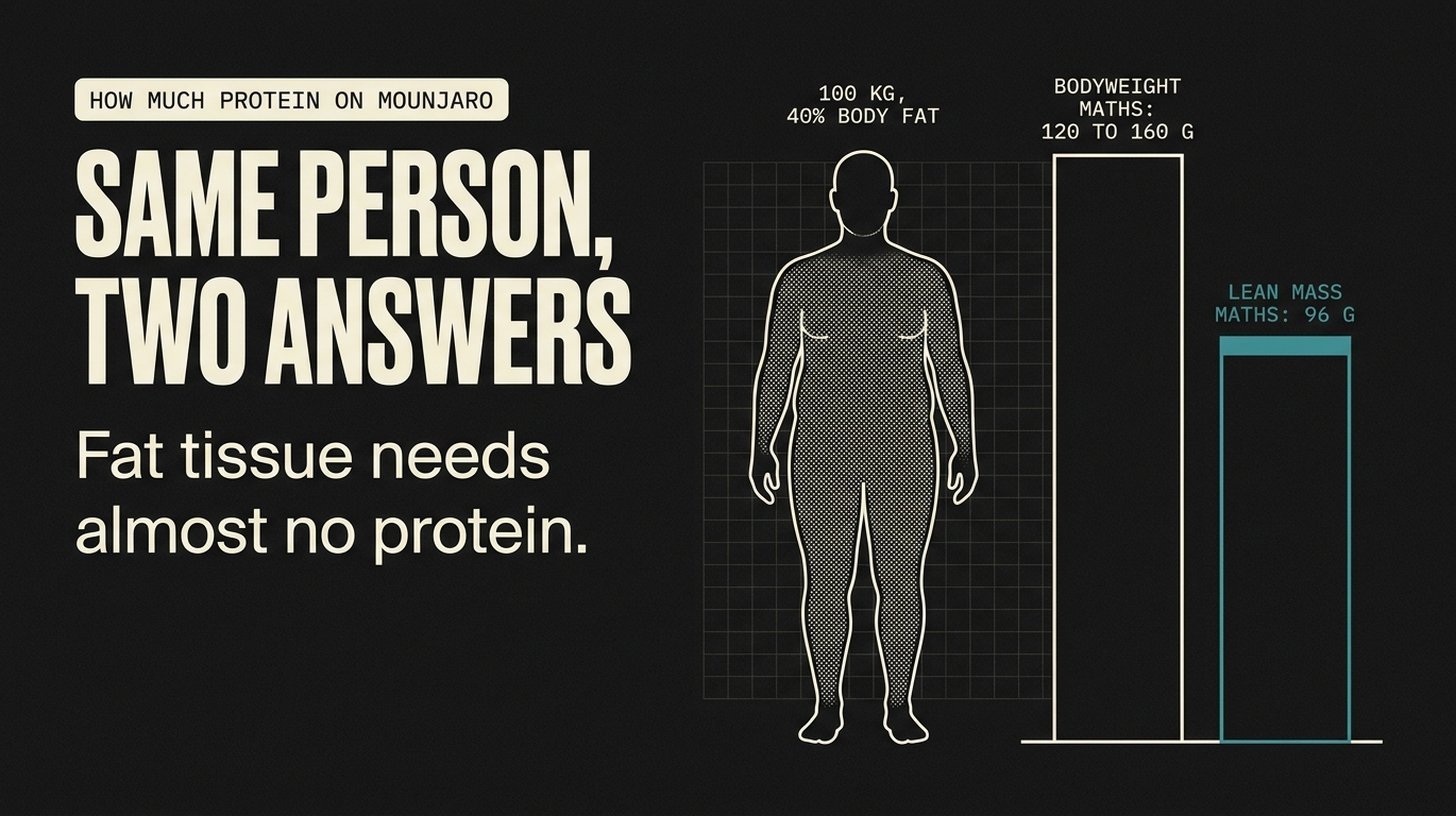
You’ve been told protein matters on Mounjaro, so you look up how much to eat, and before you’ve got an answer you’re doing maths. Multiply your bodyweight by somewhere between 1.2 and 1.6, the advice says, which at 100 kg comes out at 120 to 160 grams a day.
That’s three or four chicken breasts’ worth of protein every day. Even on a normal appetite most people find that tough going, and when something is deliberately blunting your hunger it starts to feel impossible. You miss it most days, and on top of that you’re told that missing it is a red flag, that it means you’re going to lose muscle.
I coach people on these drugs from my gym in South East London, and my guide to training and eating on Mounjaro covers the whole picture, so this piece looks at just one number inside it. Whether you take a drug, which dose, and when you inject are decisions for you and your prescriber, and I stay out of them, but I’m happy to help with the training and diet side.
The standard number is probably too much
1.6 grams of protein per kilo of bodyweight is a credible number. A big analysis of 49 studies and 1,863 people lifting weights found that eating more protein stopped adding lean mass (everything in you that isn’t fat) once people got past about 1.6 grams per kilo a day. If you’re already lean that’s a fair number, because your bodyweight and lean mass aren’t that far apart. It was worked out on total bodyweight in people lifting weights, though, with no weight-loss drug involved, and it doesn’t translate if you’re carrying enough weight to be prescribed Mounjaro and can’t finish a yoghurt because your appetite’s been blunted.
Fat tissue has almost no protein requirement. At 100 kg and 40% body fat, 40 kg of you is fat, and that part of you doesn’t need any protein, so a bodyweight multiple sets part of your target for tissue that won’t use it. Even a 2025 joint advisory from the American College of Lifestyle Medicine and other bodies, which quotes the 1.2 to 1.6 range, says using your full bodyweight "can significantly overestimate protein requirements" if you’re carrying a lot of fat, and that nobody has agreed yet on what to use instead. Its own suggestions are 1.5 grams per kilo of lean mass if you know your body composition, or a flat 80 to 120 grams a day, because a simple number may be easier to stick to.
How much protein on Mounjaro do you actually need?
My target is 1.6 grams per kilo of lean body mass a day. The advisory’s figure is 1.5, so mine sits a touch above it. I call it a working target because the number isn’t settled for these drugs: a review of 12 studies of semaglutide or tirzepatide with a dietary element found that energy intake fell by 24% to 39%, that checking protein intake systematically was rare, and that the evidence on the best dietary strategies is sparse. Protein targets for Mounjaro, mine included, are largely borrowed from research on dieting and lifting.
Your lean mass is your weight minus your estimated fat. Finding out your body fat percentage accurately is expensive, so an estimate is fine. Multiply your lean mass by 1.6, and if the answer comes back under 90 grams, use 90 to 100 grams anyway, which is my minimum.
Here’s a worked example, with body-fat figures picked only to show the arithmetic. Someone at 100 kg and an estimated 40% body fat has 60 kg of lean mass, and 60 times 1.6 is 96 grams a day. The bodyweight version gives 120 grams at 1.2 per kilo and 160 at 1.6, so the gap to the top figure is 64 grams, about 200 grams of cooked chicken breast on top of everything else you can’t manage. At the advisory’s 1.5 the same person lands on 90. Someone at 80 kg and an estimated 35% has 52 kg of lean mass, which gives 83 grams, under the minimum, so 90 to 100 is their number.
The number is a minimum, and going over costs little, so if you can eat more, do. It’s wiser to set a target you can actually reach, though, because you’ll end up ignoring one you can’t. A target you hit beats a bigger one you miss every day. The advisory also says to avoid staying at or above 2 grams per kilo a day for long periods, and if you have kidney disease, your number is a conversation with your doctor.

Spend the appetite you have on protein first
I prioritise protein first at every meal, then vegetables, then carbs, and I aim to get about 40 grams of protein in at the first meal of the day. The advisory also puts protein-rich foods first in a meal. You may have heard that your body can only use 30 grams at a time, which is a misread of research on how much protein one meal can use. You absorb all of it, and the daily total matters far more than the spread. Spreading protein across meals is fine, but on a small appetite a day built around a per-meal limit is one you won’t finish.
The common protein foods carry roughly this much:
| Food | Protein, roughly |
|---|---|
| Chicken or turkey breast | 31 g per 100 g cooked |
| Lean beef | 26 g per 100 g cooked |
| Tinned tuna | 25 g per small tin |
| Eggs | 6 g each |
| 0% Greek yoghurt | 10 g per 100 g |
| Cottage cheese | 11 g per 100 g |
| Whey protein | 25 g per scoop |
A realistic day looks like Greek yoghurt with a scoop of protein powder at breakfast (about 35 grams), chicken breast at lunch (about 31), fish or lean meat at dinner (25 to 30), and a glass of milk and one protein snack (15 to 20), which comes to roughly 105 to 115 grams. Yoghurt, cottage cheese and a shake do the job on days when a plate won’t go down. If your workouts feel flat on the days the food doesn’t go in, why sessions feel harder on Mounjaro covers that, and keeping muscle on Ozempic and Mounjaro covers what the protein is for.
If you’d like help with how much protein on Mounjaro works for you, and with getting it eaten on the days you can’t face food, my GLP-1 coaching is set up for that, and you’re welcome to message me.