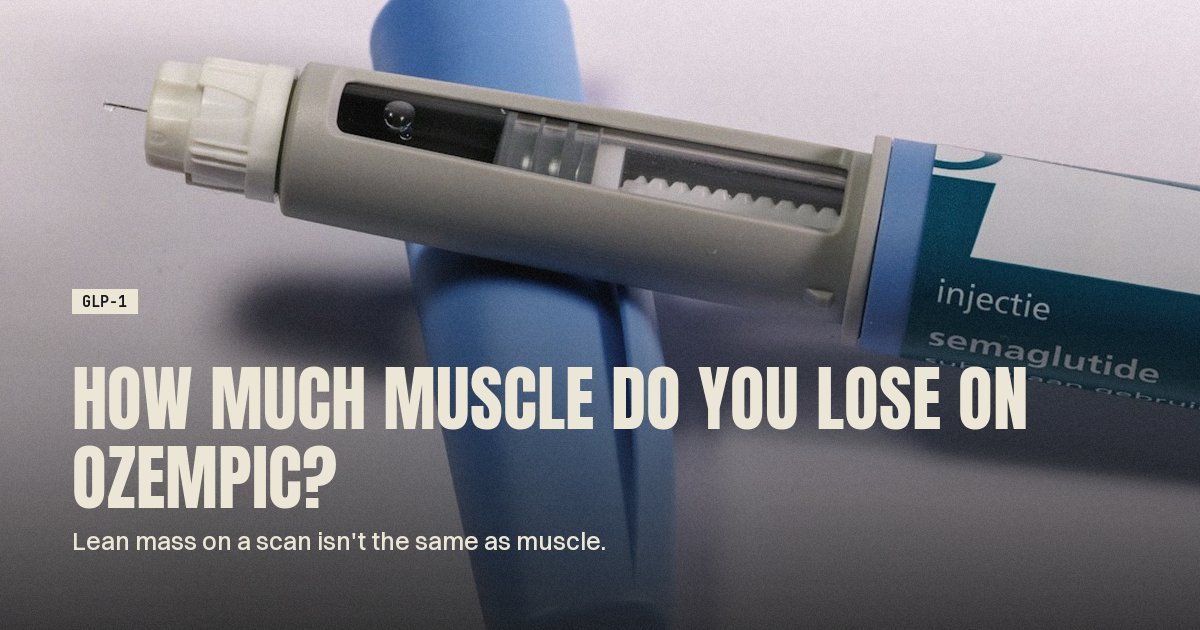
How much muscle do you lose on Ozempic? Some scary numbers are thrown out there, like that a quarter to a third of the weight you lose is lean tissue, but this misses a lot of nuance. Lifestyle programmes without the drug lose a similar share of "lean tissue". Some of that lean tissue is water and organ rather than muscle, and since nobody has yet measured muscle size or strength in a large controlled trial, the most likely scenario isn’t as scary as people make it out to be.
GLP-1 drugs are polarising. As a result you get a lot of overly positive and overly cynical takes online, and it’s hard to know who to believe. This is especially true when it comes to muscle loss. Some people will show you pictures of gaunt faces and tell you that Ozempic will eat away all your muscle mass. Others tell you it’s mostly just water and not to worry about it.
Each one feels right for a reason. The alarmist story feels true because your weight is dropping quickly, your clothes are loosening, and a lift or a flight of stairs may feel harder than it did, so it’s reasonable to wonder what else is coming off with the fat. The debunk works because it’s partly correct, and because being told to stop worrying is a relief. I coach people on Ozempic, Wegovy and Mounjaro from my gym in South East London, the muscle question comes up early, and I’ve written about the whole picture in my guide to training and eating on Mounjaro. Here I want to go through what the evidence can and can’t tell you, because both sides are making claims that are a little too extreme.
How much of the weight you lose on Ozempic is lean mass?
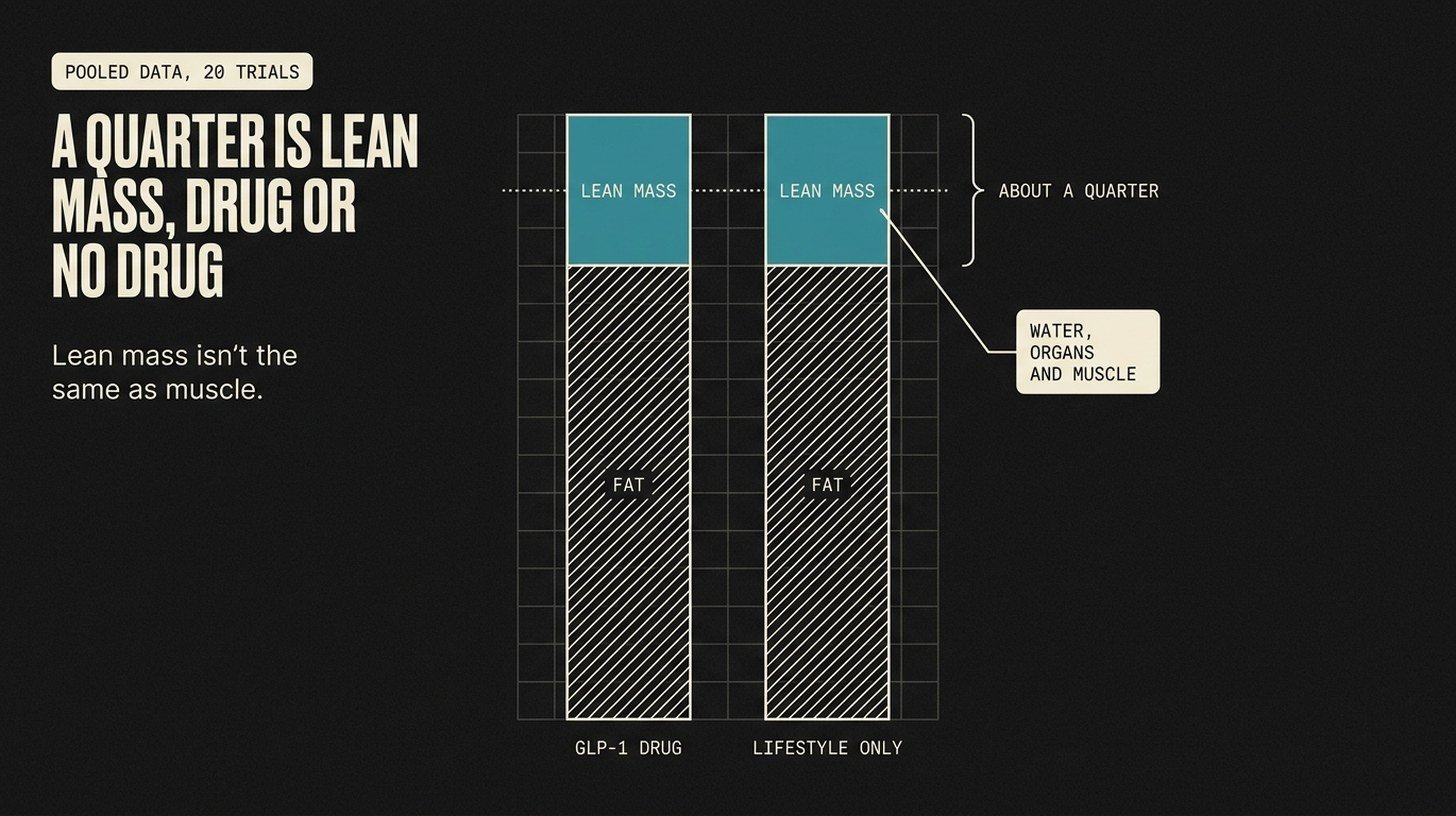
According to the best pooled data, between a quarter and a third of what you lose on Ozempic or similar is "lean mass". But it’s worth understanding what that means. Lean mass is everything a DXA scan (a body scan that uses low-dose X-rays) counts as neither fat nor bone, so it includes muscle but also water, organs and other tissue. A 2026 analysis by Eisa and Barood pooled 20 randomised trials covering 15,782 people and found lean mass made up 35.2% of the weight lost on semaglutide (the drug in Ozempic and Wegovy), 26.8% on liraglutide and 25.4% on tirzepatide (Mounjaro). In people on lifestyle programmes with no drug it was 26.2%, and the analysis found no statistical difference between that and the drugs.
To put this simply, the "quarter to a third" of the weight you lose isn’t just muscle mass, but water, organ tissue, and anything that doesn’t count as either fat or bone. When you compare it with how much of that lean mass people lose on interventions without drugs, it doesn’t seem that out of proportion.
The placebo group lost lean mass too
The clearest single trial is the SURMOUNT-1 body composition substudy, which scanned 160 people over 72 weeks, most of them on Mounjaro and a smaller group on a placebo. The Mounjaro group lost about four times as much weight as the placebo group, and in both groups roughly a quarter of what came off was lean mass and the rest was mostly fat.
In other words, losing weight costs you some lean tissue whether or not you’re on the drug, so "the drug is eating your muscle" overstates it. To be fair to the alarmists, the drug group lost a lot more weight overall, so they lost more lean tissue in kilos even though the share was the same. The scare is right that the amount is bigger, and the debunk is right that the proportion isn’t unusual.
A DXA lean mass number can’t settle the muscle question either way
So if lean mass isn’t all muscle, how much of it is? Honestly, nobody knows for sure. Neeland’s 2024 review makes the point the debunkers lean on: lean mass includes your organs, bone and fluid as well as muscle, and some of the change may just be your body adapting to carrying less weight around. Dr Jordan Feigenbaum of Barbell Medicine argues the same case and reckons only a small part of a typical lean mass loss is actual muscle. I agree with the general point, but his figure is his own estimate rather than something anyone has measured, so I’d treat it as one doctor’s best guess.
There’s another reason not to take a single scan too seriously. When you’re losing weight fast you’re eating less carbohydrate, and your body stores carbohydrate with water attached. Lose the carbohydrate and the water goes with it, and your hydration bounces around from week to week anyway. All of that shows up as "lean mass" on the printout, so two scans taken in different conditions can disagree for reasons that have nothing to do with your muscles.
What this means is that the 40% posts are treating the whole lean mass figure as muscle, and that’s wrong. The "it’s all water" posts are treating the scan’s flaws as proof that nothing real is lost, and that’s wrong too. The truth sits somewhere between them, and a scan can’t tell you where.
Nobody has measured muscle size or strength in a big controlled trial
Nearly all the trials above measured lean mass with a DXA scan. No big controlled trial has directly measured how much muscle size or strength changes on these drugs. So "you lose a lot of muscle" is unproven, and "you don’t lose any real muscle" is unproven by exactly the same standard.
That’s why I don’t use a scan to judge whether a client is losing muscle. I watch what their main lifts are doing. If your squat, press and row are holding steady or going up while your bodyweight drops, you’re keeping your muscle, and that tells you far more than a line on a printout. If you do have scans, only compare ones taken in the same conditions (same time of day, similarly fed and hydrated) and look at the trend across several rather than reacting to one. If you’re older or frail the question matters more, and it’s worth raising with your prescriber.
The group that lifted weights lost the smallest share
Back in the 2026 analysis, people on lifestyle programmes that included lifting weights lost the smallest share of their weight as lean mass of any group: roughly a sixth, against a quarter for lifestyle programmes without it. The catch is that none of those people were on a GLP-1 drug. I looked for a completed trial that tests lifting during GLP-1 treatment and there isn’t one yet. Several are running, including LEAN-PREP, due to finish in 2029.
So it’s a strong hint rather than proof. I still coach as if lifting will protect your muscle on the drug, because the cost of being wrong is a few hours a week in the gym, and the cost of being wrong the other way is muscle that’s slow to get back. Lifting is the only group in that review with a clearly lower share of lean mass lost, and the sensible move is to behave as if it works until someone proves otherwise.
So, how much muscle do you lose on Ozempic? Nobody can currently give you a number, but the evidence we do have points to less than the scare posts claim, and to something you can do about it. In practice I go with three full-body workouts a week built around the big lifts, enough protein, and watching those lifts rather than the scan. The how-to is in my post on keeping muscle on Ozempic, Wegovy and Mounjaro, and if your strength has dipped, feeling weak on Mounjaro covers why that happens and what to do about it. Anything about your dose or side effects belongs with your prescriber, not me.
If you’re on one of these drugs and want training and food built around it, I do GLP-1 coaching, and you’re welcome to get in touch.