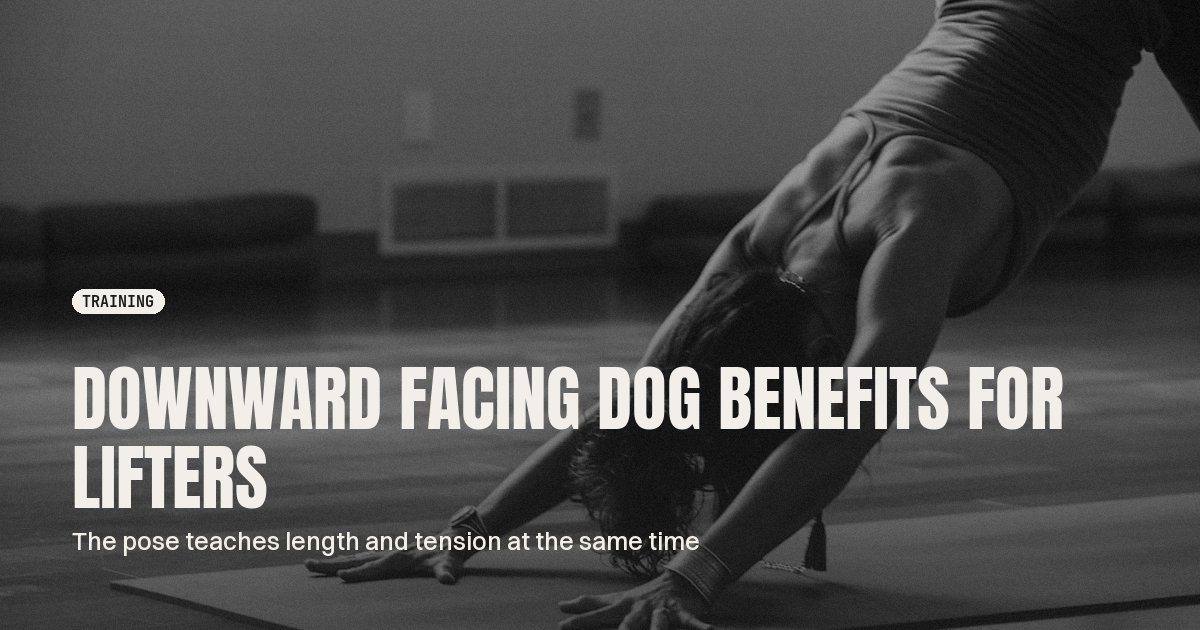
There’s a lot of overlap between yoga and strength training that doesn’t get talked about much. Often yoga people and strength people are saying the same thing in different vocabulary, and the biomechanics are essentially the same. The downward facing dog benefits I’ll cover here are the clearest case of that overlap. It’s the pose I keep coming back to as a clinic on what good movement actually looks like.
It looks unimpressive on the surface, an inverted V with hands and feet on the floor and hips in the air. Anyone who’s done a single yoga class can do it, and that’s part of why the pose tends to be underrated. There’s a lot more going on at the joints than the visual suggests, and most of it covers things lifters are notoriously short on.
Loaded shoulder flexion with thoracic extension
When you’re set up properly, the arms are in overhead flexion, somewhere around 170 to 180 degrees. That alone is useful, because most people can’t get there cleanly when standing. They compensate by flaring the ribs forward, arching the lower back, or shrugging the shoulders up around the ears. In downward facing dog, gravity does most of the work for you. The chest is dropping toward the thighs, so your upper back has to extend, and you can’t fake it.
Years of bench pressing, deadlifting and squatting build up a body that’s strong but stiff in exactly this direction, and most of my clients have some version of it. Pressing overhead without your ribs popping forward is a mobility problem that doesn’t respond to passive stretching, because the real issue is organising the rib cage and shoulder blades together under load. Down dog teaches that pattern. You’re loading the shoulder at end range while having to keep the ribs down and the spine long, and there aren’t many drills that do all of that at once.
The posterior chain on length
Hamstrings and both parts of the calf stretched simultaneously under bodyweight. The calf is two muscles stacked on top of each other: the gastrocnemius, the visible one that works hardest when the knee is straight, and the soleus, deeper and underneath, which takes over when the knee bends. If you pedal the heels in down dog, alternating one heel pressing down then the other, you’re getting a brief loaded calf stretch with the knee straight and then bent, which hits both muscles on different reps.
For lifters this matters more than it sounds. Limited ankle mobility is one of the most common reasons squats look ugly, knees cave inwards, and people shift weight to one side. You can fix it with isolated mobility drills, but most of them feel like a chore and don’t get done. Down dog gets you the same thing inside a position you’d be doing anyway as part of a warm-up flow. The hamstring length is a bonus, and unlike a static toe touch, your spine isn’t loaded in flexion while you’re getting it.
Lats in their fully lengthened position
The lats are huge muscles that attach from the upper arm down to the lower back and pelvis. Almost every gym exercise loads them in their shortened or mid-range position: pulldowns, rows, deadlifts, even hanging. The one position lifters almost never load the lat in is its fully lengthened state, with the arm overhead and the spine long.
Downward facing dog puts the lat exactly there, under tension. I had a client a while back, strong overhead presser, decent mobility, whose lockout always felt like it was working harder than it should. Two weeks of properly held down dogs in his warm-up and the lockout cleaned up on its own, without us changing anything about the press itself. Loading the lat at length is much closer to how strength actually transfers than passive stretching is.
Setup errors
The pose looks easy enough that most people don’t bother learning it properly, and then it does a fraction of what it could.
The most common error is hauling the heels down at the expense of the spine. If your hamstrings won’t let your hips fold high enough, you’ll round your lower back to compensate, and the whole pose stops doing its job. Better to bend the knees a bit and keep the spine long. You’re prioritising the upper-body and spinal work over the calf stretch, so pedal the heels for the calves separately rather than trying to grind them into the floor.
The second is letting the shoulders shrug up around the ears. The cue I give clients is to push the floor away, driving through the heels of the hands so the shoulder blades wrap onto the rib cage rather than riding up around the neck. It’s the same scapular pattern you want in a strong overhead press.
The third is letting the elbows hyperextend and go passive. The arms should be working, externally rotating at the shoulder, hands actively gripping the floor, elbows held just shy of full lock. The cue I use is to imagine screwing your hands into the ground in opposite directions. It packs the shoulder, switches the upper back on, and stops the position becoming a hangout for the joints rather than a drill for the muscles.
Programming the pose
I use it in two places with most of my clients. First, as part of the warm-up before any session that includes overhead pressing or pulling. A couple of long held breaths in down dog with deliberate heel-pedalling and a bit of spinal length, and the first set of presses or pull-ups tends to feel obviously different. Second, as a between-sets reset on heavy lower-body days, just to break out of the loaded compressed position and let everything lengthen back out. It costs nothing in fatigue and adds something to the next set.
Holds matter more than reps. Thirty seconds of a properly set up pose does more than five quick passes through it. You don’t need to do a full yoga practice to get value out of it, you just have to take it seriously when you’re in it. Treat it as a drill rather than a stretch and what it’s doing becomes obvious pretty quickly.
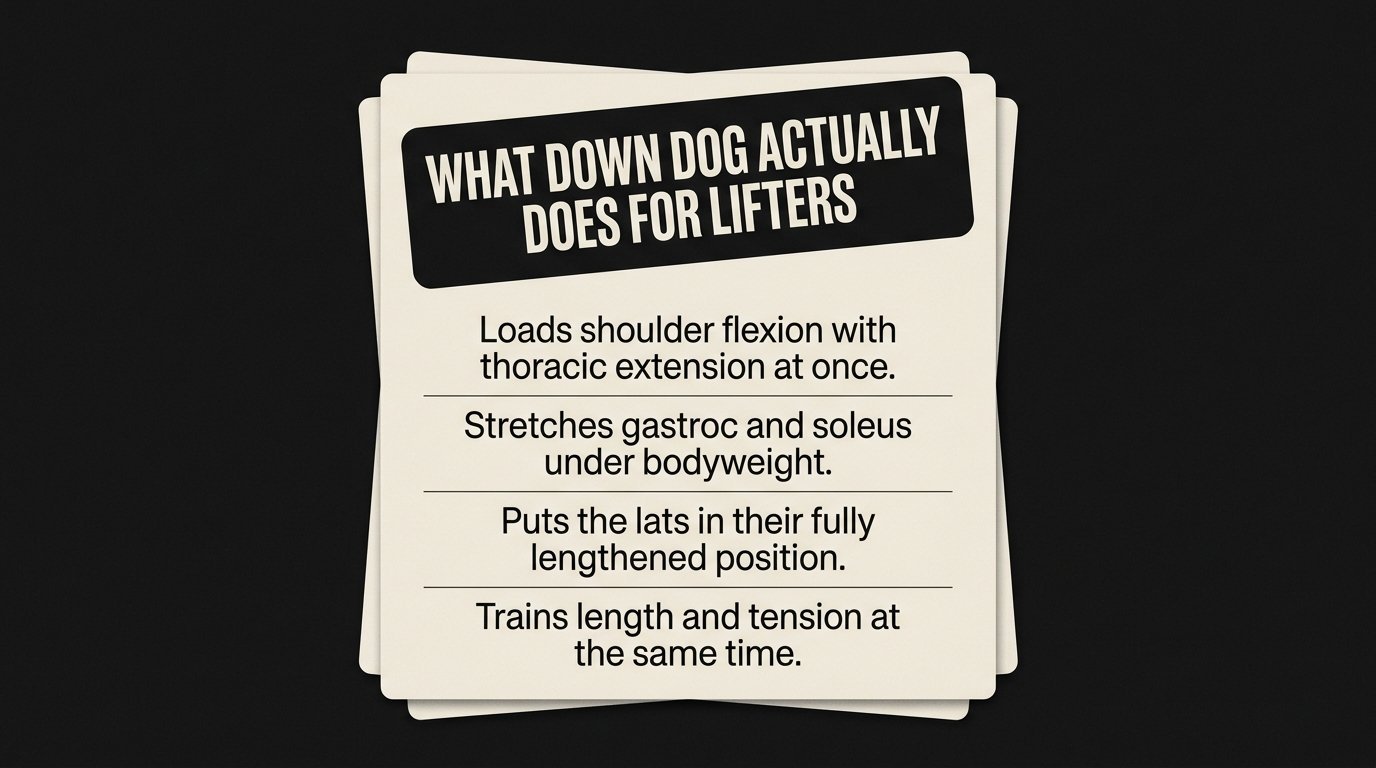
What I like most about the downward facing dog benefits for lifters is that the pose teaches a movement principle that’s hard to teach any other way: holding length and tension at the same time. Most strength work builds tension in shortened muscles, most stretching builds length without it, and down dog asks for both at once. It’s a less common skill than it should be, and it’s part of why I think the pose earns its place in your warm-up even if you’ve got no interest in the rest of yoga.