You’ve seen the Fiesta with the body kit. Spoiler over the boot, lowered suspension, exhaust loud enough to set off car alarms. You’ve also seen what’s under the bonnet, which is a 1.1 litre engine that struggles up a hill in fourth.
The reason your training isn’t working might be that you’ve done the same thing to your body. Decent chest, decent arms, t-shirt physique that holds up in photos. Then you ask the body to do something and the wheels come off. Can’t hinge, can’t run, the back goes lifting your kid out of the car seat. The body kit is on but there’s no engine to back it up.
If you’ve been at this a year or two and you’re stuck somewhere between not-quite-the-look and not-really-functional, that’s where you are. You’ve been bolting cosmetic parts onto something that needed engine work first.
Aesthetic-First by Default
Most online training content is biased toward the cosmetic, not because the creators are dishonest but because of how the medium works.
A reel on bicep peak technique gets watched. A reel on Romanian deadlift mechanics doesn’t, even though one of those exercises is doing more for your body than the other. The algorithm doesn’t know which is more important, it only knows which gets clicks. And the things that get clicks are the things that change how someone looks in a t-shirt, fast, on camera.
The result is that anyone passively consuming fitness content ends up with a feed that overweights the visible work and underweights everything else. Hinge mechanics, posterior chain volume, work capacity, conditioning, structural balance. None of it photographs well, and most of it ends up filtered out before you ever see it.
You haven’t been chasing the wrong thing because you wanted to, you’ve been chasing what was on the menu.
No Manual
The other thing that happens when you train from a feed is that you collect parts without ever assembling a car.
A chest tip from one account, a mobility drill from another, a finisher someone showed you in a story, a programming idea from a podcast. None of these are necessarily wrong on their own. But none of them were designed to work together, and most weren’t designed to work for you specifically. You end up with a garage full of parts and no manual.
Worse, the obvious response when you’re not getting results is to get more information. So you watch more reels, follow more coaches, save more posts to a folder you’ll never go back to. But you’ve been doing that for a year and the problem hasn’t moved, because more information isn’t the bottleneck. Honestly, you already have too much of it, in the wrong order, with no underlying shape.
Adding one more tip to fix this is like solving a hoarding problem by buying organisers, when what you actually need is to throw most of the pile away.
The Engine
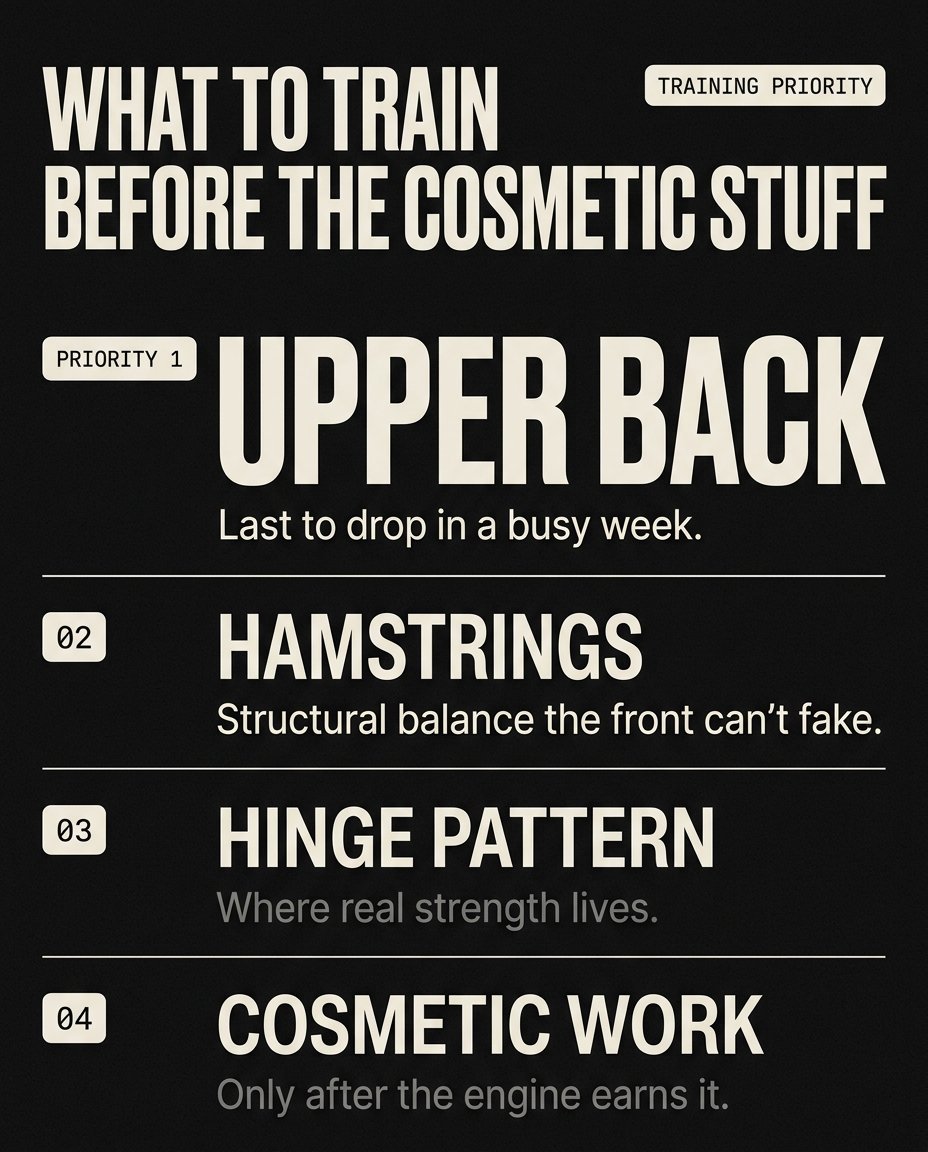
The engine is everything that doesn’t film well. Hinge mechanics, hamstrings, upper back, glutes, aerobic base. Work capacity, which is the unsexy term for being able to do another set without your heart trying to leave your chest.
I’ve trained both sides of this for years, the cosmetic stuff and the engine stuff. When work is busy and time is short and I have to cut things from my own training, the last two things to go are upper back and hamstrings. Everything else is negotiable, but those two aren’t.
Without a posterior chain you can’t take real load, and real load is what life starts handing you the second you have a job or a sport. That’s structural, and most people sort of know it. What they miss is that the aesthetic side has the same answer. Upper back is what gives a t-shirt the V it’s supposed to have, and hamstrings are what stop a leg looking like a thigh hovering above an ankle. The guys who look the most complete at 40 didn’t get there by training arms, they got there by training the bits the algorithm hides.
The bit most relevant here is the strength one. Posterior chain work is where most of your real strength lives. Train it properly and your squat, bench, even your bicep curls all start moving, because you’ve finally got something to push against.
The Diagnostic Job
Most online advice doesn’t fix the body kit problem because nobody giving it has seen you train. Even good advice can be wrong for the specific person reading it.
A good mechanic has heard a thousand engines. When yours starts making a noise, he doesn’t need a flowchart, he can place it in five minutes because he’s seen this exact failure pattern before. A coach is the same thing for bodies. After a few hundred clients you stop guessing at what someone needs and start recognising it. The shape of the problem is usually obvious after one assessment, and almost always different to what the person walked in expecting.
That’s the job: figuring out where your specific gap is and what order to fill it in. Then keeping you on the plan long enough for the plan to work.
Online coaches selling tips are doing the equivalent of an A&E doctor giving generic advice on Twitter, useful in aggregate, useless for the specific thing wrong with you.
The Two-Year Trap
Fair pushback: I’ve trained for two years, four times a week, and I’m making decent progress on my own. Why pay for what I already know how to do?
Decent progress in the first two years is the easy bit, because the novice window flatters everyone. Whatever you’ve built so far is what your body did despite the fragmented inputs, not because of them, and the rate of return drops sharply once that window closes. The next two years are where the body kit problem becomes obvious, because the parts you’ve been ignoring don’t catch up by themselves.
If your training feels like it isn’t working, the answer is rarely more information. What you need is a coach who’ll watch you train, throw most of what you’re doing out, and replace it with a plan that holds together. The body kit can stay, but what’s missing is the engine underneath it.
If you want to know what’s actually missing for you specifically, book a free consult.