A client said something to me recently that I’ve been thinking about ever since. We were talking about her stress eating, the episodes where she’d lose control around certain foods, and I was throwing out options for managing it. Maybe a small discretionary item every day. Maybe a slightly bigger weekly deficit and one fuller evening on a Friday. She wasn’t sure either would work.
Two things, she said, were the only ways out when the stress hit. Bingeing, or the Stairmaster.
She was describing the forbidden fruit effect in real time. The more you tell yourself you can’t have a food, the more you want it. Add moral weight to the restriction, treating some foods as ‘good’ and others as ‘bad’, and the pull gets stronger still.
I’d heard variations of it for years, but the way she’d put it landed something for me. Bingeing and the Stairmaster weren’t two separate behaviours, they were the same behaviour with two outlets, both losses of control around food, both paying penance, just in different currencies.
She gave me the moral framing directly a moment later. She told me she felt that eating those kinds of foods was disrespectful to her body, that having them showed a low regard for it. I’ve heard versions of that line from multiple clients over the years and it always stops me. It sounds like care for the body, but it functions as the engine of the very thing it’s trying to prevent.
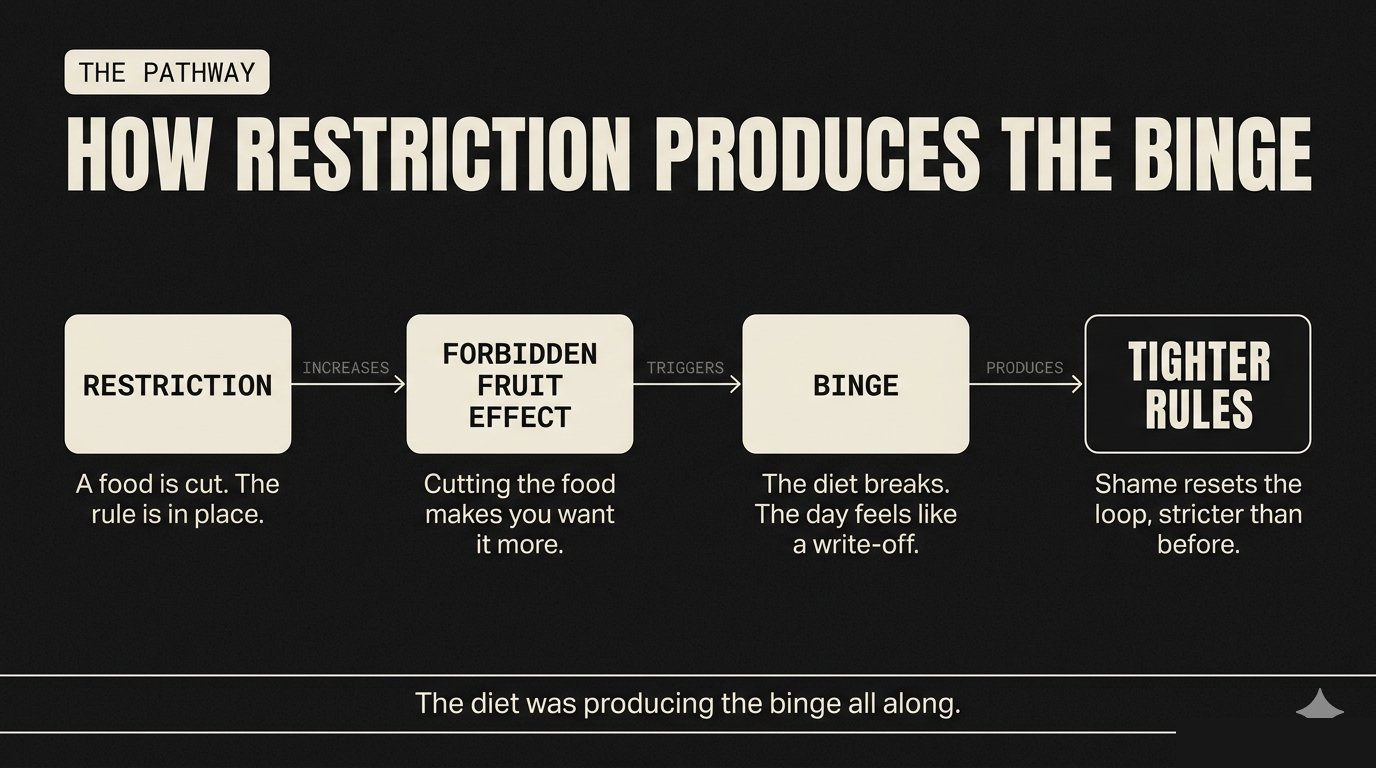
If you’ve been in this loop yourself, the cycle probably looks familiar. You restrict, you do well for a while, something gives, you lose control, you feel ashamed, you tighten the rules. Or you swing the other way: you read about intuitive eating, throw the structure out, eat freely for a fortnight, and the chaos that follows convinces you that you’re someone who needs strict rules after all. Back into restriction, back into the same loop.
Both responses miss what’s actually driving the loss of control.
The Two Camps Share an Engine
The standard advice for someone caught in this loop comes in two opposing flavours. Both are wrong, and they’re wrong for the same reason.
The first is the discipline crowd. Track stricter, cut harder, find more willpower, treat your body like a temple. Some foods are clean, some are dirty, and self-respect looks like avoiding the dirty ones. This is the version of food morality you’ve probably absorbed from clean eating influencers, transformation-culture PT accounts, or any corner of fitness Instagram that frames discipline as virtue.
The second is the militant intuitive eating camp. Throw out the scales, abandon all tracking, listen to your body, reject diet culture entirely. Tracking is the problem, structure is the problem, the whole apparatus is disordered. This is the version you go looking for after the first one stops working.
Both camps assume something they shouldn’t, which is that food is morally loaded in the first place. The clean eating crowd makes the food itself sinful, treating a slice of cake as a small moral failure that has to be paid for. The militant IE crowd makes the structure sinful, treating any calorie counting as evidence of internalised oppression. Different morality, same mechanism. Either way, you end up in a moral relationship with eating, and that’s where the loss of control comes from.
What drives the loss of control is the moralising itself, regardless of which side does the moralising.
The Forbidden Fruit Effect Isn’t a Metaphor
The forbidden fruit effect isn’t a loose metaphor people throw around to describe wanting things they can’t have. It’s a documented psychological pattern with a few decades of research behind it, and that research is fairly grim if you were hoping willpower would save you.
Polivy and Herman did the original work back in the seventies. What they found was that people who were actively trying to limit their intake (the literature calls them restrained eaters) tend to overeat after they think they’ve broken the diet, while people who weren’t actively dieting just carry on eating normally. The pattern got a colloquial name: the ‘what the hell’ effect. Diet’s been broken, the day’s already a write-off, might as well finish the packet.
Specific food restriction makes the pattern sharper. In studies that tell people not to eat a forbidden food and then later give them access to it, the people who’d been told to avoid it eat more of it than the controls. Telling someone they can’t have a food increases its pull. Calling something off-limits is closer to advertising than control.
Mann and colleagues reviewed the long-term dieting literature in 2007 and the picture isn’t pretty. Most dieters regain the weight, and a meaningful chunk end up heavier than they started. The rebound isn’t an exception, it’s what restriction tends to produce, and at least part of the reason is psychological.
What this means for you, in plain terms, is that the diet was producing the binge all along. The restriction works exactly as designed, and the binge is part of what the design produces.
Is the Food the Problem, or Is It the Restriction?
There’s a question I ask clients who describe these patterns. Would the loss of control around this food still happen if you weren’t actively restricting?
It does something useful. It moves the focus off the food itself and onto the diet around it. Most people who feel out of control around chocolate, bread, ice cream, whatever the trigger food is, assume the food is doing it to them. The loss of control feels like the food’s effect. But if the binge only shows up when you’re restricting, the diet is what’s actually causing it.
Most of the time, when clients sit with the question, the answer is no. They don’t binge on these foods at Christmas, when there’s an obvious cultural permission to eat them. They don’t binge on them on holiday, when the restriction’s been temporarily abandoned. What’s actually triggering the binge is the rule against the food.
Sometimes the answer is yes, and the behaviour shows up outside dieting too. That’s a different problem, and it’s likely past what nutrition coaching can solve on its own. If your eating feels chaotic regardless of whether you’re trying to lose weight, the work is broader, and you probably need more support than a blog post can give you.
But for most people stuck in this loop, the diagnosis is simple: the restriction is the cause. If a food only feels uncontrollable when you’re restricting, the food isn’t the problem.
Flexible Dieting as the Bridge
The militant IE crowd has a valuable point that they ruin by overstating it. They’re right that tracking calories shouldn’t be a forever activity, that most people don’t want to weigh chicken into their fifties, that body cues like hunger and fullness are real signals worth listening to, and that the eventual goal is a relationship with food that doesn’t need an app. None of that’s wrong.
They’re wrong about how you get there. You can’t just teleport to intuitive eating. If your body cues have been wrecked by years of dieting, by years of treating hunger as something to suppress and fullness as something to ignore, telling you to eat intuitively is roughly like telling someone who can’t swim to trust their instincts in the deep end. The instincts aren’t reliable yet, and being told to follow them isn’t going to make them reliable.
This is what flexible dieting is for. It bridges the gap between broken cues and intuitive eating. That’s tracking with planned discretionary calories, structured deficits that include food you actually want, hand portions if you don’t like numbers, whatever shape the structure takes. It’s scaffolding. Training wheels aren’t the opposite of cycling, they’re how you learn to cycle without them. If you’ve never set one up before, here’s how a working calorie deficit actually runs.
In practice, the structure looks different for different people. Some clients do well with one small discretionary item every day, like a packet of crisps with lunch, a square of dark chocolate after dinner, whatever fits. Other clients find the daily option doesn’t really satisfy. They need a slightly bigger weekly deficit so they can have a fuller Saturday, with pizza, a takeaway, a proper pudding. As long as the total works across the week, I don’t have a strong preference. It comes down to what feels regulated rather than deprived for the person in front of me.
For my own part, I used to do the bigger feed model. Heavy training day on Saturday, then pizza or a tub of Halo Top in the evening. Over time I’ve shifted towards a small daily discretionary item rather than one weekly event, and these days, in maintenance, I rarely have to think in regulated terms at all. The hunger and fullness signals the IE crowd talks about did come back, but only after years of using structure to rebuild them. The structure was the prerequisite for the freedom that came after.
One pattern I notice over and over with clients: the ones who’ve had the most exposure to fitness culture tend to have the most rigid food rules, and the most rigid food rules tend to produce the most chaotic eating. The people who actually need to lose the least weight are often the ones with the most punishing relationships with food. They feel like they’re almost where they want to be but not quite, and the ‘not quite’ carries a load of internalised stuff about food and appearance that no amount of further restriction is going to lift.
Taking the Moral Weight Off
Taking the moral weight off the food is what changes the loop. After that, the structure you use to rebuild a calmer relationship with eating matters less than the absence of moralising. Tracking, hand portions, planned discretionary calories will all work as scaffolding. What doesn’t work is more discipline alone, and the cheat meal model that swings between restriction and blow-outs is the same loop with a different label.
Notice the moral language in your own self-talk. ‘I shouldn’t have eaten that’ is moralising. ‘That’s what I ate’ is information. The change of phrasing is small but it gradually drains the charge out of the food. Run the diagnostic on the foods you lose control around: would this be a problem if I weren’t restricting? If the answer is no, the forbidden fruit effect is what you’re up against, and the way forward is less restriction and more flexibility, not more discipline.
If you want help building structure that doesn’t run on shame and getting out of the binge-restrict cycle for good, that’s the kind of work I do with one-to-one clients in South East London and online.