A family member told me recently, with a great deal of confidence, that they’d switched entirely to butter and animal fats because they were better for you. When I asked what had led them to that, the reasoning was fairly vague. They’d heard it somewhere. It sounded right. The more I pushed, the more firmly they held to it.
That’s exactly what’s playing out at scale with the Make America Healthy Again movement and RFK Jr.’s push to remove seed oils from the food supply. The underlying concern is sound: ultra-processed food is genuinely making people unwell. Where the movement goes wrong is in the specific ingredient it’s blamed on. Vibes over science. Podcast wisdom over actual data, scaled to federal health policy. I’ve had clients ask me recently whether they need to swap out their cooking oils, genuinely unsure if they’ve been doing something wrong all along.
The short answer is no. The human evidence consistently points away from seed oils being a cardiovascular risk. The chemistry concern isn’t entirely invented, which is why it sounds credible, but it doesn’t translate to harm in people eating a normal diet. What’s actually driving the health problems the movement has correctly identified is worth understanding separately.
Does the Seed Oil Chemistry Make Them Harmful?
The chemistry behind the anti-seed oil case isn’t fabricated. Polyunsaturated fats, which make up most of sunflower, corn, canola, and similar oils, are structurally fragile. Heat them at typical frying temperatures in a lab and they oxidise, generating compounds called aldehydes. Some of these cause cell damage in high concentrations. Beef tallow, being predominantly saturated fat, is considerably more stable under the same conditions and breaks down at a much slower rate.
It’s also fair to say that seed oils in their whole food form, in nuts, seeds, and oily fish, aren’t the same thing as the highly refined versions in commercial deep fryers. The extraction and processing does alter the oil. Critics are right to point that out.
Where the argument overreaches is the translation from lab chemistry to human harm. A human trial had two groups get 20% of their daily calories from either corn oil or beef tallow for a month. At the end, there was no significant difference in oxidised LDL between the groups. Whatever’s happening in the deep fryer, it didn’t produce a measurable difference in a blood marker of oxidative stress in people eating these fats as part of a normal diet.
People With More Seed Oil in Their Blood Live Longer
The anti-seed oil argument rests almost entirely on laboratory chemistry. What it struggles to account for is what actually happens to people over decades.
A 2020 Cochrane review pooled 15 randomised controlled trials covering roughly 59,000 participants. Replacing saturated fat with polyunsaturated fat for at least two years cut combined cardiovascular events by 21%. That’s the largest and most rigorous synthesis of this specific question we have. The greatest benefit came from replacing saturated fat with the type of polyunsaturated fat found in seed oils.
The individual-level data makes the point sharper. A pooled analysis of 30 cohort studies found that people with the highest levels of linoleic acid in their blood and tissue had a 22% lower risk of dying from cardiovascular disease than those with the lowest. Linoleic acid is the primary omega-6 fat in the oils being labelled toxic. If these oils were doing the cardiovascular damage being claimed, the people with the highest circulating levels should be dying at greater rates. They’re dying at considerably lower rates.
| Lab evidence | Human evidence |
|---|---|
| Seed oils generate more aldehyde compounds at high heat | No difference in blood oxidation markers between seed oil and tallow groups in a human feeding trial |
| Beef tallow is more heat-stable | People with the most linoleic acid (the main seed oil fat) in their blood have 22% lower CVD mortality |
The fat that performs worst in a lab performs best in humans.
The strongest counterargument in the research is the Minnesota Coronary Experiment, and it deserves a fair hearing. A large NIH-funded trial replaced butter with corn oil in around 9,000 participants, successfully lowered their serum cholesterol, and found a 22% increased death risk per 30 mg/dL drop in total cholesterol. That’s a genuine finding, and citing it isn’t dishonest. The caveats are also genuine: the trial used pure corn oil in an institutionalised psychiatric hospital population, with no mixed real-world dietary context, and no other large trial has replicated the mortality signal. The Cochrane review, pooled across fifteen trials and a far broader range of populations, found the opposite direction.
It’s the Bagel, Not the Butter
When someone cuts seed oils and feels better, something real has usually happened. The cause is almost certainly removing ultra-processed food from the diet. Seed oils in the real world appear in crisps, biscuits, fast food, and the overwhelming majority of processed snacks. When people cut seed oils in practice, they cut those foods. Calorie intake drops, fibre goes up, blood sugar stabilises. The improvement is real, but it tracks the food context, not the specific fat molecule.
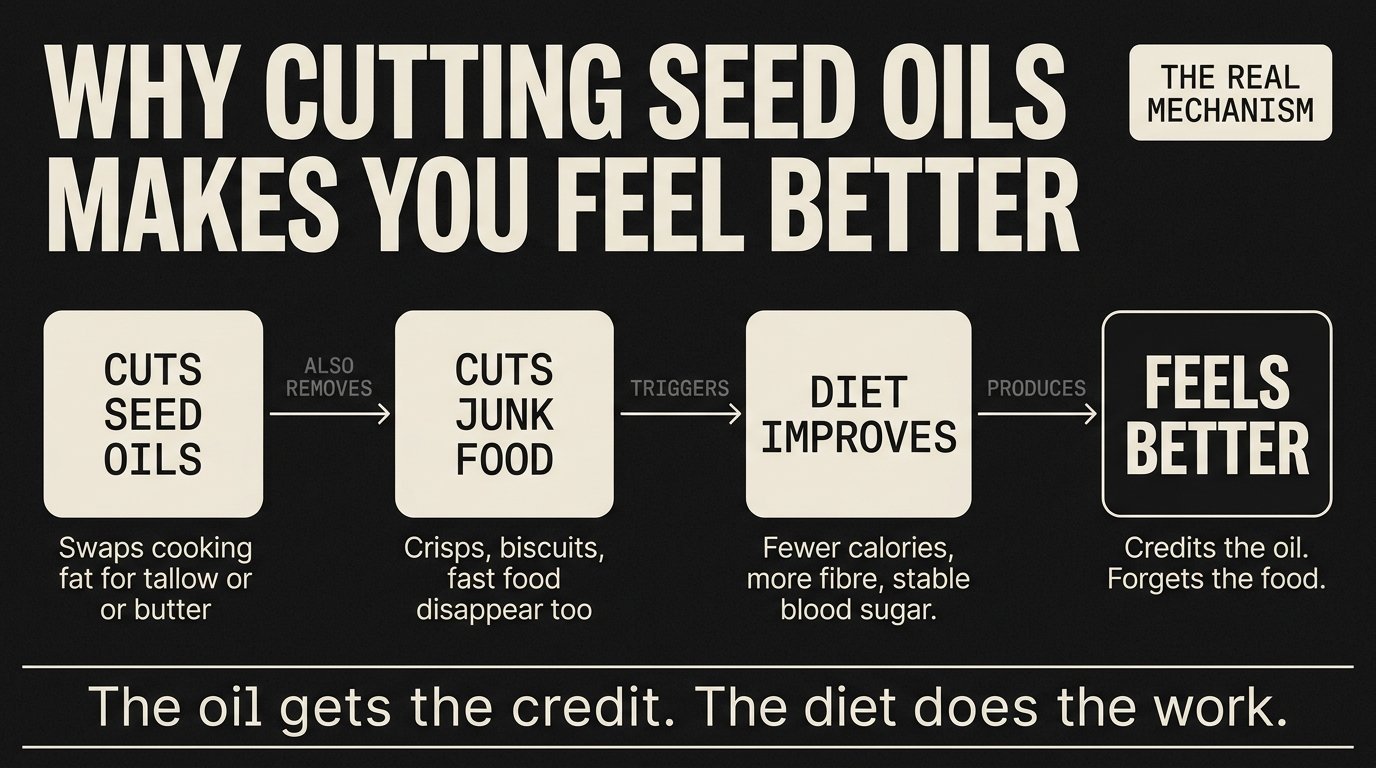
The combination of saturated fat and refined carbohydrate is considerably more atherogenic than either in isolation. Butter on broccoli produces a different physiological response to butter on a bagel. Rapeseed oil in a home stir-fry is a different proposition to rapeseed oil in a commercial deep fryer running all day. The food that carries the fat is doing more work than the fat itself.
I cook with olive oil at home, and the main reason is practical rather than cardiovascular: liquid oils are straightforward to measure. A tablespoon is a tablespoon in a way that a knob of butter off the block isn’t. That argument for unsaturated fats doesn’t require the epidemiology above, though the epidemiology points the same way.
Beef tallow is roughly 50% saturated fat. Saturated fat consistently raises LDL cholesterol and, more specifically, increases apolipoprotein B, the particle that accumulates in artery walls and drives plaque formation. Decades of evidence across multiple study types have confirmed how that process works. Replacing unsaturated oil with saturated fat in an otherwise poor diet doesn’t address the diet; it adds a cardiovascular risk on top of it.
If you’re cooking at home with decent ingredients, the oil is relatively far down the list of variables worth worrying about. If you’re eating heavily processed food regularly, no oil swap will compensate for it.
The anti-seed oil movement has correctly identified that modern food is making people unwell. What’s driving the harm is the combination of refined starches, excess calories, and low fibre that tends to come with the foods cooked in these oils. Sort the overall diet, and the oil question largely resolves.
If you want nutrition coaching that cuts through the noise, get in touch below for a free consultation.