Cardio for Fat Loss: Why 600 Calories Burned Adds Only 200
You’ve been hitting the cardio. Four runs a week, maybe a spin class on top, the watch lit up green every day. The calories-burned column reads like a win, 500 here, 600 there, a whole evening meal earned back by Thursday. And yet the scale hasn’t really moved in a month.
If that’s you, you haven’t done anything wrong. You’ve done exactly what the fitness industry told you to do, and you’ve done it consistently, which is more than most people manage. The trouble is the maths you were handed for cardio for fat loss was a bit broken before you ever started.
The number on the treadmill is honest about the workout itself, but it’s lying about the rest of the day.
Your Cardio Worked for Fat Loss, Until It Didn’t
Let’s be fair to cardio first, because the popular advice isn’t pulled from nowhere. Running burns real calories, spinning burns real calories, and in the early weeks of a diet, before your body has caught up with what you’re doing, adding some cardio often does produce a drop on the scale. This isn’t in your imagination. You felt it work once, which is exactly why you reach for more of it when things stall.
The mistake is assuming the same hour keeps paying out at the same rate. It doesn’t. The cardio that shifted half a kilo in month one can do almost nothing by month four, and the reason isn’t that you’ve gone soft or stopped trying. It’s that your body has gradually adjusted around the new workload. To see how, it helps to look at some people who move a lot more than any of us.
The Hadza Burn No More Calories Than You Do
The Hadza are a hunter-gatherer people in Tanzania. They walk miles every day to forage and hunt, with none of the chairs, cars or desks that fill a Western life. By any sensible guess they should burn far more energy per day than an office worker in London.
But something strange turns up when you actually measure it. When Herman Pontzer’s team measured the Hadza’s total daily energy expenditure using doubly labelled water, the gold-standard method for this, they burned roughly the same number of calories per day as sedentary Westerners once you account for body size. All that extra movement accounted for no extra total burn.
That finding is the heart of what researchers call the Constrained Energy Expenditure model. The idea is that your body treats total daily energy as a budget it wants to keep within a fairly narrow range. When you spend more on exercise, it doesn’t just bolt those calories on top of everything else. It trims spending elsewhere to balance the books.
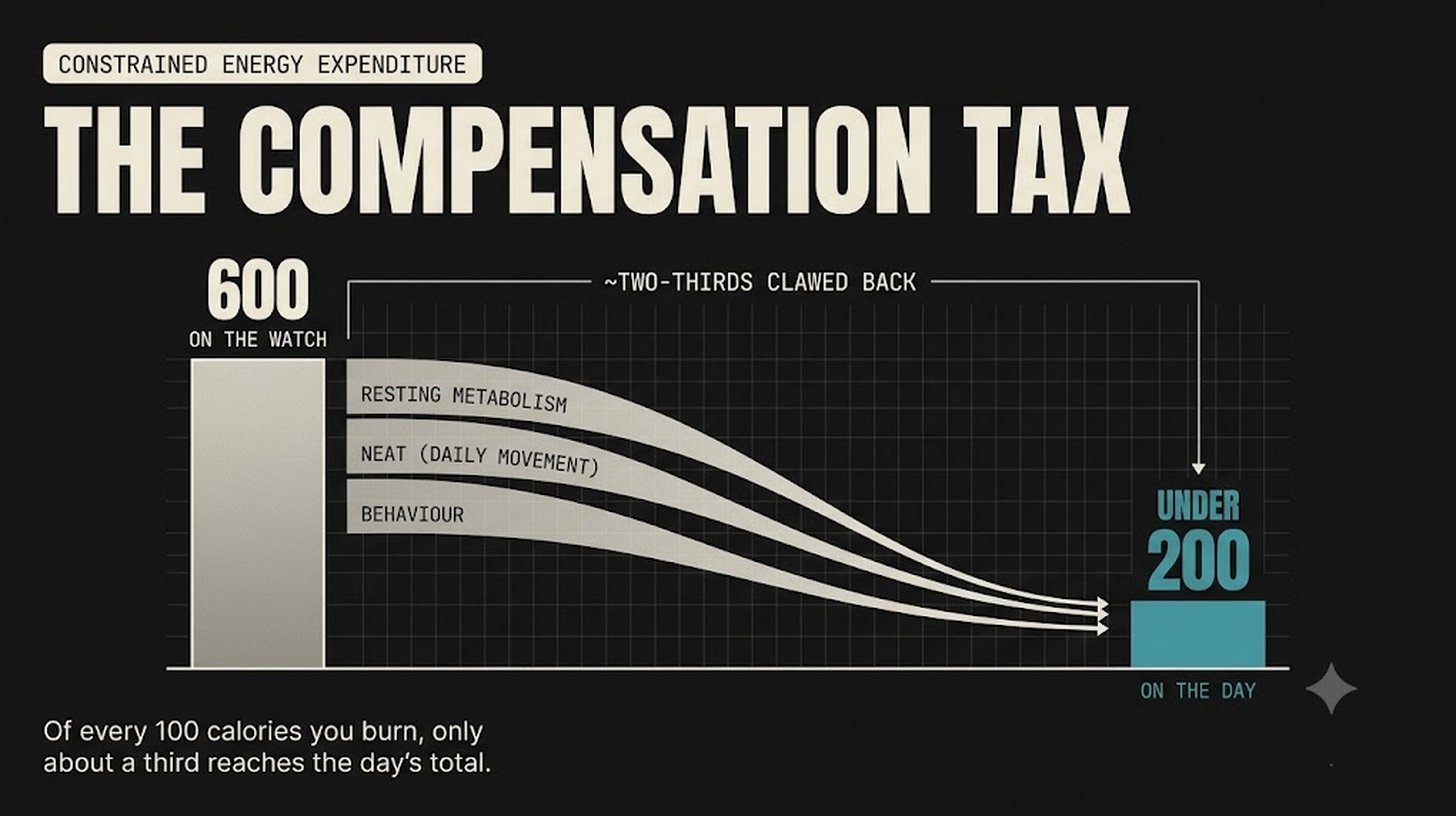
You see the same thing in ordinary exercise studies, not just remote foraging tribes. When researchers systematically reviewed exercise training interventions, the clearest pattern was that the clawback grows the longer people stick with the programme: in interventions running around eighteen months, compensation approached 84% of the calories burned. Stay consistent long enough and 600 on the display can mean under 200 in your actual daily total.
It’s not always that severe. The biggest and cleanest dataset, a doubly labelled water database of 1,754 adults, put the average free-living compensation at about 28%, which is far gentler. But that same study found something that matters a lot for anyone dieting: the more body fat someone carried, the harder they compensated. The leanest group lost about 28% of their burn to compensation, the heaviest closer to 49%. The exact figure moves around with who you are and what you’re doing, but the direction is always the same.
Where Do the Missing Calories Go?
The burn drains away in three places at once:
- Resting metabolism. After heavy training loads the body temporarily runs your basal and sleeping metabolic rate a little lower, spending less on background upkeep.
- Incidental movement, what physiologists call NEAT. Without deciding to, you fidget less, take the lift, sit a bit longer, walk to the kitchen a fraction slower.
- Plain behaviour. People who start a structured plan tend to rest more around it, swapping the gardening or the long walk they’d have done anyway for the sofa, because they’ve already "done their exercise" for the day.
Think of it like a payslip. You pick up £600 of overtime, but the higher tax band takes most of it, and £200 lands in your account. The calories-burned readout is the gross figure on the slip. Compensation is the tax. People budget their eating against the gross and then wonder why they’re skint. The watch is honest about the work you did but dishonest about the day’s net.

It’s worth me being fully honest here though. This model isn’t settled science, and I’d be misleading you if I pretended it was. A large 2025 study tracked people across very different activity levels and found their daily burn just kept climbing the more they moved, with no sign of the body capping it the way the constraint model predicts. Other researchers argue that most of the "missing" calories are behavioural, you moving less outside the gym, rather than any hard metabolic ceiling. Whether your body has a genuine cap or just a strong habit of rebalancing is a real open question.
For a coach and a client, though, the distinction doesn’t really affect what you end up doing. Whether the calories vanish into a suppressed metabolism or into you flopping on the sofa afterwards, the result on the scale is identical: the net is a good deal smaller than the screen, and it’s smallest exactly when you’re lean and in a deficit, which is to say when you’re trying hardest to lose the last bit.
Lifting and Walking Don’t Get Taxed the Same Way
The compensation tax falls hardest on steady aerobic work, and it doesn’t seem to hit lifting or walking nearly as much. That changes what your training should be built around.
Resistance training appears to add to your daily burn far more linearly. The short, hard bursts of a heavy set are awkward for the body to adapt around, so more of that energy cost sticks. And lifting does the thing cardio can’t: it protects the muscle you’re carrying, which is the tissue that keeps your metabolism ticking over in the first place. Most lifters think they train for muscle and do cardio for fat loss. The research hints it’s closer to the other way round. The barbell hour is the one that compensates least, holds onto muscle, and gives you the body composition you actually wanted.
Walking is the other one that dodges the tax. Low-intensity, spread-out movement doesn’t seem to trigger the same rebalancing at the step counts most people realistically hit. Adding a few thousand steps a day really does add to your expenditure without the hunger and wipeout that a hard aerobic session brings. The thing the fitness industry won’t sell you, because nobody needs a programme to go for a walk, is one of the most useful tools you’ve got.
Drive the Deficit From Food
If the burn number is mostly fiction, the obvious question is what you do instead. The answer is less complicated than the science behind it.
Get the deficit from your food, where you actually control the number. Cutting 100 calories from your intake is reliable in a way that burning 100 on a treadmill isn’t, because eating a little less doesn’t set off the same compensatory clawback. Start from a sensible maintenance figure, take roughly 20% off, and run your diet from there. Stop eating back the calories your watch hands you, because for cardio in particular that figure can overstate your real deficit by a wide margin.
Keep lifting, for the muscle and the body composition. Raise your step count, because it’s the cheapest way to nudge your daily burn up. And if you really love running or your spin class, keep it, just keep it for the right reasons. Cardiovascular health, your head, your fitness, the way it helps you recover between lifting sessions. Those are real and worth having. Fat loss just isn’t the job it’s best at.
New clients come to me with the same story almost word for word. They’ve added three or four cardio sessions a week, they’re more tired than they’ve ever been, and the scale has stalled. Nine times out of ten we cut the cardio back, push the daily steps up, keep the lifting heavy, and tighten up what’s actually going in their mouth. The scale usually starts moving again within a couple of weeks. They didn’t need to work harder, they needed to stop paying a tax nobody had told them about.
If you’re in South East London and you’re tired of cardio that isn’t working for fat loss, I can help you build a plan around what actually moves it.
[CTA BUTTON: Book a free consultation]