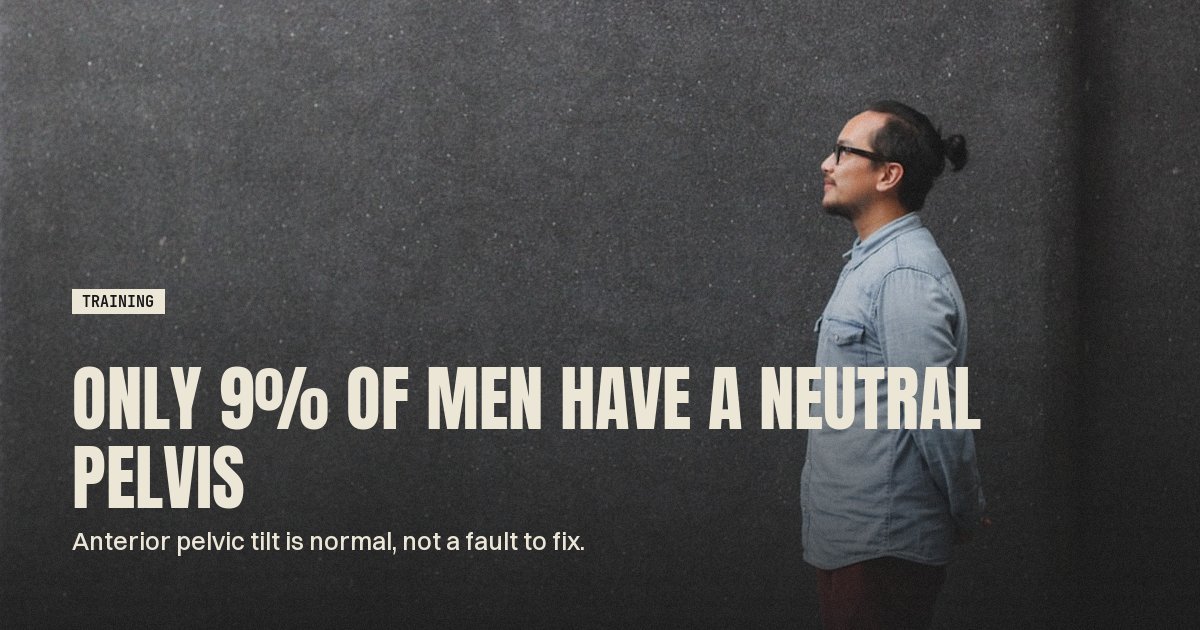
When I started out as a coach, anterior pelvic tilt was one of the easiest things I ever sold. Almost everyone who walked through the door seemed to have it. I’d stand them side-on, point out the tilt in their lower back, explain that their hip flexors were tight and their glutes had switched off, and hand them a routine of glute bridges and hip flexor stretches to sort it out. It felt like proper coaching.
The problem was it never did much. Weeks would pass, the stretches got done, and the tilt sat exactly where it always had. I’d feel a bit deflated and a bit confused, because the theory was everywhere and it sounded right. It took me longer than I’d like to admit to notice the thing that was staring me in the face. The reason almost every client “had” anterior pelvic tilt is that almost everyone does, and it’s completely normal.
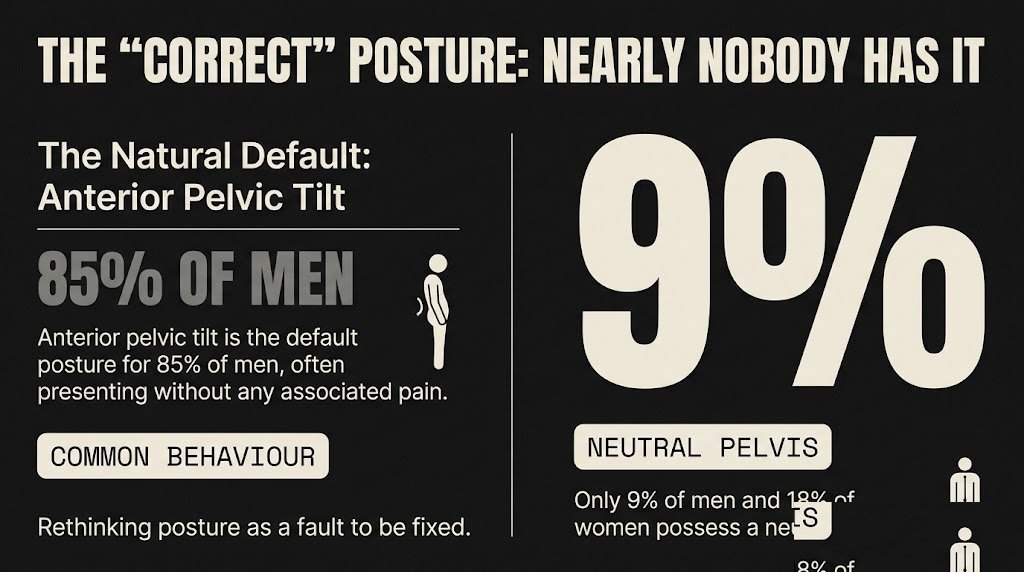
In one study of 120 pain-free adults, 85% of men and 75% of women had some degree of anterior pelvic tilt. Only 9% of men and 18% of women had what you’d call a neutral pelvis. Read that back. The “correct” posture I’d been diagnosing people against is the one almost nobody actually has.
Anterior Pelvic Tilt Is the Norm, Not a Fault
If you’re not sure what that actually means: anterior pelvic tilt is when the top of your pelvis tips forward, deepening the arch in your lower back (the curve clinicians call lumbar lordosis) and making your belly and backside sit a little more prominent. It’s the posture the fitness world badges as “lower cross syndrome” and treats as a problem to fix. For the large majority of people, it’s neither a problem nor anything that needs fixing.
Posture gets talked about as if there’s one right way to be built and everything else is a fault to correct. Your bones make that hard to judge in the first place. When researchers measured the bony landmarks coaches use to eyeball tilt, the points at the front and back of the pelvis, those landmarks varied by up to 23 degrees from one person to the next, even with every pelvis held in the exact same position. Two people whose pelvis sits identically can measure 23 degrees apart purely because their bones are shaped differently.
That’s why the side-on assessment is so misleading. What you see, and what those landmarks tell you, is mostly your own bone shape and body shape: the curve of your lower back, where you carry a bit of belly, how your glutes sit. It says almost nothing about the actual angle of the joint underneath. For years I was reading off bone structure and blaming it on lazy glutes.
Does Anterior Pelvic Tilt Cause Back Pain?
The whole reason anyone worries about anterior pelvic tilt is the fear it’ll wreck your back. It’s an intuitive idea. A tilted pelvis, an exaggerated curve, surely that adds up to trouble for the spine over time.
When this gets tested properly, the link doesn’t hold up. A 2019 review of reviews looking at spinal posture and back pain found no consensus that the way you’re built actually causes the pain. People with a marked tilt are walking around pain-free in their millions, and plenty of people with textbook posture get back pain anyway.
I’m not telling you posture never matters or that back pain isn’t real. There are specific cases where pelvic position does matter, recovery from certain hip surgeries being one, and over-arching your lower back under a heavy barbell is a genuine technique fault worth fixing. That’s a long way from the idea that the way your pelvis rests while you’re stood at the bus stop is slowly damaging you.
The Correctives Don’t Do What They Promise
Say you decided your tilt was worth changing anyway. The standard fix mostly doesn’t change it. In one eight-week trial, people followed a programme of core work, strengthening and stretching aimed squarely at reducing anterior pelvic tilt. Their resting tilt shifted by about 1.6 degrees, which is nothing you’d ever notice, and their pain didn’t improve either. That lined up with my own experience exactly. My clients were doing the glute bridges perfectly well. The bridges still did nothing, because resting posture mostly isn’t yours to renegotiate.
Sport gives the idea its hardest test. In running events, more anterior pelvic tilt tends to appear as athletes get better, because it helps with the kind of force you drive into the ground when you sprint. Footballers and sprinters develop the very thing the corrective industry sells a cure for. You can train how your pelvis moves during a fast, specific action like a sprint. What you can’t do is stretch your resting skeleton into a different shape.
It Only Matters Under Load
None of this means your hips, glutes and core aren’t worth training. They are, for strength, performance, and how you move and feel. Train them because they’re useful, not because someone told you they’ll re-tilt your pelvis.
The one place pelvic position genuinely earns your attention is under load. What’s worth cleaning up is deliberately cranking your lower back into a big arch when the weight is heavy, at the bottom of a squat, the lockout of a deadlift, the top of a press. Brace your core, keep a roughly neutral spine through the lift, and catch yourself before you over-arch. That’s coachable, and it genuinely protects your back.
Your resting posture, the bit you can see in the mirror, can be left alone. If you’ve spent months bolting a corrective routine onto your training because you were worried your hips were broken, you can drop it and put that time into work that actually changes something. For nearly everyone, the tilt was never the problem.
If you’re in South East London and you want training built around what actually changes how you look and lift, not fixing problems you don’t have, I can help.
Sources
- Herrington (2011), Manual Therapy: pelvic tilt in a pain-free population
- Preece et al (2008), J Man Manip Ther: variation in pelvic morphology
- Swain et al (2019), J Biomech: posture and low back pain, a review of reviews
- Falk Brekke et al (2022), MSK Sci Pract: exercise for excessive anterior pelvic tilt
Hero image by Airam Dato-on on Unsplash.