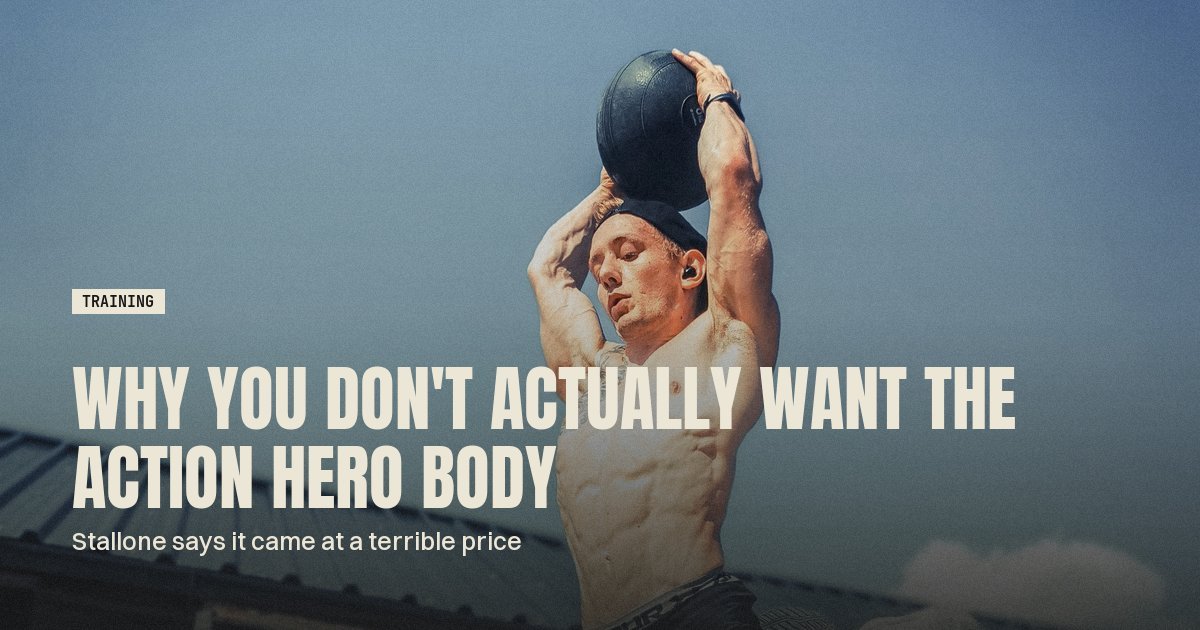
Why wouldn’t you want the action hero body? Because the man who wore the most famous one in film history now says it wasn’t worth having, and the evidence on what that physique costs the mind backs him up.
There’s a clip of Sylvester Stallone doing the rounds at the moment, taken from a recent sit-down interview. He’s 80 now. Asked how his relationship with his body has changed over the years, he doesn’t talk about training or diet at all. He calls the body his armour, and then spends the next two minutes describing what wearing it cost him.
It started as character work, he says: Rocky was a smooth, normal-looking guy, so for the warrior roles he set out to redesign himself "like a jaguar". Then, in his own words, "it became an obsession. Really bad." It got to the point where he became bulimic, something he says he’s never admitted publicly before. "I couldn’t hold anything down. Or if I did, I didn’t want to keep it down." On drugs, he doesn’t hedge at all: "Nobody does it without additives and drugs, period." And the toll wasn’t only physical; his moods went with it.
The detail that stays with me is which role finally felt good: not Rambo, but Cop Land, the 1997 film where he played an overweight, partially deaf small-town sheriff, the weakest man in the room. He describes letting the physique go for that part as liberating. And at 80, taking "a lot of pills to keep going", he sums the whole thing up himself: "It’s coming at a terrible price. If I could do it all over again, I would say let someone else carry the banner."
I’m not a neutral observer here. The heroes I grew up on were Bruce Lee, Jean-Claude Van Damme and, above all, Stallone as Rocky, and the shape he was in for Rocky III and IV is still the exemplar of the 80s action physique. A post went round recently claiming a study had found people’s workouts improved after watching the Rocky IV training montage. I couldn’t track the study down, but I didn’t need to, because every man my age knows from the inside exactly why it would be true.
Everyone knows the action hero body is fake now, and that hasn’t helped
Credit where it’s due: the fitness industry has got far more honest about half of this conversation. Most lifters now understand that the action hero body is built with steroids on top of outlier genetics, then finished with dehydration and lighting. The whole "natty or not" genre (is he natural, or is he on drugs) exists to make that point, and making it was a genuine service, because a generation of men were comparing themselves to physiques that were never on offer to them.
But the honesty stops at achievability. The arguments are all about whether you could look like that naturally (you couldn’t) and which drugs are involved (more than you’d think). The follow-up question almost never gets asked: we’ve spent twenty years arguing about whether the action hero body is achievable and never asked whether it’s desirable.
That missing question matters, because for a lot of men the achievability argument has backfired. If the only thing wrong with the physique is that it takes drugs, then drugs stop being a dealbreaker and start looking like the missing ingredient. And they’ve never been easier to reach for: "hormone optimisation" clinics now advertise to healthy men in their 30s, and the framing has shifted from cheating to self-care. Stallone’s clip cuts past all of that. He actually had the body, so his verdict answers the question nobody asks: it wasn’t worth having.
What do steroids actually do to your mind?
The physical risks get all the airtime: the heart, the liver, blood pressure, fertility. The psychological record gets discussed far less, and it’s arguably worse.
The first problem is dependence. Steroids are habit-forming in a way almost nobody warns you about: the best estimates we have suggest around 30% of users develop a genuine dependence, which in America alone works out at roughly a million men. That puts "I’ll just run one cycle" in a similar category to "I’ll just have the one cigarette".
Then there’s what happens when you stop taking them. Steroids shut down your own testosterone production, and a review of the recovery research found it can take anywhere from months to years to come back, with depression hitting around 29% of men in withdrawal against roughly 5% of comparable non-users. One study found former users still had suppressed testosterone and more depressive symptoms over two years after stopping. In plain English, the mood crash lands at exactly the moment the body you built everything around is deflating.
Underneath the drugs sits a recognised body-image disorder. Psychiatrist Harrison Pope and colleagues first described muscle dysmorphia in bodybuilders in the 90s: a form of body dysmorphic disorder where you see yourself as small no matter how muscular you get. It overwhelmingly affects men, and it’s strongly associated with steroid use. The two feed each other, because the distorted self-image drives the drug use, and the physique the drugs build raises the bar the self-image keeps failing against.
Stallone hiding bulimia for fifty years fits the same pattern. In the UK, about a quarter of people with eating disorders are men, yet men make up a tenth or less of the people who actually turn up in clinics, because the male version hides inside words like discipline and dedication. A man who can’t keep food down gets called committed, and that miscategorisation is most of what keeps it hidden.
The leanest I’ve ever been was the worst I’ve ever felt
I can’t speak to the drugs first-hand, but I can speak to the condition, because I’ve been movie-star lean myself, four or five separate times between 2020 and 2025: for fight camps, for photoshoots, once during lockdown, and once just for a holiday. About as conditioned, in other words, as an everyday person can get. And the model I was working from on every one of those runs was exactly the one above. Far more than any performance goal, I wanted to look like the heroes I grew up watching. Sadly, things don’t work like they do in the movies, although given everything Stallone has just said, maybe they work exactly like the movies.
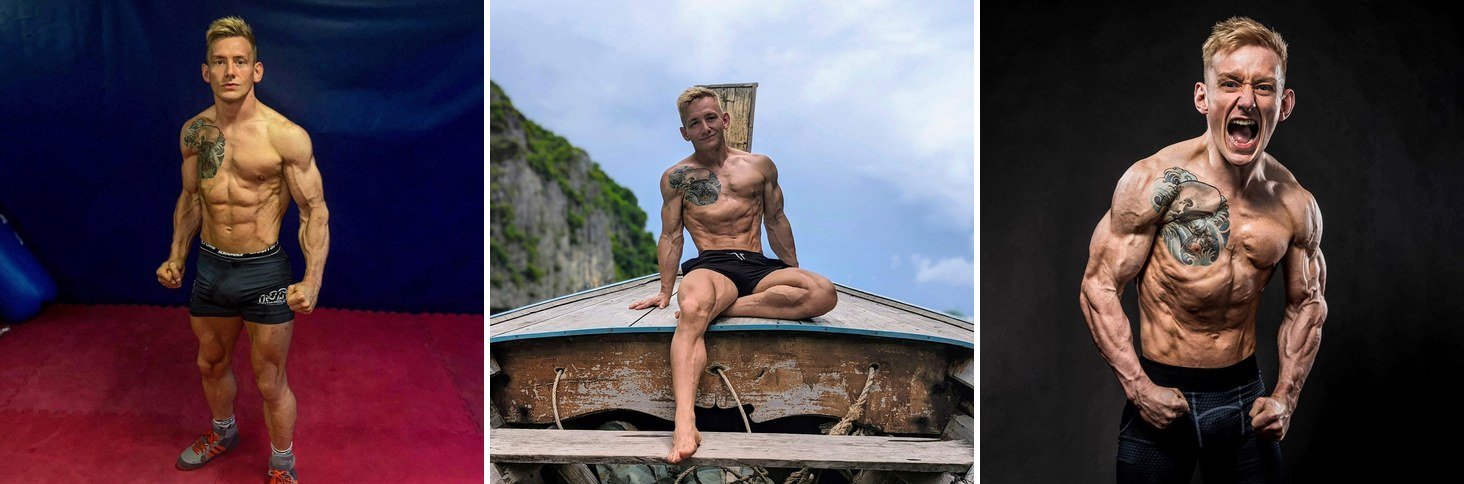
For the record: I never took steroids, which is also why I never got unreasonably big. What I had came from willpower, time, probably a bit of genetic luck, and a stretch of life with very little responsibility in it. If you’re young, determined and free of real commitments, that level of lean is possible without drugs, at a cost. (In the interests of full disclosure, I did once try yohimbine, a fat-loss stimulant, when I was younger and stupider. It gave me nothing except an uncomfortably high resting heart rate.)
The cost was that I felt, for want of a better word, like shit. Every single time. I was sluggish and cognitively slow, obsessed with food, waking up several times a night from hunger, and stressed more or less constantly. My training performance was terrible, and I carried a rotating collection of minor injuries, shoulder, wrist, knee, because my body didn’t have the resources to recover from the damage training was accumulating.
The thing you realise is that none of it means you’re doing something wrong, and none of it is unique to you, because this is how it has to work. That level of leanness isn’t a place the human body is designed to operate, and it isn’t sustainable for anyone. All the benevolent systems built to keep you alive read it as an emergency, and they’ll fight you tooth and nail to pull you out of it.
The worst of it, though, was the self-image. You don’t realise it explicitly, but you judge your own body almost entirely in a relative sense: not against other people, but against the best condition you’ve ever seen it in. Once you’ve been properly stage-lean, somewhere under 8% body fat, you can sit at 10 or 12%, a level where everyone else thinks you’re in incredible shape, and all your own eyes report is the distance from the peak. It spreads outward from there, because normal, healthy bodies start reading as soft too. Stay lean enough for long enough and your reference point moves, until the only body that looks right to you is one you can’t healthily keep. That shift in perception is the seed of everything Stallone describes, and I didn’t need a single drug to get there. The drugs just take you further down the same road.
Pick a benchmark you’d want to live in
None of this is an argument against training hard or caring how you look, and Stallone isn’t making that argument either; the man is still training at 80. You can carry a six-pack and feel fine, and you can be what any reasonable person would call "pretty ripped" and still feel good. The problem sits specifically at the peak: the physiques we grew up admiring, and are still bombarded with on social media in one form or another, are pipe dreams. If they’re achievable at all without drugs, holding them will make you feel terrible, and the right lens for every one of them is a sceptical one.
The argument is about the benchmark. If the body in your head belongs to a man who now says he’d hand it back, it’s a bad benchmark, and you’re allowed to replace it. What I build with clients instead is deliberately less dramatic: strong, visibly athletic, clothes fitting well, performance going up, all running on an amount of food and sleep you can sustain without thinking about it every waking hour. That version compounds for decades, while the extreme version sends you the invoice later, and Stallone has just shown everyone what the invoice looks like.
The early markers matter because the gradient starts natural: training through every illness and injury, panic when you miss a workout, your mood for the day set by what you see in the mirror. I’ve been on that slope, which is why I recognise it in the clip. If the eating side of this is live for you, Beat, the UK’s eating disorder charity, is the place to start, and that applies to men every bit as much as women.
Stallone’s clip is being shared as a steroid confession, but listen to it again and it’s really the last word on the action hero body: desirable was always the question that mattered, and his answer is no. He carried the banner for fifty years and says to let someone else carry it. I’m inclined to take his word.
If you want to get stronger and leaner in a way that improves your life instead of taking it over, I can help: contact me below for a free consultation.