Is Tom Holland’s ‘Monster’ Workout realistic? Not for most people who train – and on the evidence, not really for Tom Holland either. But understanding why not will get you much further toward making that look a reality
A client asked me about this one recently. With the new Spider-Man film out, the familiar story of how a Hollywood actor got into superhero shape is doing the rounds again, this time in the form of a bodyweight circuit called the ‘Monster’ Workout. My client wanted to know my thoughts on it. Having looked it up, it’s the perfect specimen of a certain kind of workout gimmick.
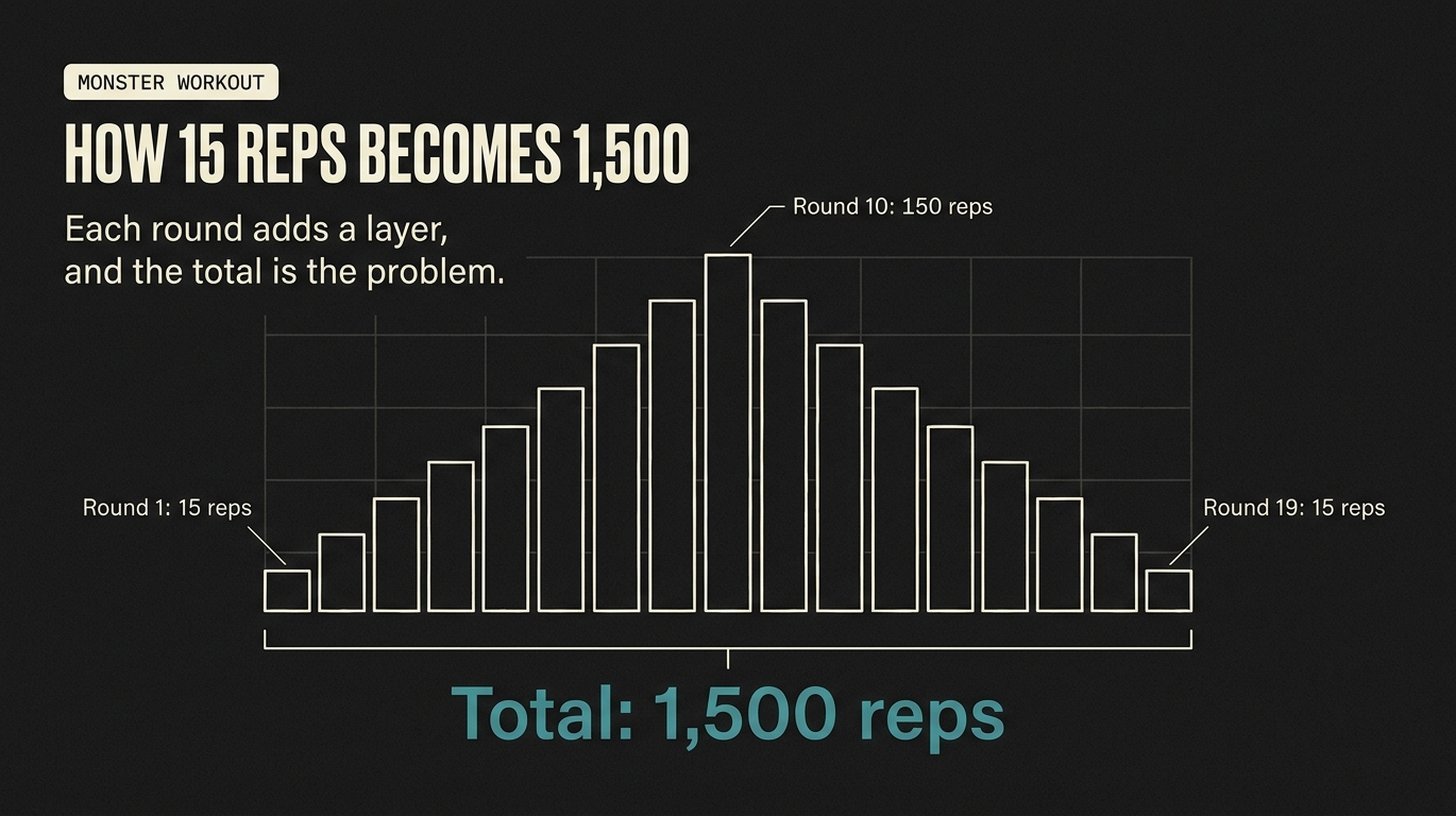
The version attributed to Holland’s trainer Duffy Gaver goes like this. Round one is 1 pull-up, 2 dips, 3 press-ups, 4 sit-ups and 5 squats. Each round adds a layer, so round ten is 10 pull-ups, 20 dips, 30 press-ups, 40 sit-ups and 50 squats, and then you climb all the way back down to round one. So the total for the whole workout is 100 pull-ups, 200 dips, 300 press-ups, 400 sit-ups and 500 squats; that’s roughly 1,500 reps in a single workout.
The moment I looked it up I could see it was absurd. But it’s caught a lot of attention.
The Hollywood effect
The appeal of these stories is obvious. A workout attached to a well-known figure with a fantastic physique is a bit like a recipe featuring a glossy photo of the finished dish. And the transformation narrative of ordinary lad to superhero implies that the same door is open to you.
What you’re looking at, though, is a kind of illusion. Not only do physiques belong to already well-trained actors with access to full-time coaching, nutrition support and every performance resource a studio can buy. On top of that, by the time a shirtless scene reaches you, the actor has dehydrated for it, pumped up for it, and been lit, filmed, graded and edited by specialists whose whole job is making him look extraordinary. Even the actor doesn’t look like that in an ordinary week of his life. When you compare yourself to that image, you might as well compare yourself to the Incredible Hulk.
The very existence of a Tom Holland workout implies that the only thing standing between you and that body is effort, rather than genetics, a decade of training and a team of professionals.
Transformation without learning
The ‘Monster’ Workout itself is particularly compelling. Everyone knows what a press-up and a pull-up are, most of us flatter ourselves that we already know how to do them, and the pyramid structure is easy enough to write on the back of your hand. There’s no kit beyond a bar, no programme to follow, nor any expensive coach to pay. It has the same DNA as workouts like Murph or 75 Hard: a finite, countable challenge that sounds brutal in a shareable way.
The real thing this implicitly promises is transformation without learning. You don’t have to study technique, change your diet, or get access to any of the resources we just talked about. You just do a massive overkill amount of the two exercises you learned in school PE. That’s the promise at the heart of most celeb or viral workouts.
The ‘Monster’ Workout’s numbers disprove themselves
Start with the maths. A hundred pull-ups in a session is beyond most people who’ve trained seriously for years, and journalists who attempt the workout for articles keep failing it in print. An untrained person who tries it cold is looking at days of severe soreness at best, and at worst the kind of muscle breakdown that could land you in hospital.
There’s an even bigger claim in circulation: a 20-minute version with 5 pull-ups, 10 press-ups and 15 squats on repeat. Holland’s record is reported as 27 rounds. That works out at 135 pull-ups, 270 press-ups and 405 squats, 810 reps in 20 minutes. Anyone who’s spent time around CrossFit will recognise that as a score for professional athletes at championship level, not an actor with a thousand other obligations.
So either the reps aren’t real reps, or the numbers aren’t the real numbers. My honest guess is the first, but it’s not necessarily the case that anyone’s lying. Howard Bloom, a music publicist turned author, claimed for years that he did 700 push-ups every morning. People scoffed, and when footage eventually surfaced, his push-ups turned out to involve his arms barely bending at all. I don’t think he was conning anyone, he just had a genuine blind spot. Assessing your own technique objectively is extremely hard, especially at high reps with no one around who’ll be honest with you. So it’s entirely possible Holland believes he’s doing 200 dips in a workout while doing 200 of what can best be described as "somethings".
I’ve been training for close to twenty years, and with some specific preparation I could probably get through the Monster Workout. I wouldn’t get through it well, and if I ever did try, it would be a one-off stunt for charity, not a regular weekly workout. It’s in the same category of overkill as competitive eater Joey Chestnut’s 83 hot dogs in ten minutes. You might happily eat a hot dog a few times a week, but nobody looks at an eating contest and calls it a meal plan, and nobody should look at 1,500 reps and call it a weekly workout.
The more marketable, the less effective
Every movie role workout story reduces to the same basic problem: the workout could not have made the body. If the ‘Monster’ Workout were achievable, it wouldn’t be remarkable enough to write about; its marketing appeal is its absurdity. And a workout absurd enough to trend is, by the same token, too wacky to be anyone’s real training. There’s no progression built into it, it’s not repeatable, and no version beats a normal programme for building muscle.
So if it wasn’t this ridiculous workout, how did Tom Holland end up looking so ridiculously good? Well, he started ballet at ten and trained for two years before performing in Billy Elliot in the West End, which is about the best foundation for muscle and movement a young person can get outside a gym. He literally backflipped his way into the Spider-Man screen test. He’s now roughly a decade and four films into the role, with continuous access to professional coaching, and every resource he needs. Ultimately the broad answer, as usual, is consistent progressive effort over time. It’s boring and doesn’t sell magazines, but it does actually work.

Holland during his Billy Elliot run, 2010. He’d already done two years of ballet training before most people touch a barbell. Photo: DenP Images, CC BY-SA 2.0.
Right moves, wrong dose
The frustrating thing about the Monster Workout is that the exercise selection is mostly excellent. The press-up, the pull-up, the dip and the squat are four of the best muscle builders in existence, and every one of them is far more technical than people give it credit for. Most people I meet can’t yet do one proper press-up with full depth and a rigid trunk, and that goes double for dips and pull-ups. The sit-up is the one I’d cut. It has a few biomechanical issues; it’s a passable exercise but not as structurally efficient or as broadly effective as the other three.
Each of these exercises can deliver fantastic results both for strength and aesthetics, if treated with the care, focus and attention to detail they deserve. So the first job is learning what a quality rep looks like and holding yourself to a high standard, whether that’s alone or with a coach. Calisthenic Movement’s press-up guide and pull-up guide are the best free breakdowns I know, this dip tutorial covers the hardest of the four, and Squat University’s guide will fix most squats in one read.
The next thing is to say to hell with the gimmick workout, and abandon the idea of a fixed number of reps. A rep target may be stimulative to one person, but too much or too little for another. Instead, the amount of reps you do is dictated by the quality of your reps and the proximity to failure.
Say you’ve been doing 10 reps for dips. You would add an 11th rep if and only if you can complete those full 10 reps with good technique in full range of motion without it feeling close to failure. If you’re confident that your 10 reps are perfect and they feel easy, add an 11th. Otherwise, stay where you are and focus more on the technique itself.
None of this is as fun as telling your mates you’re doing Spider-Man’s ‘Monster’ Workout, and honestly, I get it. But if you’d like help building the sane version around a real job and a real life, message me below for a free consultation. It’s also worth keeping in mind that this won’t get you looking like Spider-Man in eight weeks. But it will get you a lot closer to that physique much more quickly, and with far less effort wasted on redundant marketing gimmicks.
Featured image: Tom Holland at San Diego Comic-Con by Gage Skidmore, CC BY-SA 2.0, via Wikimedia Commons.