![[alt]](https://peakbodycoach.co.uk/wp-content/uploads/2026/09/what-is-functional-training-featured-1.jpg)
What is functional training? Ask three different coaches and you’ll get three confident, contradictory answers. The word does mean something, but training is only ever functional relative to what you want your body to do, and only you can decide that.
Over the last few weeks my feeds have shown me three completely different things, all calling themselves functional training. One was an F45-style HIIT class with the word functional plastered across the walls and the captions. Another was a Korean strongman arguing that the functional fitness movement has it completely wrong, and that the genuinely functional lifts are deadlifts, squats, sandbag lifts and log presses. A third was a coach insisting that the most functional thing you can do is swing a mace or a club around your head. And somewhere past all of them was a fourth, well off the deep end, doing spinning jumps while attached to a cable machine and a resistance band at the same time, with barely any weight on either.
To a large degree these contradict each other, so they can’t all be right at once, which leaves three options: none of it is really functional and the word is empty; only one of them is right, in which case someone owes us a proper argument for why the others aren’t; or all of it is functional, whatever functional turns out to mean.
The odd part is that this one word has built walls between entire schools of training, each claiming it while insisting the others don’t qualify, and not one of them has stopped to define what we’re actually talking about.
Nobody can tell you what isn’t functional
So what does it mean for training to be functional, and is there a strict definition anywhere, or is it one of those words where you know it when you see it? And nobody ever seems to ask the mirror question: at what point can we look at an exercise and honestly say it has no function at all?
Because that’s the strange thing about functional training: everyone can tell you why their own training is functional, and nobody can tell you why anyone else’s isn’t.
Ask the strongman crowd and they’ll tell you that picking heavy things up off the floor, carrying them on your back and pressing them overhead are basic functions of life, whether that’s moving furniture or getting a suitcase into an overhead locker. That’s true, although real life never asks you to do any of it with anything like that much weight. The functional-movement crowd will tell you instead that human movement is rotational, and that we don’t spend our days moving in the neat straight lines most gym exercises live in, which is also true. And the interval-class person will point out that everything you do all day long sits on a base of aerobic fitness, and that’s true too.
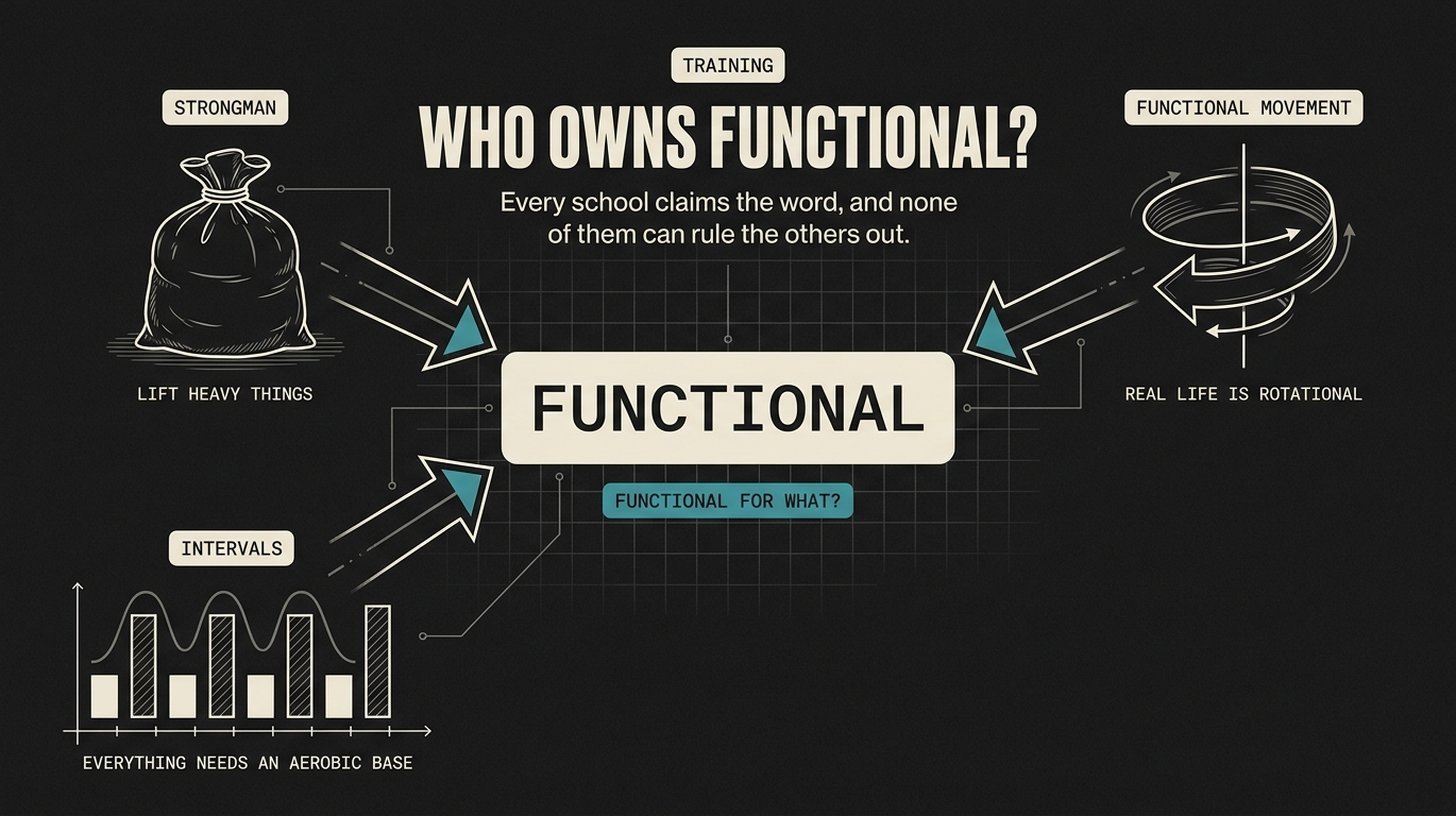
Each of these cases stands up fine on its own, and none of them does anything to rule the others out. The case for the defence is always detailed and confident, and the case against everyone else amounts to flatly going nuh-uh.
A function just means being able to do something, so whether training is functional depends entirely on what you’re trying to do. Rotating hard is functional if you throw punches, or hammers at the Olympics; lifting heavy things off the floor is functional if you move pianos for a living, or fancy competing in strongman; and swinging a mace around your head has a real function if you’re into axes and claymores. All of these are specific, contextual functions, and none of them cancels out any of the others. So if everyone’s training is functional for something, the real question is why every school is so determined to deny the word to everyone else.
Why everyone wants to own functional training
The answer is mostly about what the word does for the person using it. Admitting you train mainly to look better feels vain, and training purely because you enjoy it sounds to a lot of people like training for nothing. Functional fixes both problems at once: now your training is for something, and you never actually have to say what. It’s a purpose-shaped word with the purpose left blank, which is exactly why nobody in those videos could define it: there was never a definition underneath to find.
Its real content is everything it rules out. Functional says your training isn’t vanity and isn’t lifting for the sake of it. For the person buying it the word works as a shield, and for the person selling it the same word works as a weapon, because if their training is the functional kind, then yours, by implication, isn’t.
That also explains why the word has to be owned exclusively. If everything is functional relative to some context, which is where we honestly ended up, then functional describes all training and sells none of it. A shield only protects you if someone else is left standing exposed. So every school claims the word and denies it to the others at the same time, and the contradictions I opened with stop looking like sloppiness and start looking like the business model working as intended.
If the pattern feels familiar, that’s because natural works exactly the same way. You decide where the bounds of natural sit, and they always seem to sit just past whatever it is you happen to do. Is whey protein natural? Is lifting a knurled steel bar in a temperature-controlled room? Under any strict reading, probably neither one is. And yet nobody who opposes a diet or a training method has ever described their own approach as unnatural, just as no school of training has ever described its own method as non-functional. These words only point outwards: you can claim them for yourself forever, and you only ever deny them to somebody else.

So what should your training actually be for?
Whatever you actually want to do, and I mean that as a real answer rather than a shrug. The first thing to settle with any kind of training, before the exercises, the sets or the method, is what you want your body to be able to do. Answer that honestly and functional sorts itself out. If the honest answer is that you want to look better, then the training that makes you look better is functional for you, and you’re allowed to just say so. Someone planning on moving pianos around might find heavy deadlifts are exactly the answer, while a would-be world champion fighter probably won’t. I spent years as Jonathan Haggerty’s strength and conditioning coach, through two world title wins and two title defences, and these days I coach ordinary people, whose honest answers look nothing like his.
The menu is as wide as the word. Strongman work, bodybuilding, kettlebells, maces, intervals and yoga are all functional for something, and none of them is functional for everything. The label can’t make the choice on your behalf, because the function belongs to you, and all you have to do is choose.
So when something sells itself to you as functional training, the question that cuts through it is functional for what? If the answer lines up with something you actually want to do then you’ve found your training, whatever anyone else calls it, and if nobody can give you an answer, you’re looking at marketing.
If you want help deciding what your training should be for, and a programme built around an honest answer, get in touch for a free consultation.