How Much Does a Personal Trainer Cost in London?
If you’ve started pricing up personal trainers in London, you’ve probably noticed the numbers make no sense. A trainer at your local Pure Gym charges £40 a session, an independent coach at a private gym wants £90, and a studio in the City will quote you over £5,000 for a twelve-week package. Nothing on any of their websites explains what the difference is, so you’re left trying to work out what a personal trainer should cost in London, and whether £90 an hour is a rip-off or £40 an hour is a false economy.
You’re doing that research alone, because asking a trainer about money feels awkward. Part of you suspects the expensive end is vanity pricing: nicer website, same squats.
And maybe you’ve been burned already. You bought a block of sessions at a chain gym, got counted at for forty-five minutes a week, saw nothing change, and concluded that personal training is overpriced. After an experience like that, cheap feels like the safe mistake.
I’m a personal trainer in South East London, so read this with that in mind. But I’m going to do something trainers almost never do in these articles: give you the real market numbers, tell you exactly what I charge, and explain what the price differences are made of.
What Does a Personal Trainer Actually Cost in London?
Most London PTs charge somewhere between £40 and £150 a session, and where a trainer sits in that range follows a fairly predictable pattern.
| What you’re buying | Typical London price |
|---|---|
| PT at a budget gym chain | £40 to £65 a session |
| Experienced independent coach | £60 to £90 a session |
| Premium or in-home specialist | £90 to £150+ a session |
| Studio transformation package | £5,000+ for 10 to 12 weeks |
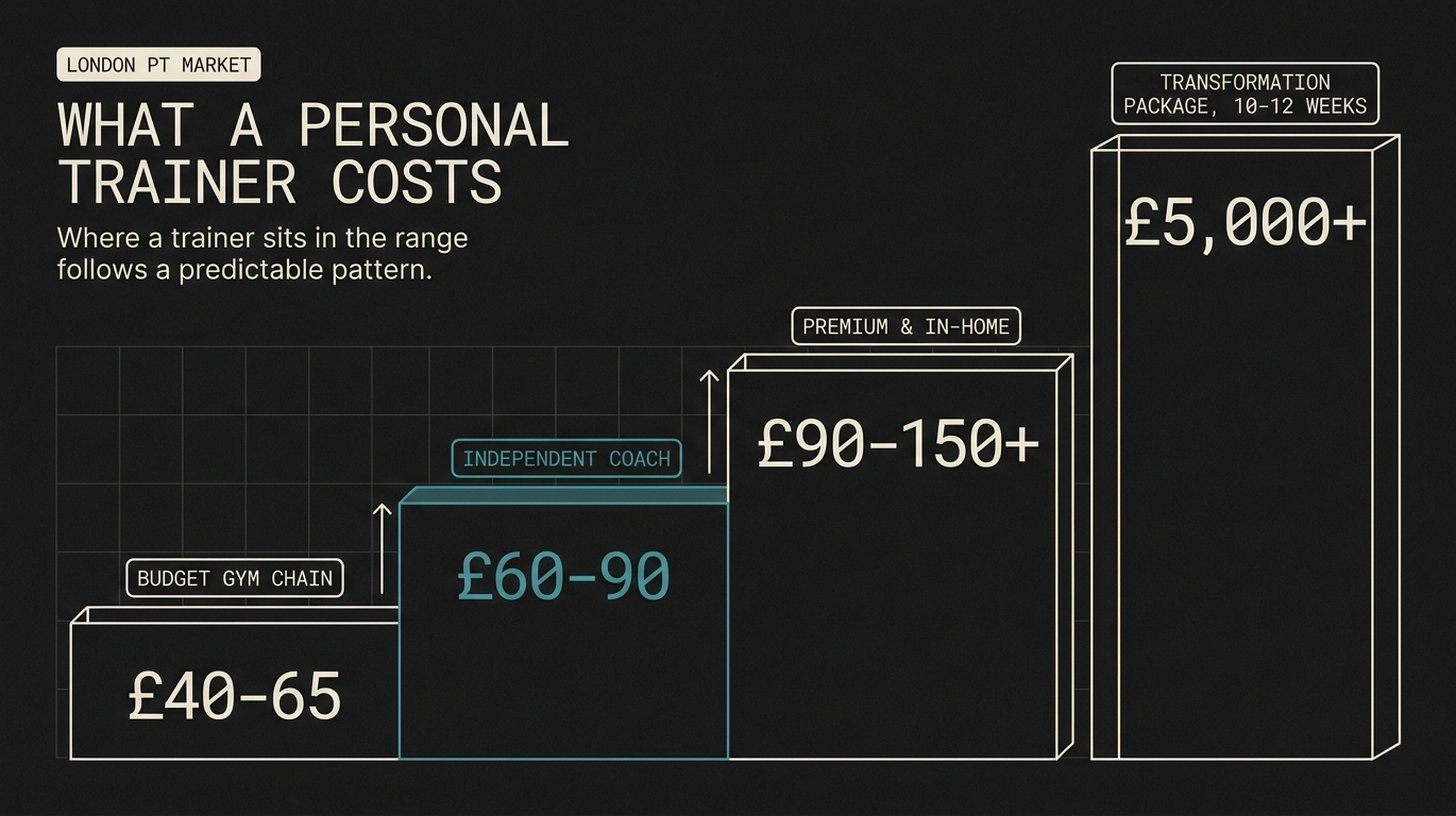
Pure Gym’s own guide puts London sessions at £45 to £65. A 2026 London pricing guide bands the wider market at £40 to £60 for newer gym-based trainers, £60 to £90 for experienced coaches, and £90 to £150 or more for premium and in-home specialists. At the very top, Ultimate Performance’s transformation packages have been listed at £5,400 for twelve weeks of three sessions a week, which works out at roughly £150 a session.
So the range you found is real, and every band in it has customers. I’ve had clients arrive from both ends of that table.
Some came from £40-an-hour Pure Gym PTs, and several came from a £5,400, ten-week Ultimate Performance package. I’ll be honest about what I saw: results varied in both cases, depending on the coach and what the client needed. Price didn’t directly dictate the quality of what they got at either end.
The Cheap End Runs on New Trainers
If price doesn’t guarantee quality, buying cheap looks sensible. And some of your suspicion about the top end is right: part of a premium studio’s rate is branding and postcode, and an expensive address doesn’t make anyone a better coach.
The cheap end’s problem is different: qualifying as a PT takes weeks, the commercial gym floor is brutally competitive, and most people who qualify quit inside their first couple of years, before they’ve built much real coaching experience, which is why cheap personal training is a false economy. The trainers charging £40 an hour are, with respect, mostly at the start of that curve. Their cost of living is the same as mine, so surviving at that rate means taking on huge session volume, which spreads their attention thin across every client they’ve got.
Think about how you’d choose a contractor to renovate your house. You wouldn’t pick on day rate alone; you’d pick on their knowledge, the work they’ve done before, and your confidence that they’ll deliver the renovation you want with the minimum of pain and hassle. You’d expect to pay more for the experienced, reliable one, because what you’re buying is confidence that the job gets done well, and PT pricing works exactly the same way.
You’re Buying the Week, Not the Hour
The market table hides a bigger problem than experience levels: two trainers charging the same rate can be selling completely different products. One is selling an hour of supervised exercise, and the other is selling that hour plus the programme you follow on your own, the nutrition plan built around your real life, the check-in where someone reads your week’s data, and the reviews where the plan gets adjusted. From the gym floor the two look identical, because a squat looks like a squat whoever’s counting the reps.
The difference matters because your results mostly come from the other five or six days of the week. What you eat, whether you train on the days in between, and whether anyone notices your weight has stalled for three weeks: a trainer whose service ends when the session ends leaves all of that to chance. You’re not paying for the hour, you’re paying for what happens between the hours.
Judging a trainer by the hourly rate is a bit like judging an accountant by the length of the meeting. You’re paying for what happens to your tax bill, and the meeting is just where that gets organised.
There’s an incentive problem buried in pricing by the hour too. If the session is the whole product, slow progress is profitable, because when nothing changes you just buy more hours. A trainer who needs you three times a week forever has built himself an income stream out of your slow progress.
To be fair, beginners do benefit from more contact early on while technique gets built, but that contact can be remote, and the need for it should shrink over time rather than grow.
What I Charge, and Why
My session rate starts at £90 and slides down with frequency: £90 for a one-off, £85 a session if we train once a week, £80 a session at twice a week. That’s fairly standard for an experienced PT in London, possibly even towards the lower end, and when my diary gets overbooked I’ve considered putting it up more than once.
That price buys the system around the hour as much as the hour itself. My clients get their programme in an app, a nutrition plan built around how they already eat and live, a weekly check-in where I read their training and weight data, and a proper review every six weeks. Most of them train with me once or twice a week at The Commando Temple in Deptford, and most of their results happen on days I never see them. The service is designed and priced around that, because that’s where results come from.
The false economy runs in both directions here: paying for someone cheaper and not getting the results you wanted, or paying premium money for branding and still not getting them. A cheap trainer you have to hire twice costs more than a good one you only hire once.
Ask Every Trainer the Same Question
Before you compare prices, ask every trainer you’re considering the same question: "what happens between our sessions?" Then compare the answers, not the rates.
A good answer is specific: it tells you what programme you’ll follow on your own, what happens with your eating, and when someone looks at your numbers. A vague answer ("I’m always on WhatsApp if you need anything!") tells you the product is supervision, however friendly the supervisor.
And if the maths says even the mid-band doesn’t fit your budget right now, don’t stretch for it. Fewer in-person sessions with a proper remote layer around them beats more sessions with nothing between them, usually at a lower total cost, and online coaching is cheaper again. If none of it fits, a decent free programme done consistently will take you a long way before you ever need to pay anyone. I’d rather you did that than bought a block of hours from whoever was cheapest.
If you’re in South East London and want a straight answer on whether a personal trainer is worth the cost for your situation, message me for a free consultation and I’ll give you one, including "not yet" if that’s the honest answer.