Your HIIT Class Isn’t Really HIIT
Walk past an Orangetheory or an F45 on a weekday evening and it looks like it’s working. The class is packed, everyone’s drenched, the music’s going, and people leave buzzing. As a fat loss coach in South East London I get asked whether these classes are worth it all the time, usually by someone going four or five times a week who can’t work out why the scale hasn’t moved in three months.
So I’ll be straight about where I stand: I’ve got a real problem with these gyms. You’ll work hard in there, nobody’s disputing the effort. But a hard hour and a well-designed one aren’t the same thing, and what’s on offer is a premium price for a result the format was never built to deliver, sold mostly to people who don’t know enough to spot the difference. The word on the door, HIIT, does a lot of that selling, so it’s worth starting there.
Is Your HIIT Class Actually HIIT?
The honest answer is probably not. High-intensity interval training has a real definition in the research, and it’s savage. The original Tabata protocol, the one the science is named after, is twenty seconds of all-out work then ten seconds of rest, repeated eight times, at roughly 170% of your VO2max. That’s four minutes of effort so hard you couldn’t talk, couldn’t hold the pace much longer, and would want to lie on the floor afterwards.
A 45 or 60 minute class can’t run at that intensity, and it isn’t trying to. You get harder and easier stretches, sure, but strung out over an hour at a level you can actually sustain. That’s a circuit. It’s moderate-to-vigorous training with some hard bits in it, which is a perfectly good thing to do with your time. It just isn’t HIIT in the sense the name implies.
Borrowing the name matters, because it borrows the evidence with it. When you read that "HIIT torches fat" or "HIIT is the most time-efficient training there is," those headlines are describing the real four-minute stuff, not an hour-long circuit with a leaderboard. The class gets credit for research it isn’t really doing.
The Screen Is Selling You Three Things That Aren’t True
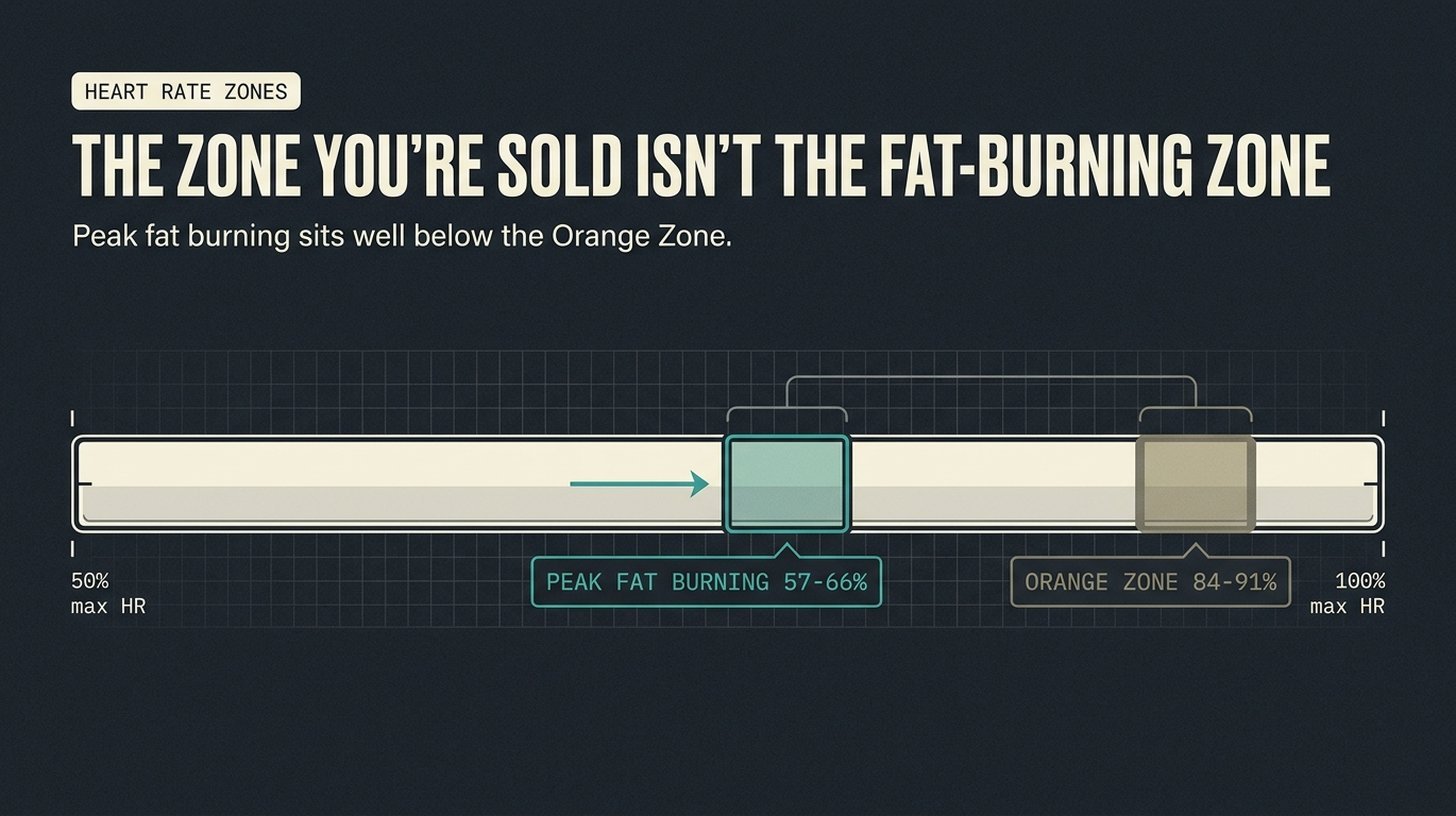
Take Orangetheory’s heart rate zones. The whole model pushes you towards the Orange Zone, 84 to 91% of your maximum heart rate, and rewards you with points for staying there. The marketing wraps this in fat-burning language. Your body actually uses the highest proportion of fat as fuel at around 57 to 66% of peak heart rate, well below that orange band. The "fat-burning zone" idea is shaky to begin with, but even on its own terms, the zone you’re pushed into and scored on isn’t the one the story describes.
Then there’s the number it flashes up at the end, the calorie burn. It looks precise, it’s tied to your heart rate and your account, so it reads like a measurement. It’s an estimate, and not a tight one. Energy-burn figures from wrist and chest wearables are routinely off by 15 to 30% or more. Orangetheory can point to a 2025 study that validated its OTBeat monitor, but that study checked the device’s heart-rate accuracy against a medical ECG, not the calorie figure and not the workout itself. The heart rate can be spot on and the calorie count still be a guess, and it’s a guess you shouldn’t be eating against.
The last piece is the afterburn, the promise that you keep burning calories for a day or more after you leave. There’s a real effect here, called EPOC, where your body uses a bit of extra energy recovering from hard exercise, but it’s small. It usually adds something like 6 to 15% on top of what you burned in the room, which is a rounding error on your day rather than the 36-hour furnace the pitch implies.
When the Calories Match, the Fat Loss Is the Same
The core promise falls apart the moment you account for calories. When researchers compare hard intervals against steady, moderate cardio and match the calories burned, the fat loss comes out the same. A 2024 review pulling all the evidence together found exactly that: interval training has no special fat-loss advantage once you account for the energy used. There’s no metabolic trick hiding in the format. What drives fat loss is the total energy balance across your week, and that’s mostly set by how you eat.
Which is why the calorie screen does real damage. Finish a class, see 650 on the display, and let that number talk you into a bigger dinner or an extra snack, and you can rub out the deficit the workout created and then some. People come to me having trained hard five days a week for months, really putting the effort in, and stalled. The class flashes up 600 calories, they eat a bit more to match it, and the deficit they worked for disappears. Their effort was real, and a calorie count the machine invented was the thing undoing it.
Who These Classes Are Actually For
I’m not going to pretend there’s nothing good here. Proper interval work is excellent for your VO2max, one of the best single markers of overall health, and it helps blood sugar control, which matters if you’re heading towards or managing type 2 diabetes. And a hard class you actually enjoy will beat an optimal plan you dread and quit, every time.
But that carve-out is narrower than the marketing wants you to think. If you go because you love the format and the buzz of the room, you’re getting exactly what you paid for, and I’d never talk you out of it. The trouble is that most people in that room didn’t sign up for the experience. They signed up for the result on the poster, and that’s the one thing the format is worst at giving them.
The Format Was Built for the Studio, Not for You
Once you look at these classes as a business rather than a training programme, the design choices make far more sense. These are premium operations, and the industry aims to pull well over $200 a month out of every member, run for the studio’s own efficiency rather than any individual’s progress. A boutique studio lives or dies on retention, and the numbers there are grim: around half of new members quit within 90 days. The model runs on a steady stream of new sign-ups, enough to cover the roughly half who quit inside three months.
Almost everything you associate with the format is aimed at that problem. The constant variety, a different workout every day so you never get bored, is the single biggest thing that keeps members past the three-month cliff. It also makes real progress almost impossible. You can’t add weight or reps to a workout you’ll never do the same way twice, and that gradual added load over time is what actually builds strength and muscle.
The leaderboards and the points are retention tools dressed up as training tools. Even the tidy 45-to-60-minute slot fits a commuter’s schedule and lets one studio run back-to-back classes all day, which is about filling the room, not about your body adapting.
If you want proof that these are businesses first and gyms second, look at what happened to F45. It grew fast, sold itself as science-backed functional fitness, then lost close to $400 million across 2021 and 2022, watched its share price fall about 99%, and got delisted from the New York Stock Exchange in 2023. It later settled a securities-fraud claim for $10.5 million. The workouts didn’t stop working; the business did, because it ran on selling franchises rather than on getting results for the people inside them. Orangetheory is in better shape but the shape of the story is similar underneath, with nearly a fifth of surveyed studios running at a loss at the studio level by early 2024.
So Are HIIT Classes Worth It?
For most people who signed up to lose fat, honestly no, not at that price. If you love the class for its own sake, stay, and just stop letting the screen decide what you eat. But if you’re handing over a fortune in money and effort for a scale that won’t move, understand that the problem isn’t you and it isn’t how hard you’re working. You were sold a result on a model that was never built to give you one, and most people in that spot eventually give up, decide they’ve failed at fitness, and stop training altogether. That last part is the real cost of all this.
Fat loss is won or lost in the kitchen, with resistance training to hold onto your muscle while you’re in a deficit. For your heart and your cardio fitness, one or two properly hard interval sessions a week will get you there more directly, and far more cheaply, than chasing points in a crowd. None of it needs a premium membership that takes your money every month and your motivation with it.
If you’re in South East London and you want to lose fat and keep it off without guessing your way through it, I can help.