I work with a lot of people whose backs scare them.
Not lifters mostly, not athletes. Regular adults in their thirties and forties who do a job, run a household, pick their kids up, garden at the weekend. People whose backs occasionally hurt, or used to, and who at some point in the last few years got told by a coach or a physio or someone on Instagram that the answer was to never round their back, to brace at all times, to keep everything stiff.
They’ve absorbed this so completely that I can watch them tense up at the suggestion of bending forward without a locked spine. They’ve stopped doing certain exercises on principle, stopped picking things up the way human bodies pick things up, and are living a smaller, more careful life on the advice of people they were right to trust.
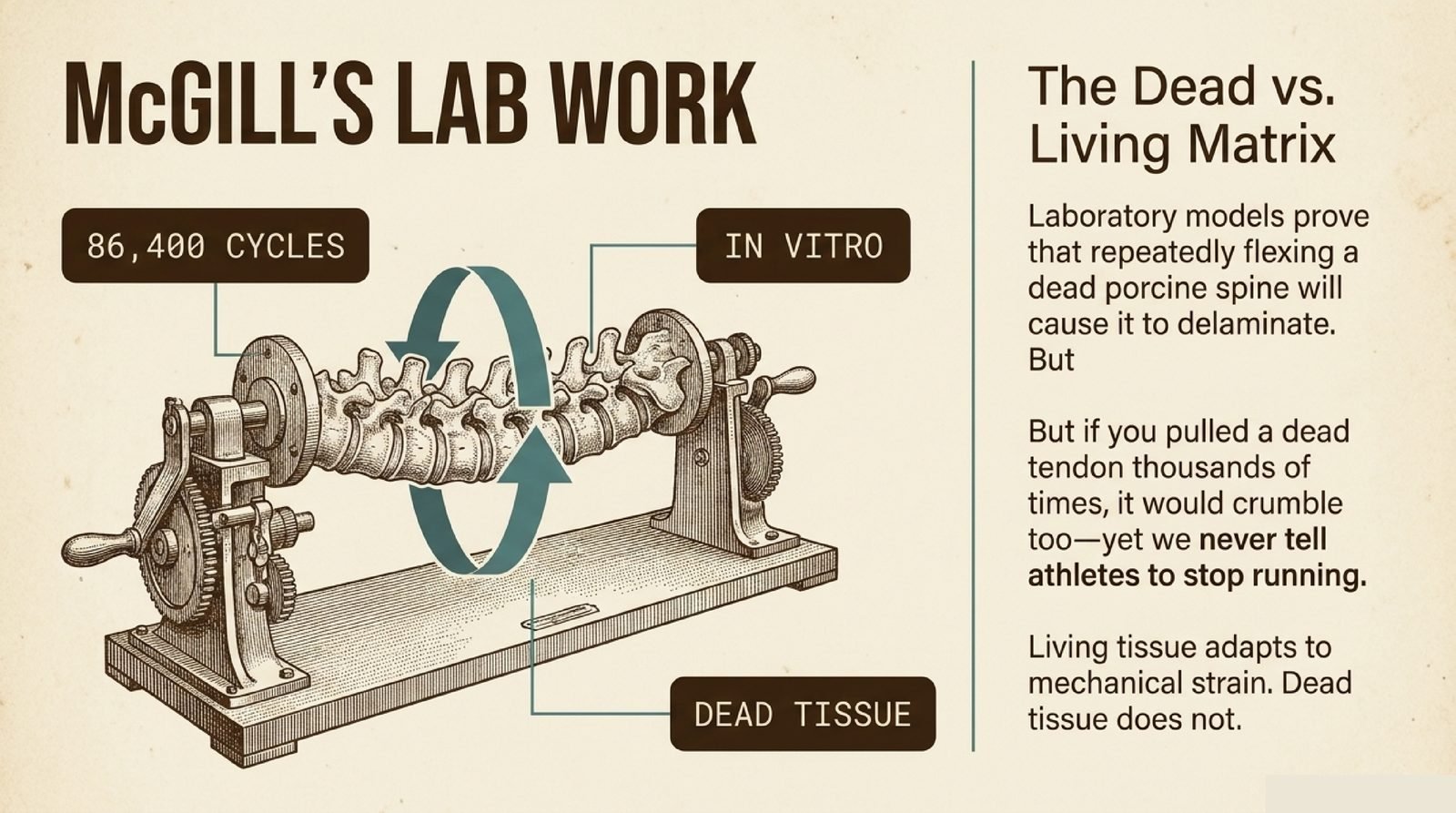
Honestly, most of the advice has good intentions. It’s a partial reading of lab research on dead pig tissue, then turned into a life rule for living human spines.
To answer the title question directly: for a healthy spine, no. Rounding your back under load isn’t inherently dangerous, and the history makes that case more clearly than most modern coaching does. The rest of this article is the case.
How "always neutral spine" became gospel
Modern fitness has been telling people the same thing for about twenty years now: keep your spine neutral, brace your core, never round your back under load. The headline source most of it traces back to is a Canadian spine researcher called Stuart McGill, who spent decades studying how spines fail in the lab. He bent pig spines back and forth tens of thousands of times in machines until they herniated. The footage is shocking, and the conclusion is reasonable given what he was looking at: repeated bending under heavy compression can damage spinal discs.
The problem is what’s happened since. McGill’s finding has been amplified, packaged, and sold by people who never read the original work. To be fair, most of them aren’t being deliberately misleading. The "always neutral spine" advice gets repeated by Instagram form-correctors, gym coaches, and physios trained in the last fifteen years, almost none of whom have actually opened McGill’s writing. If they had, they’d find what he actually says is much more measured. McGill himself has said openly that bending your spine when nothing hurts is fine, and that limiting how much you bend only matters for people who are currently injured. The mass-market version flattened all of that into a forever rule, and that’s the version most lifters and most patients have absorbed.
The strongmen built backs that should not have been possible
Around the turn of the twentieth century, before squat racks existed, a German lifter called Henry Steinborn worked out how to back-squat over 500 pounds, from the floor with no squat rack. He stood the loaded barbell up vertically on one end, dropped into a deep squat next to it, and tipped the bar laterally onto his back. To unrack the weight he had to bend his spine sideways under several hundred pounds of iron. He used this method his entire career and held world-class squat numbers for years.
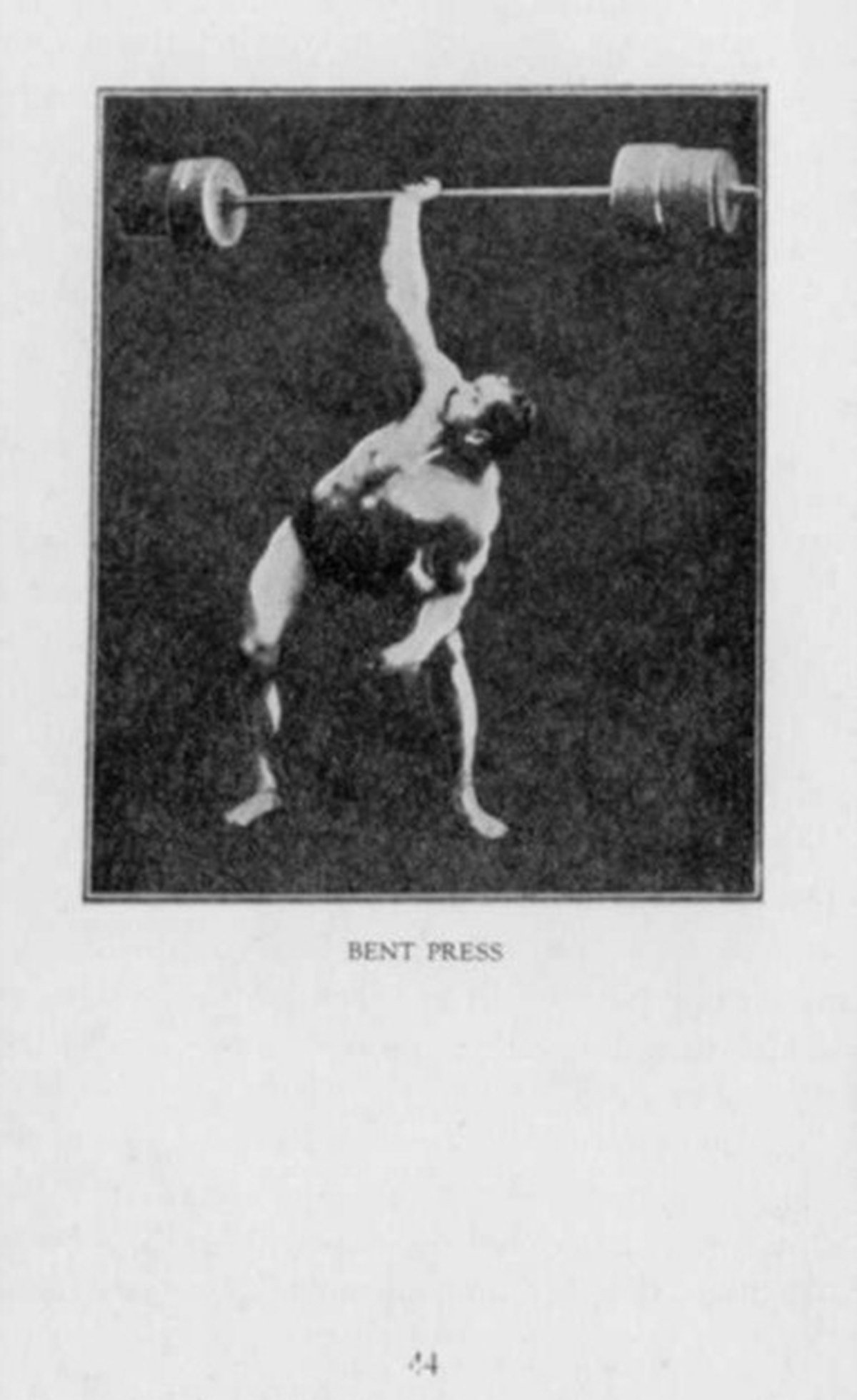
Around the same time, a German lifter called Arthur Saxon, who made his name touring Britain’s music halls, held the world record for the bent press at 370 pounds, with an unofficial gym best of 386. The bent press is a lift you don’t see in gyms any more, for obvious reasons. You stand a barbell up on one shoulder, then bend your torso sideways and forward until your arm is straight up overhead while you’re still leaning under the bar. Then you stand up. Saxon also set the record for the "two hands anyhow" at 448 pounds, which involved bent-pressing 336 pounds overhead with one arm, then squatting down with the bar still locked out, cleaning a 112-pound kettlebell from the floor with his free hand, and pressing that overhead too.
Georg Hackenschmidt, the Russian-German wrestler who wrote one of the first widely-read training books in 1908, was still bench-pressing 150 pounds and running seven miles at age 89, in a routine that included weighted sit-ups, stiff-leg deadlifts, overhead good mornings with completely straight legs, and heavy wrestler’s bridges where he pressed a barbell while his head and heels were the only parts of him touching the floor.
By modern coaching standards, these lifts should have herniated these men’s discs on contact, and yet none of them broke from lifting. Saxon died at 43 of pneumonia after developing tuberculosis, not from his back; Hackenschmidt stayed strong well into his eighties and trained until shortly before his death; and most of the other Bronze Era names lived long enough that nobody can write them off as a statistical fluke.
You can call this selection bias if you like. We mostly remember the strongmen who succeeded, and yes, some did get hurt. But the survivors lived long enough and stayed strong enough that the "any loaded bending will destroy you" claim has to answer for it. If progressive loaded flexion were universally dangerous, it wouldn’t be possible to do it at all, never mind to a world-record level. The strongmen are the extreme end of a spectrum that exists in everyone to a degree. Whether your spine has any business bending at all is a different question to whether you should be doing Saxon’s bent press, and the answer to the first one is plainly yes.
Yoga has been doing this for thousands of years
If the strongmen are too foreign to take seriously, consider yoga. The yoga tradition has treated deliberate spine movement as the cornerstone of practice for thousands of years, across the whole family of poses people actually do every week: forward folds, backbends, twists, side bends, and the segment-by-segment work of cobra, locust, wheel, camel, rabbit, and child’s pose. These poses are the architecture of nearly every yoga class run in the world.
If bending the spine under load and moving it through its full range were inherently dangerous, the research on yoga should look like a disaster. Millions of people moving their spines in every direction every week, all going wrong at scale. The research doesn’t show anything close to that.
The 2022 Cochrane review on yoga for chronic low back pain (Cochrane reviews are the most rigorous kind of summary medicine produces) found that yoga produces real, if small, improvements in back-related pain and function. A 2022 review of multiple studies in the journal Pain found short-term improvements in pain intensity, physical functioning, and mental health that held long-term.
Yoga isn’t a miracle, and it does carry a small risk of flare-ups (mostly temporary back pain that settles), but at no greater rate than any other form of exercise. The tradition that bends the spine most aggressively, in front of more people than anything else in human history, actually helps the exact condition the modern fear is built around.
Look, this is a pattern I see across fitness and nutrition all the time. When two opposite approaches both produce results, the thing they disagree about isn’t usually the source of the problem. People lose weight on diets that are high-carb low-fat, and on diets that are high-fat low-carb. So the breakdown of what you eat isn’t where the answer lives. Same here. Both the strict-neutral camp and the deliberate-bending camp have groups of people getting good results, which tells you the position itself isn’t where the answer lives. The answer is in how carefully you build up to it.
Finding Neutral
For a long time, I believed I was bracing into a neutral spine. I’d set up for a deadlift, lock everything down, feel solid, and assume my position was perfect. What I was actually doing was extending my lower back into a slight over-arch and calling it neutral because it felt firm. I had no body awareness of what true neutral was, because I had no experience of either side of it. The position I called "braced" was just the position my nervous system defaulted to when I tried to be tight.
What changed it was deliberate spine-bending work under weight. I started adding exercises like Jefferson curls with a barbell, weighted seated good mornings, and back-arched crunches on the glute-ham developer. The Jefferson curls slowly bend the spine forward bit by bit and back up; the GHD crunches deliberately load the spine into extension. I’d come across the gymnastics tradition (specifically the work of Christopher Sommer, a former US national team coach) and decided to take the historical evidence seriously, and that’s what got me trying these in the first place.
Over months of doing this, my strength and flexibility improved as you’d expect. The unexpected result was that I could finally find a true neutral spine. The position became something I could feel, recognise, and return to on demand. I could tell the difference between actually neutral and the slight over-arch I’d been calling neutral, and I could feel the moment when I started rounding instead of holding. The body awareness arrived as a side effect of having explored both sides of the position. You can’t find the middle if you’ve never been to either edge.
Honestly, this pattern is everywhere in my coaching. Clients come in with forward shoulders, an over-arched lower back, a forward-tilted pelvis, all the usual posture problems. The standard analysis is strength imbalance: weak muscles at the front of the hip, undertrained hamstrings, tight chest. Those imbalances are often real.
But underneath the strength gap is a body-awareness gap nobody talks about. The client has never been taught what the different positions feel like. They can’t feel a flexed spine because they’ve never deliberately experienced one under control, and they can’t feel an extended one for the same reason. So when you tell them to "find neutral", you’re giving them an instruction in a language they don’t speak. The instruction starts working once you’ve taught them the words for it.
The advice "never bend your spine" produces lifters and adults who have no idea what their spine is doing, and then the orthodoxy calls that safety.
What to Do If Rounding Your Back Scares You
If you’ve absorbed the fear of bending and you want to work back into it, you don’t start with heavy Jefferson curls or anything resembling a strongman lift. The first level is so low it doesn’t feel like training at all.
The progression looks like this:
- Stretching: gentle yoga poses that round the spine, with no weight at all.
- Bodyweight ab work: real crunches that actually let the spine bend.
- Light loaded bending: adding a kilo or two to weighted bending exercises, very gradually.
Here’s what each one looks like in practice.
The lowest level is stretching, specifically the yoga poses that work toward a rounded spine: rabbit pose, child’s pose with active rounding, and cat-cow done slowly with attention to your spine bending bit by bit through each section. These cost you nothing, they ask nothing of your strength, and they reintroduce the feeling of a bent spine without any weight on you at all.
After that, bodyweight ab work that lets the spine actually round. Real crunches, not the modern variations designed to keep your spine still throughout. The rectus abdominis, your six-pack muscle, is built to bend the spine. Bending is the muscle’s job, and an ab exercise that prevents bending is doing the opposite of what the muscle’s there for. Curl up properly, let your spine bend bit by bit through the movement, and pay attention to what’s happening. Keep it light and controlled, and do it often enough to build a feeling for the motion.
Once those feel normal, you can start adding light weight to bending exercises. An empty barbell is about 20 kilos, which is too heavy for most beginners. Christopher Sommer, the gymnastics coach whose Jefferson curl programming is the most carefully documented in the world, recommends starting at one or two kilos, single digit on purpose. The connective tissues in your spine (ligaments and the tough fibrous parts) adapt on a slower clock than muscle does: it takes about 200 to 210 days for them to fully rebuild, where muscle does it in about 90. The strongmen knew this without anyone having to tell them, because they had to test their bodies under load in carnivals and shows. Progression in this work is measured in months and years, not weeks.
If you have an active disc injury, see a clinician first. There’s a place for restricted movement during the acute phase. But the endpoint should always be a gradual return to varied movement, not a permanent box you live inside. A clinician who tells you to brace for the rest of your days is missing the same thing the coaches are missing.
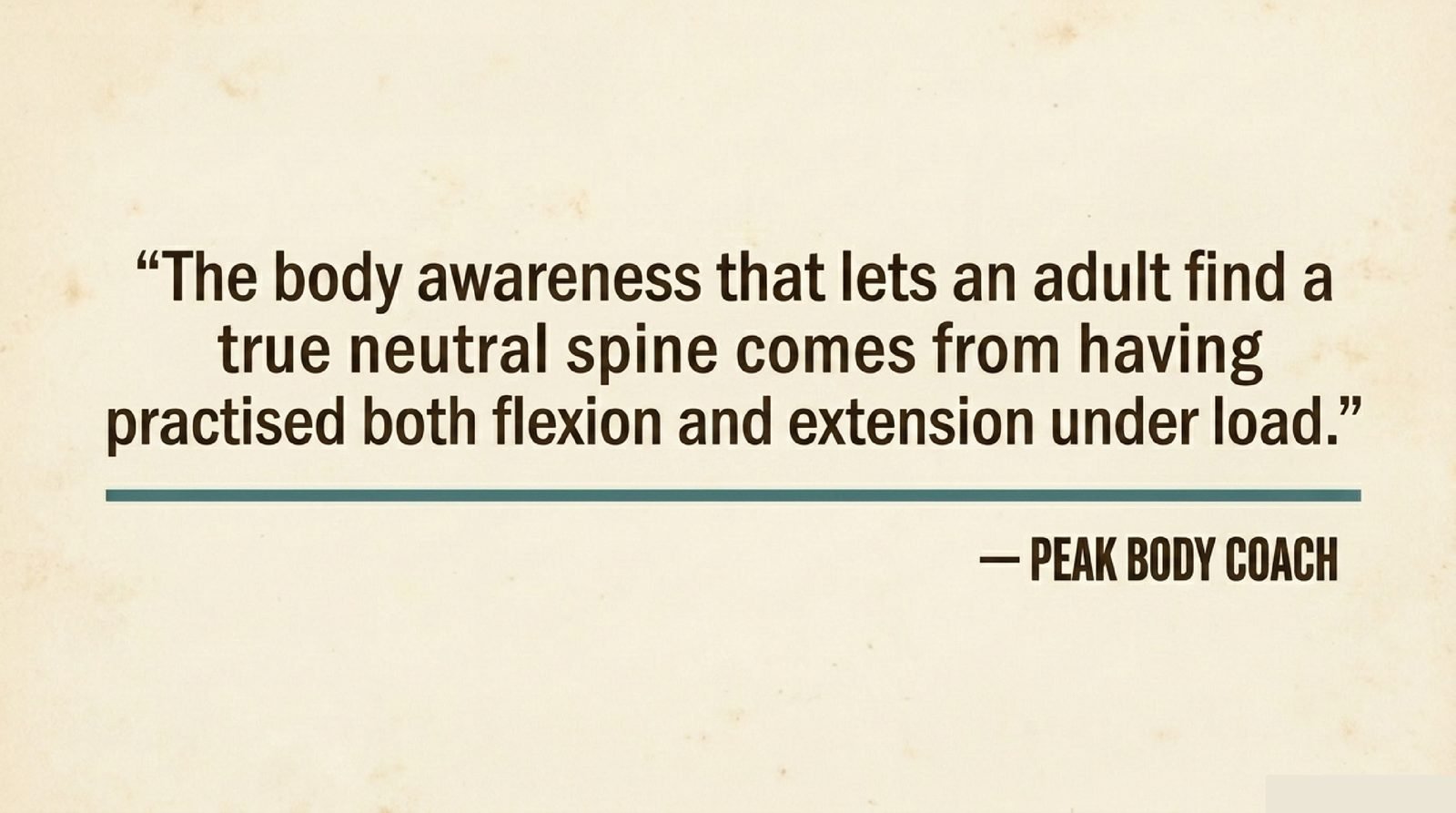
The strongest backs in lifting history were built by people who deliberately loaded spinal flexion in ways modern coaching forbids. The yoga tradition that bends the spine most aggressively, across the widest population in human history, actually helps the very condition the modern fear is built around. The body awareness that lets an adult find a true neutral spine comes from having practised both flexion and extension under load. And the desk worker, the family man with a toddler in his arms, the regular adult who’s been told to never round their back has been sold a version of safety that has made them weaker, more fragile, and more disconnected from their own body than they were before anyone started warning them.
If you’ve been carrying back fear and want help working back into varied, loaded movement at a pace that suits you, I work one-to-one with people in southeast London and online.