The most common supplements I get asked about, I can see the logic in: vitamin D through a UK winter, creatine for anyone training seriously, fish oil if oily fish isn’t a regular part of your diet, magnesium if sleep is a problem. These have genuine evidence behind them and a clear population who benefits.
Probiotic supplements are a different case. The mechanism sounds intuitively right, bacteria in a capsule supporting the bacteria in your gut. The gut health conversation has been everywhere for a decade, and the products look scientific enough to feel credible, with strain names, CFU counts, clinical-looking packaging, and refrigeration requirements. I get asked about them all the time, and my answer’s always the same: I don’t generally recommend them, because the evidence for whether probiotic supplements actually work for healthy adults is weaker than the industry would prefer.
Some probiotic strains do have genuine randomised trial evidence, for specific conditions and doses. When a GP recommends one alongside a course of antibiotics, there’s real clinical reasoning behind that. What the supplement industry did was take that specific clinical picture and strip everything specific out of it.
Do Probiotic Supplements Work for Healthy Adults?
For healthy adults without a diagnosed gut condition, the research consistently says no. Twenty-two randomised controlled trials found no meaningful effect on microbiome diversity. The mechanism behind that result is more interesting than the headline.
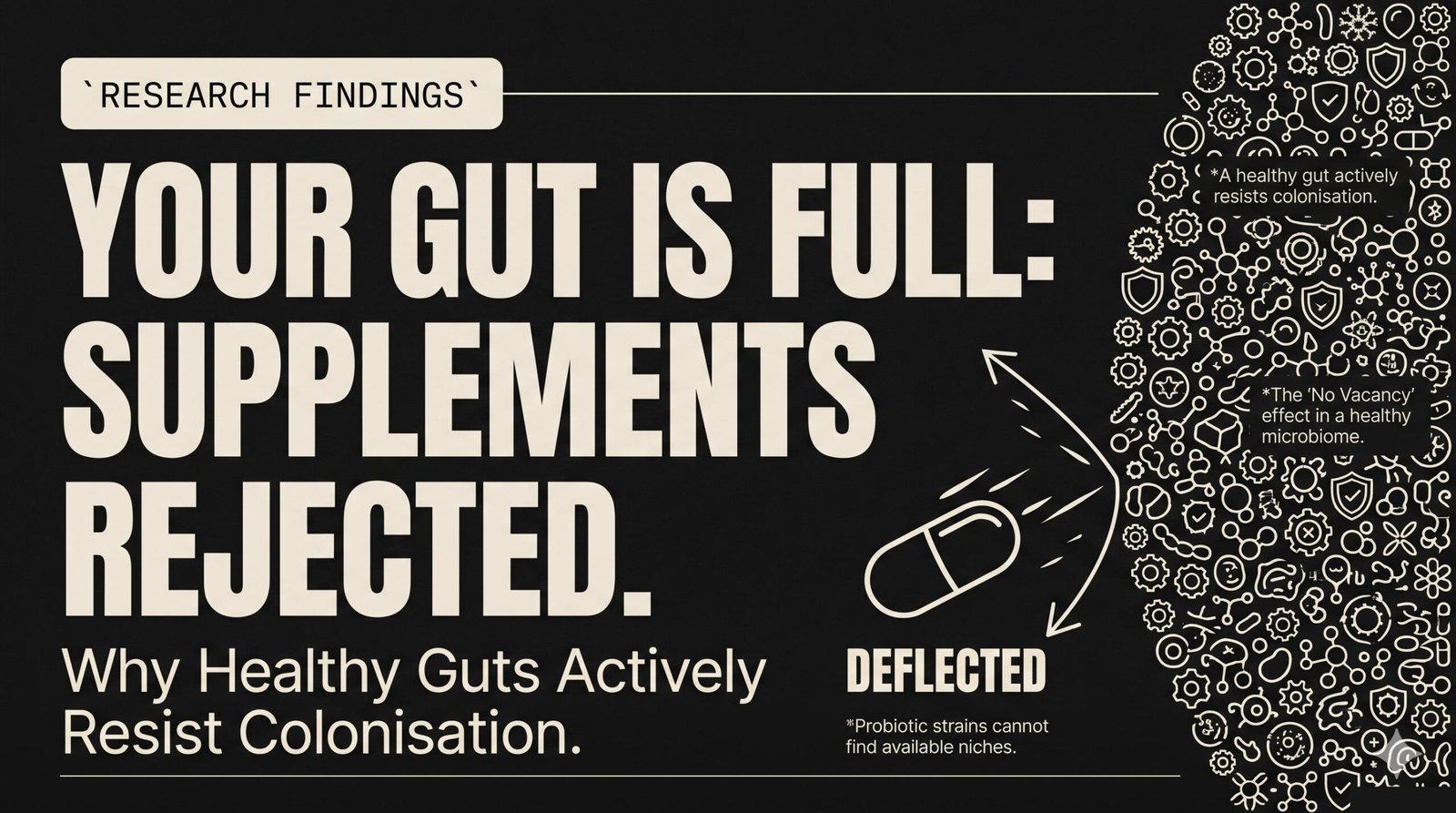
Your Gut Doesn’t Have Vacancies
In 2018, researchers at the Weizmann Institute studied probiotic supplementation in healthy adults after a course of antibiotics. A healthy gut, they found, actively resists colonisation by supplemental strains, and people who skipped the probiotic returned to their normal microbiome baseline faster than those who took one. A healthy gut doesn’t have room for new residents.
A 2025 meta-analysis in BMC Medicine pooled 22 randomised controlled trials on probiotic supplementation in healthy adults. The researchers measured microbiome diversity in three standard ways: how varied the bacterial species were, how differently participants’ microbiomes compared to one another, and overall species richness. To be clear: across all three, not one of the twenty-two trials showed a meaningful improvement in microbiome diversity for healthy adults without a diagnosed condition.
The Probiotic Label Tells You Nothing Useful
Most probiotic supplement labels display a CFU count: “10 billion CFU,” “50 billion CFU.” CFU stands for colony-forming units, a measure of how many live organisms are in the capsule. It sounds precise enough to mean something.
“Probiotic” isn’t a substance, though. It’s a category covering thousands of different organisms with completely different mechanisms, evidence bases, and target conditions. Knowing the CFU count without knowing the strain is like knowing the milligram dose of a tablet without knowing which drug it is. Some therapeutic strains do require billions of organisms, at doses confirmed in specific trials. Without the strain name and a condition the strain has been tested for, the number on the label is decoration.
Rather than a single strain with evidence for a specific condition, most blends give you ten or fifteen at a fraction of any relevant trial dose, sold under the label of “comprehensive gut support.”
If you can’t name the strain, you don’t know what you’re taking. And if you don’t have a diagnosed condition the strain is indicated for, the dose doesn’t matter.
Fermented Food Outperforms the Supplement
In 2021, Christopher Sonnenburg’s research group at Stanford ran a randomised trial comparing a high-fermented-food diet against a high-fibre diet over ten weeks. Participants eating fermented food, six daily servings of yoghurt, kefir, kimchi, sauerkraut, or kombucha, showed a significant increase in microbiome diversity and reductions in 19 inflammatory markers, results that the probiotic supplement trials above had consistently failed to produce in healthy adults.
One serving of fermented food a day is what the evidence supports, yoghurt at breakfast or kimchi alongside dinner, kept up consistently over weeks. It’s cheaper per serving than most probiotic supplements.
Probiotics Do Work, After Antibiotics and Diagnosed IBS
If you’ve just finished a course of antibiotics: ask your pharmacist specifically for S. boulardii, which has solid evidence for preventing antibiotic-associated diarrhoea. Ask for it by name, not for whatever’s on offer at the chemist.
If you have diagnosed IBS: ask your GP or dietitian specifically about L. plantarum 299V for symptom reduction. The evidence is for that strain at the doses used in trials, not a multi-strain blend.
Outside these situations, the case for a daily probiotic in someone with no diagnosed gut condition doesn’t hold up.
The probiotic supplement industry took a medical tool that works for specific conditions at specific doses and stripped the specificity out of it. They sell healthy adults the impression of gut health management for a problem that, in most cases, doesn’t exist. If you noticed an improvement after starting a probiotic, that improvement is probably real, but a change in what you were eating around the same time, or simply paying closer attention to your gut once you’ve started monitoring it, are more plausible explanations than the supplement. A daily serving of yoghurt is cheaper and better evidenced, and if kombucha’s your thing, drink it because you enjoy it rather than because the evidence on whether probiotics work gives you any other reason to.
If you’re in South East London looking for straightforward, evidence-based nutrition coaching, get in touch below for a free consultation.