For about eighteen months after my ankle surgery, calf raises came last in every session. That’s the conventional wisdom on exercise order: Big compound movements at the start, and the small isolations like calf raises at the end. The advice applies whether you’re chasing strength or muscle growth.
At some point I moved them to the start as an experiment. Same exercises, roughly the same total work, different position in the session. Within a few weeks I was doing more reps at higher weights than I’d managed in the previous year and a half. Everything about how sessions should be structured said this was exactly right: the muscle you most want to develop, trained first, when you’re freshest. That’s the logic most training programmes are built around.
But my calves looked exactly the same.
It’s a story about which goal that logic is actually built for, and why most coaching advice never specifies the difference.
The Priority Rule Is Built for Strength, Not Size
The rule most of us have absorbed goes something like this: big compound exercises before the smaller isolation work, large muscle groups before small ones, the muscles you care most about trained first. It appears in the ACSM guidelines, the NSCA frameworks, and in the programmes of most evidence-based coaches. It feels intuitively right. Hard things first, when you have the most to give.
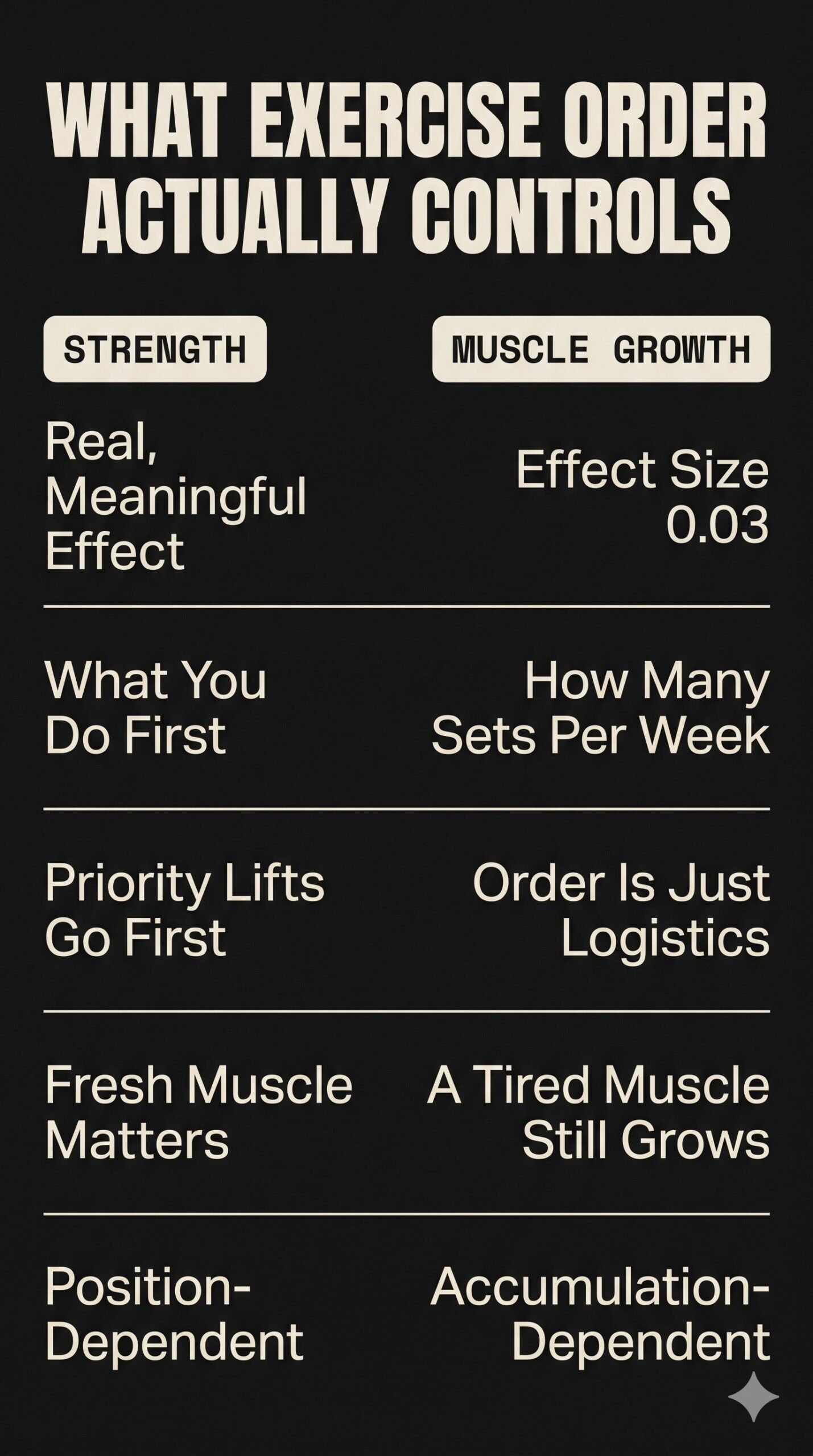
For strength, that intuition holds up. Whichever exercise you do first in a session tends to show the largest strength gains over time. A 2021 study that pooled results from multiple trials found this pattern consistently across different exercises and types of lifters: the exercises you do earliest in a session produce the biggest strength improvements. Nunes et al. 2021, European Journal of Sport Science If you want to get stronger at the bench press, do it first. If squatting strength is the priority, squat first. The nervous system is freshest, technique is sharpest, and you’ll make your biggest strength gains in whatever comes first.
The problem is that most people in the gym are primarily chasing muscle growth, and the priority rule doesn’t specify which outcome it’s built for.
Why Doesn’t Exercise Order Affect Muscle Growth?
training volume for muscle growth
When researchers look at what exercise order does to muscle growth specifically, they find almost nothing. The same 2021 study measured the actual difference in muscle growth across different exercise orders and found an effect size — the statistical measure of how big the difference is — of 0.03. Small effects in exercise research typically start around 0.2. At 0.03, that’s not a small effect on muscle growth. It’s no effect. Whether you start with the big compound lifts or the smaller exercises, whether your chest comes first or third in the session, the results for muscle growth are equivalent when you match the total number of sets. A 2022 umbrella review confirmed the same finding independently. Bernárdez-Vázquez et al. 2022, Frontiers in Sports and Active Living
Muscle growth happens in response to load — specifically, load heavy enough to be challenging, applied consistently over the week. A tired muscle still gets that signal and still responds. Strength responds to what comes first in the session. Muscle growth responds to what accumulates across the week.
Research on sessions that combine lifting and cardio makes the same point clearly. Doing the lifting before the cardio produces meaningfully better lower-body strength, around a 7% advantage. Eddens et al. 2017, Sports Medicine The muscle growth difference between the two orders? About 1%, and not statistically significant. Same session, same subjects, same total work, and the two outcomes respond to exercise order in completely different ways.
Because of a condition affecting one side of my chest, I don’t feel my pec particularly well in the bench press; my triceps tend to take over. I’ve experimented with pre-fatiguing my chest with isolation work before pressing, to get some activation before the triceps run the show. The exercise feels noticeably different: more chest involvement, a better connection to the muscle. I genuinely can’t say with confidence whether it produced meaningfully better muscle growth than pressing first would have done. The research would predict it makes little difference.
The most common pushback I hear is: “I prioritised my lagging body part by training it first and it grew. The order made the difference.”
It’s a fair observation. What usually happened, though, is that moving something to the start of a session meant you stopped cutting it short or skipping it when time ran out. You probably did more total sets per week than you had been. The order change usually meant doing more total work, and that’s the thing with actual evidence behind it. When studies match the total number of sets across different exercise orders, the muscle growth outcomes are the same. What changed was probably how seriously you were taking the muscle, not the signal it received per set.
Audit Your Weekly Sets, Not Your Exercise Order
training volume targets by muscle group
If your goal is primarily muscle growth, the number worth auditing is how many sets per muscle group you’re accumulating each week. Ten or more sets per week per muscle group is the minimum the research supports for meaningful muscle growth, with twenty sets as roughly the upper practical range before returns start to diminish. That’s the number with real evidence behind it. The sequence those sets fall into is mostly logistics.
There are still perfectly good reasons to put the big compound exercises first. You might not want to face a heavy squat when you’re already forty minutes in. Your warm-up probably flows better in that order. For clients who want both strength and size, compounds first makes sense on multiple grounds, and I programme it that way routinely. But it’s a practical default, not a requirement for muscle growth, and knowing the difference matters.
I had a client whose programme had squats as the first exercise, which was correct by every conventional principle. The squat rack was always busy when he arrived, so he’d stand around for ten or fifteen minutes at the start of every session instead of getting on with everything else. The principle had turned into a practical problem: he was losing a chunk of every session waiting for a rack he didn’t need to wait for. All he needed to do was start somewhere else and come back. But the rule made that feel wrong. For his actual goal, it wouldn’t have made a scrap of difference either way.
The sequencing rules in most programmes are real. For building muscle specifically, they’re also mostly convention. Knowing which is which gives you considerably more flexibility than most training plans imply.
If you’re training for muscle growth and want to understand what’s worth your actual attention, contact me here for a free consultation.