I give every new client a specific protein target. Not because I’ve calculated some precise optimal dose for their body, but because “somewhere between 1.6 and 2.2 grams per kilogram” isn’t something anyone can build a meal plan around. Most people need a specific number to aim for, and that’s fine.
The specific number is a starting point rather than a prescription, but that’s not how the industry frames it. A range is harder to put on a template, and a precise number looks authoritative, so coaches give specific numbers. People treat them as facts, spend mental energy hitting them to the gram, and people get lost in what is basically just numerical nit-picking.
The 1g Per Pound Rule Isn’t Entirely Wrong
For decades, the standard gym recommendation was one gram of protein per pound of bodyweight. It became so embedded in training culture that it still appears in fitness content as established fact.
The problem is 1g/lb figure puts most people well above what research shows is needed for muscle growth, sometimes by 50% or more. For an 80kg person, that’s 176g of protein per day when around 128g would give roughly the same result.
What 1g/lb gets right is that it lands people in or above the effective range. If you’re consistently hitting 176g, you’re covered. The figure isn’t harmful unless it makes protein feel impossible to hit, at which point people give up rather than adjust. That’s the only real cost: not that the number is inaccurate, but that its inaccuracy sometimes makes the whole project feel unachievable.
The Evidence-Based Correction Made the Same Mistake
A 2018 meta-analysis by Morton et al. showed 1.6g/kg as enough for muscle growth in most people under most conditions. For our 80kg person, that’s 128g, not 176g. That correction is accurate.
The problem is that coaches and influencers just framed this in the same way as before: here’s your number, here’s the optimal target, hit this. They replaced one precise number with a slightly more accurate precise number, when the problem was never which number to use, but the assumption that precision was the point at all.
1.6 and 2.2 Are Doing Different Jobs
The research supports an effective range of roughly 1.6-2.2g/kg. Anywhere inside that range, with consistent training, you’ll get roughly the same results. The difference between sitting at the bottom and the top barely registers compared to all the other things that affect muscle growth.
The two ends are doing different jobs. 1.6g/kg is the lowest amount the research backs, the floor. 2.2g/kg is more of a coaching number that works as a buffer: if you aim for 176g and land at 130g on a hard day, you’re still fine; if you aim for 128g and land at 100g, you’re consistently undershooting. The reason to use the higher number isn’t that it’s more accurate biologically, but that it gives you room for the inevitable misses.
Protein quality plays into this too. If most of your protein comes from high-quality sources (meat, fish, eggs, dairy), 1.6g/kg covers you. If your diet is more varied or plant-heavy, a higher target gives you some breathing room without having to get into the finer nutritional details.
The Right Target Is the One You’ll Hit
My own intake usually sits somewhere between 130 and 155g, depending on the week. Some days I’m below that and I don’t stress about it. Quite often I’m over it, not because I’ve calculated anything, but because I’ve built habits around protein-rich foods and reach for them without much thought. What matters is the pattern over time, not hitting a number to the gram on any given day.
When I give clients a specific target at the start, it works like training wheels. When you haven’t paid attention to protein before, having a target gives you something to compare against: you look at what you’re eating, see where protein is low, and adjust. Over time, as better habits bed in, the number matters less. You end up eating roughly the right amount without having to think about it much. Eventually, the target becomes something you check in on occasionally rather than obsess over every day.
Sleep works the same way: eight hours is the recommendation, but 7-9 all give you good outcomes. Obsessing about hitting exactly eight tends to make your sleep worse rather than better.
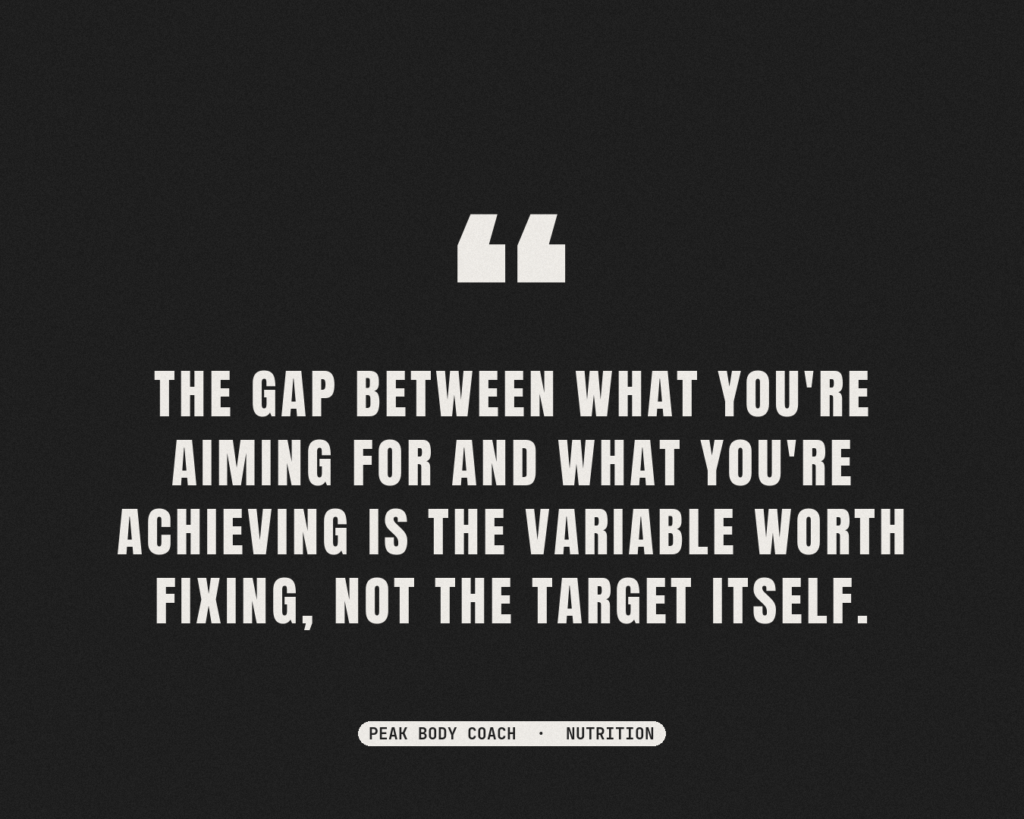
If you’re consistently hitting your current target, the number is working, so stay there. If you’re consistently falling short of 2.2g/kg, try dropping to 1.6g/kg and actually hitting it. The gap between what you’re aiming for and what you’re achieving is the variable worth fixing, not the target itself.
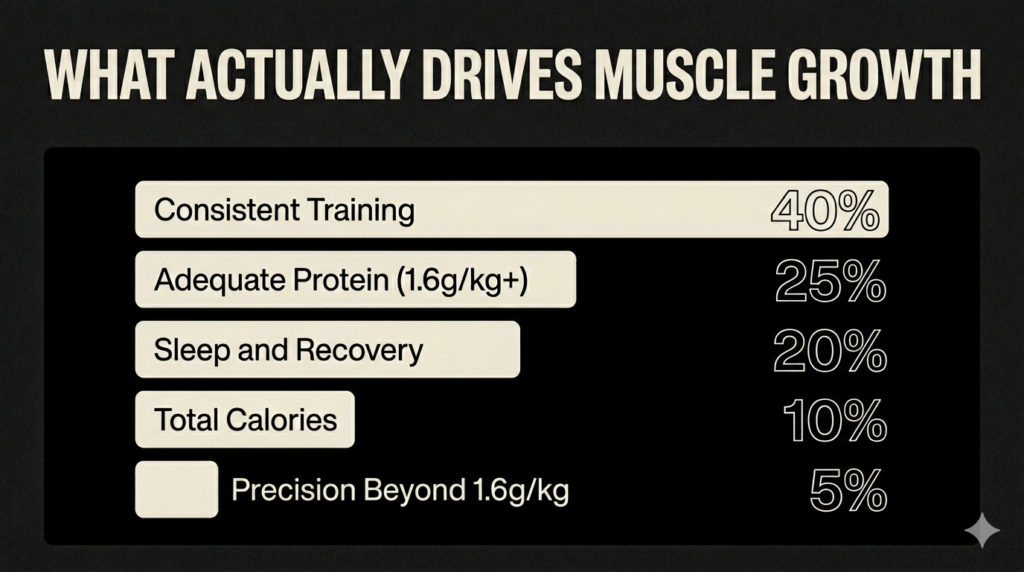
If you’re still agonising over 160g versus 220g, the things that actually drive muscle growth probably haven’t been sorted: sleep, total calories, training quality. Getting lost in the protein maths is usually a sign your energy is going elsewhere.
If you’re a recreational lifter who wants practical nutrition advice without the obsessive tracking, get in touch below for a free consultation.