New clients come to me with the same story all the time. They decided they were ready to change, spent a couple of weeks reading everything they could about it, bought the supplements, overhauled the kitchen, and by week four they’d stopped going.
All of those things are admirable and useful. There’s nothing wrong with any of them. The problem is the order they did them in.
They tried to optimise before they’d built anything to optimise.
The Wrong Order of Operations
Think about anyone you know who’s genuinely good at something. Maybe they’re strong, lean, a brilliant cook, an expert in their field. Did they get there by reading all the right things first and then executing perfectly from day one?
Obviously not. They got there by doing the thing repeatedly, over a long enough period of time, until they figured out what works. The knowledge and the refinement came from doing the repetitions consistently, not before them.
This is true in fitness as much as anywhere else. Whether you’re trying to lose weight, build muscle, get stronger, or improve flexibility, the mechanism is the same: volume over time does the work. Not volume over a few weeks. Volume over months and years.
The problem is we already know this in the abstract, we’ve heard it a million times. “Consistency is key” is probably the most repeated phrase in fitness. But knowing it and actually internalising it well enough to behave differently are two separate things, and most people haven’t made that leap.
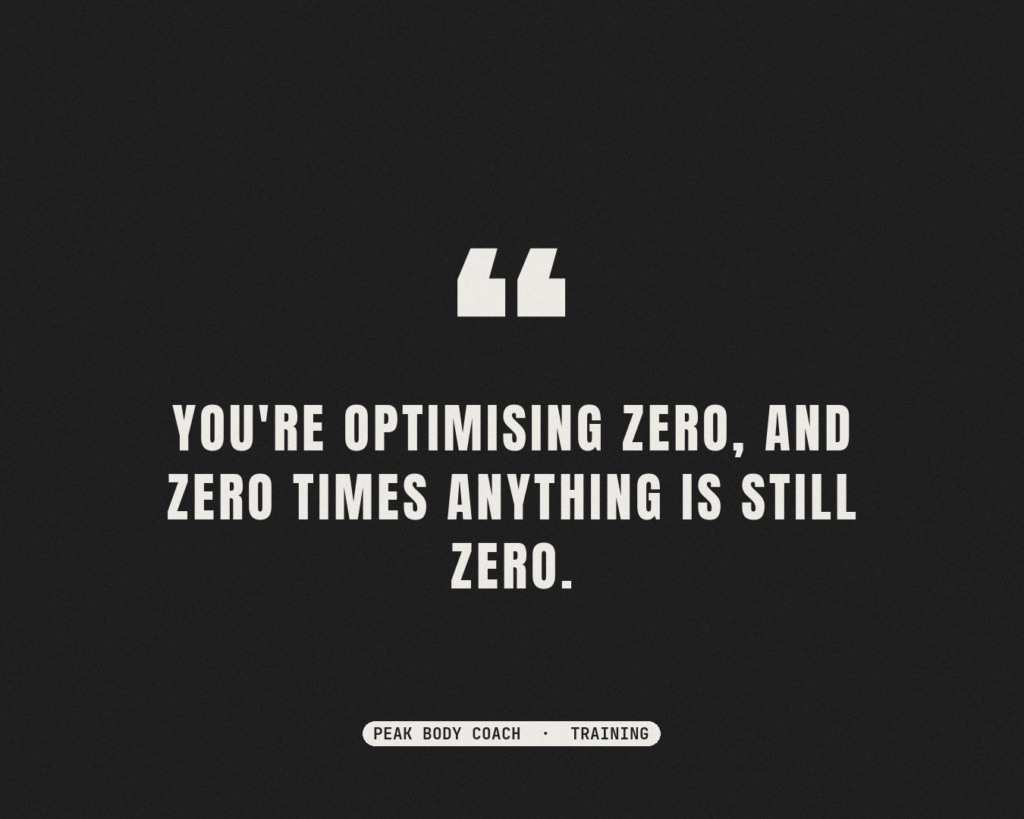
So they research first. They read the books, watch the content, buy the equipment. They’re trying to find the optimal approach before committing to anything. That sounds totally reasonable. But it tends not to work that way in real life, because without a base of consistent practice there’s nothing for the optimisation to improve. You’re optimising zero, and zero times anything is still zero.
The Volume Has to Come First
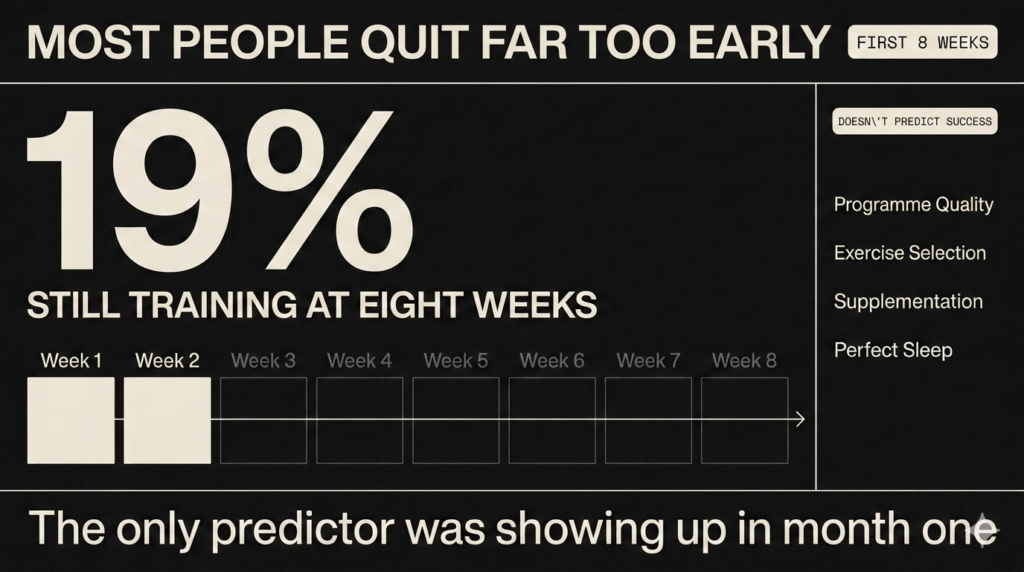
Research tracking beginners across six months found that early consistency was the strongest predictor of whether someone was still training at the six-month mark. Programme quality, exercise selection, supplementation — none of it came into it at all. The only thing that mattered was whether you showed up in the first month.
Only around 19% of people maintain their fitness goals past eight weeks, and the gap between that 19% and everyone else almost certainly isn’t knowledge. Most people who start a new fitness programme know roughly what they should be doing, the gap is whether they actually did it long enough for it to matter.
I’ve been coaching for over a decade now, and I’ve never had a client fail because they didn’t know enough about optimal rep ranges or meal timing. The ones who don’t get results either quit too early or never built a consistent enough training habit to accumulate meaningful volume in the first place.
When you try to optimise from day one, you also tend to create a fragile system. Everything depends on everything else being perfect: from the right gym, to the right meals prepped, the right sleep, the ideal split, and so on. One disruption knocks the whole thing over, and you’re back to square one with nothing to show for it.
Consistency built before optimisation is more robust than that. A consistent trainer who travels and can’t follow their usual programme just does something. A consistent eater who has a bad week still eats mostly reasonably. The volume keeps accumulating even when the conditions aren’t perfect, because the behaviour has been embedded somewhere underneath the conscious effort.
Volume Over Time
The other thing people underestimate is how much the process teaches you, and not in a vague motivational-poster sense but very practically.
Once you’ve been training consistently for six months, you know which movements make you feel strong and which ones cause you grief. You know whether you respond better to higher or lower frequency. You’ve learned where your appetite patterns are, what actually keeps you on track with food, and what causes you to go off the rails. You’ve collected real data about yourself, which is infinitely more useful than reading about what works for other people.
That’s the information that optimisation actually requires. And the only way to generate it is to do the thing and pay attention.
Most people skip that process and try to import other people’s optimised approaches wholesale. There’s nothing necessarily wrong with the approach itself, but it rarely works because it wasn’t built based on their own patterns and preferences. You end up following a system that’s been optimised for someone else, then quitting when it turns out it doesn’t quite fit.
Applying This in Real Life
The order of operations for anyone getting started, or restarting, should be fairly simple.
Build the habit first. This means picking a frequency you can actually sustain. It probably won’t look like the optimal frequency you’d read about on a website or see on social media, but it should be something you can handle even on your worst week. Two sessions a week that you actually do will outperform five sessions that you white-knuckle for three weeks and then abandon. Similar rules apply for the training programme itself: keep it simple, stick to fundamentals, and keep it manageable. Don’t overthink it, just pick something reasonable and get on with it.
Then, once you’re consistently showing up, start paying attention to what’s working and what isn’t. That’s when refinement becomes useful, because now you have something to refine.
The optimisation will come. It always does when the volume is there. But nothing compensates for the volume not being there: not knowledge, not the right supplements, not perfect sleep, not the ideal programme.
Show up enough times, for long enough, and most of it sorts itself out.
If you want help building a training and nutrition approach that fits your actual life rather than an idealised version of it, that’s what I do.