
If you’re thinking about becoming a personal trainer, I need to tell you something.
This industry will chew you up and spit you out. The qualification is easy. The job is hard. And the business model most trainers are funnelled into is designed to burn them out before they ever build anything sustainable.
I’ve been a PT for years. I’ve seen hundreds of trainers come and go. And I’ve watched too many good people get crushed by an industry that doesn’t care about them.
Here’s what nobody tells you before you sign up for that course.
The Qualification Is A Joke
Let’s start with the basics.
How long do you think it takes to become qualified to give people exercise and nutrition advice? To take responsibility for someone’s physical health and safety?
A year? Two years? A degree?
Try six to twelve weeks.
That’s it. The Level 3 Personal Trainer qualification – the minimum requirement to work as a PT in the UK – can be completed in a few months of part-time study. Some providers advertise “qualify in 16 weeks” like it’s a selling point.
Compare that to other professions where people’s health is on the line. Physiotherapists train for three to four years. Dietitians need a degree plus supervised practice. But personal trainers? A few weekends and an online exam.
The qualification teaches you the basics. It does not make you a good trainer. It does not prepare you for the reality of running a business. And it certainly doesn’t give you the experience to handle the complexity of real clients with real problems.
If you’re thinking about hiring a trainer: this is why “qualified” means almost nothing. The qualification is a starting point, not a mark of expertise.
Commercial Gyms Will Use You
Here’s how the system works.
Commercial gym chains partner with training providers to funnel new PTs through their qualification systems. Get your Level 3 with us, and you’ll have a guaranteed place on our gym floor.
Sounds like a good deal, right?
It’s not.
These gyms operate on a sliding scale rent system. The more clients you have, the more rent you pay. When you’re starting out with no clients, your rent is low – sometimes nothing at all.
Why would a gym let someone work on their floor for free?
Because you’re the free labour.
New PTs are put on the gym floor to approach members, offer free consultations, and do sales for the gym. The gym gets foot traffic, energy on the floor, and a constant stream of people promoting their brand – without paying a penny.
You get thrown into the deep end with minimal support, unrealistic targets, and a business model designed to extract value from you before you burn out.
If you’re thinking about hiring a trainer: this is why so many gym-floor PTs seem desperate, pushy, or distracted. They’re not bad people. They’re trapped in a bad system.
The Money Doesn’t Work
Let’s talk numbers.
The average personal training session in London costs around £50. Outside London, it’s closer to £30-40.
Sounds decent? Let’s break it down.
A PT working at a commercial gym pays 30-50% of their session fee in rent. That £50 session? Now it’s £25-35.
Then there’s:
- Travel time between clients
- Admin and programming time
- Cancellations and no-shows
- Self-employment taxes and national insurance
- Insurance and CPD costs
- Marketing and client acquisition
Factor all of this in, and a PT charging £50 per session is probably earning the equivalent of £12-15 per hour once you account for all the unpaid work.
That’s barely above minimum wage.
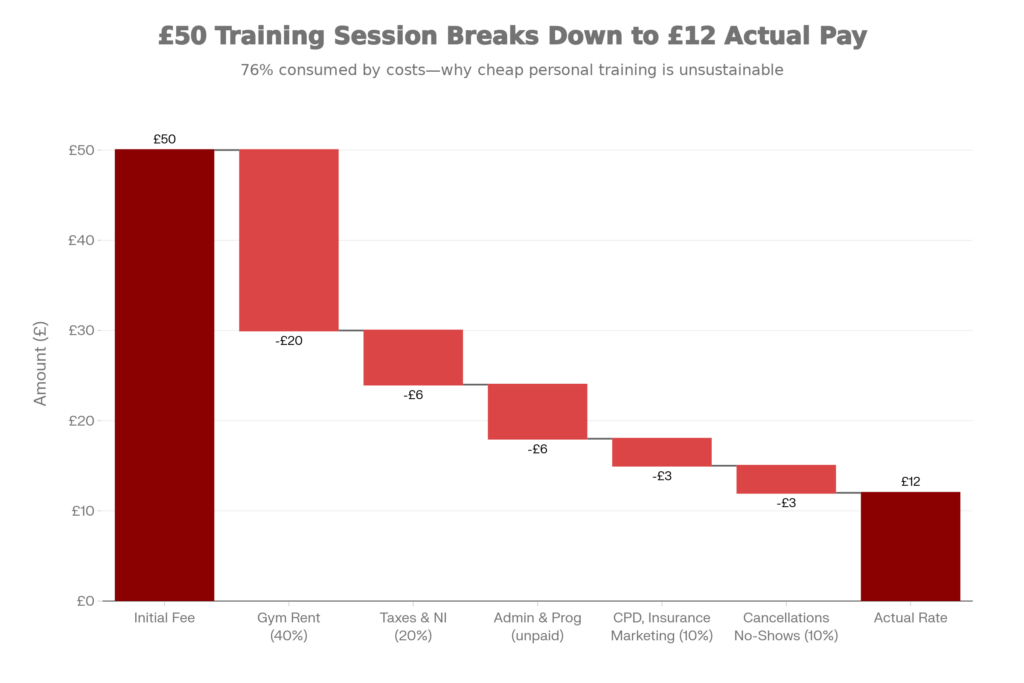
So what happens? You take on more clients. You rush between sessions. You copy-paste the same programme for everyone. You don’t have time to properly plan, review progress, or give your clients the attention they deserve.
The economics force you to cut corners just to survive.
If you’re thinking about hiring a trainer: this is why cheap training often means bad training. It’s not that the trainer doesn’t care. It’s that they literally cannot afford to care. They’re spread too thin, underpaid, and exhausted.
80% Of You Won’t Make It
Here’s the statistic that should stop you in your tracks:
80% of personal trainers don’t make it past their first few years in the industry.
That’s not a typo. The vast majority of PTs quit within the first couple of years. They burn out. They can’t make the money work. Or they simply realise this isn’t the dream job they were sold.
If you’re thinking about becoming a PT, ask yourself: what makes you different from the 80% who fail?
Do you have a business plan? A niche? A way to generate clients that doesn’t involve begging people on the gym floor? A financial runway to survive while you build?
Most people don’t. Most people get their qualification, get a gym placement, struggle for a year or two, and leave.
If you’re thinking about hiring a trainer: this is why experience matters so much. If your trainer has been in the industry for five, ten, fifteen years – they’re in the 20% who figured it out. They’ve survived where most couldn’t. That’s not nothing.
The Exception: Making It Work
I’m not saying it’s impossible. I’m saying it’s hard.
The trainers who survive – and eventually thrive – do things differently. They:
- Build a sustainable business model with rates that actually support quality work
- Specialise instead of trying to train everyone
- Invest in their education far beyond the basic qualification
- Create systems that let them deliver consistent, high-quality coaching
- Take their time instead of rushing between 30 clients a week
It takes years to get there. Years of learning what actually works. Years of refining your methods. Years of building a client base that values quality over price.
The trainers who reach this point are rare. And they don’t charge £40 an hour.
If you’re thinking about hiring a trainer: this is what quality looks like. A trainer who’s been in the game long enough to build something sustainable. Someone who charges enough to actually give you their attention. Someone with the experience to know what works – and what doesn’t.
The Real Cost Of Cheap
Here’s the uncomfortable truth for both sides:
For aspiring trainers: if you charge cheap rates, you’ll be trapped in a cycle of overwork, burnout, and mediocrity. You’ll never have the time or energy to actually become good at this.
For clients: if you hire a cheap trainer, you’re probably hiring someone who’s overworked, inexperienced, and won’t be around in six months. You’ll spend hundreds of pounds and get nowhere.
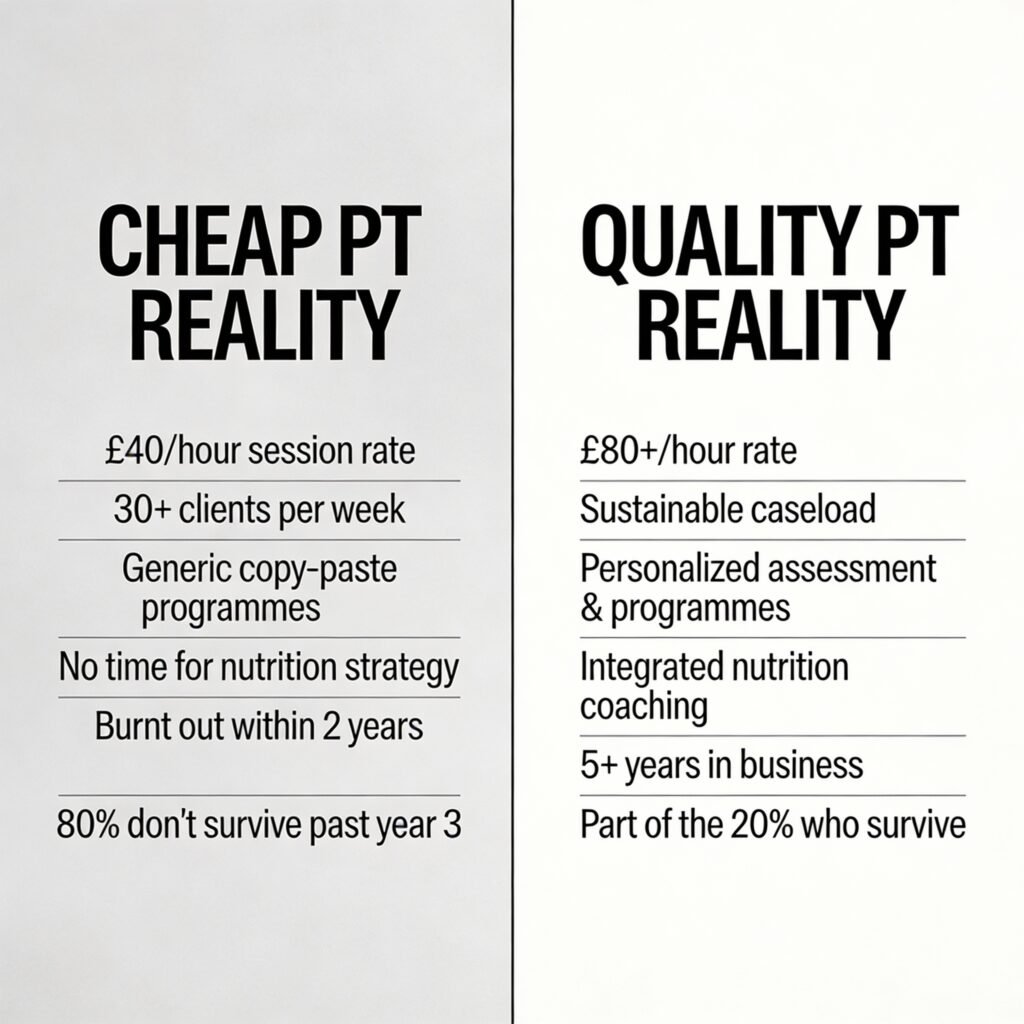
Cheap personal training is a false economy. It doesn’t serve the trainer. It doesn’t serve the client. The only people it serves are the commercial gyms who profit from churning through both.
What To Do Instead
If you want to become a personal trainer:
Think very carefully about whether this is right for you. If you’re going to do it, do it properly. Build a business model that lets you charge what you’re worth. Specialise. Invest in ongoing education. Play the long game.
Don’t let yourself become another statistic.
If you want to hire a personal trainer:
Look for experience. Look for someone who’s been doing this long enough to know what they’re doing. Look for systems, specialisation, and a sustainable business.
Expect to pay more. Because the trainers who are worth your time have built something that lets them actually focus on you – and that doesn’t come cheap.
The question isn’t “how much does a trainer cost?”
The question is “how much is it costing you to keep getting this wrong?”