
The real key to hitting your fitness New Year’s resolution lies in long-term thinking. Whatever changes you make in January should be changes you keep until December. The best way to lose fat, build muscle, or get in shape this year is to plan across all twelve months – not just the first four weeks.
Different diets and programmes work for different people, but the one universal truth is consistency. The compounding interest of showing up day in, day out builds results that short bursts never can.
TL;DR
- Plan for the full year, not just January
- Safe fat loss maxes out at around 1% of body weight per week
- Muscle gain is even slower – roughly 1% of body weight per month
- Short-term intensity leads to burnout; sustainable effort leads to lasting change
- Whatever goal you hit, you need to keep – so build habits you can maintain
Having spent 12 years coaching, I know most people approach their resolutions with complete sincerity. They have plenty of willpower. What they lack is a strategy that fits how bodies actually change.
The Problem: Short-Term Plans Meet Long-Term Biology
Research consistently shows that the majority of New Year’s resolutions fail within the first few months. A YouGov survey found only 31% of Britons who made resolutions for 2023 kept them all. Fitness goals are no exception. But why?
Psychologists haven’t identified some mass lack of willpower. Most people genuinely want to change. The problem lies in a fundamental cognitive bias we all share – short-term thinking.
You can easily imagine what you need to do today or tomorrow. But picturing what your routine will look like in three or six months? That’s harder. So people plan meticulously for week one – the training split, the foods to eat, the calories to burn – and give almost no thought to what happens in March, July, or October.
This short-term planning crashes into a physical reality: your body has upper and lower limits for how fast it can change.
The Maths That Most People Ignore
Fat Loss Limits
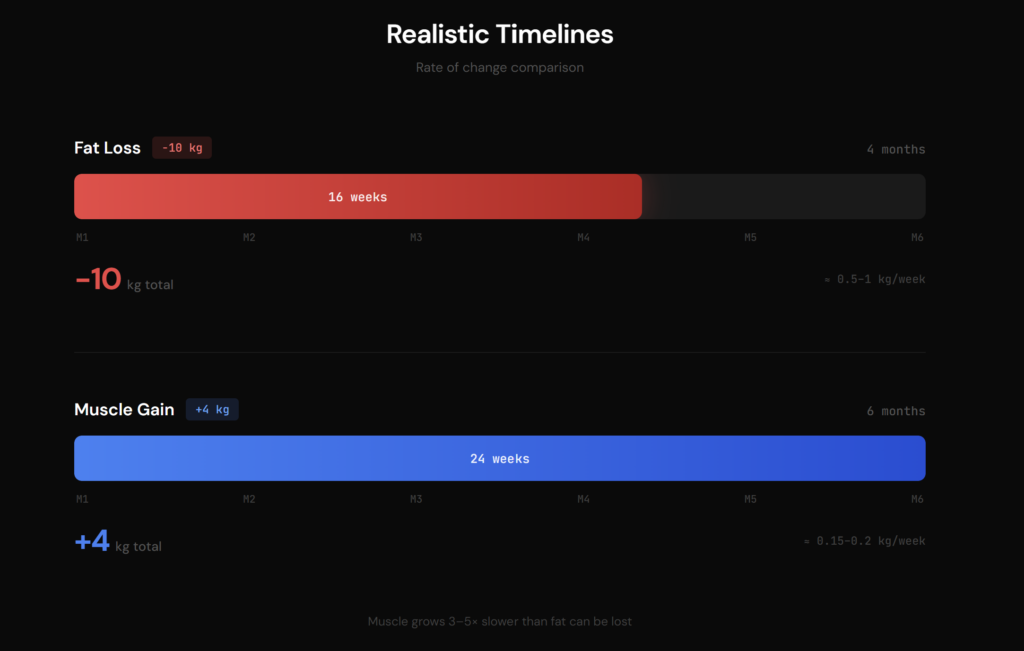
The safe upper limit for fat loss – without bouncing back – is around 1% of your body weight per week. Push harder than that and the diet becomes brutal. Adherence drops. Weight yo-yos right back up.
In practical terms, that means in a single month you could lose about 4% of your body weight at best. If you weigh 70kg, that’s roughly 2.8kg in a month.
Good progress. But not dramatic.
If you have 10kg to lose, you’re looking at four months minimum – and that’s if everything goes perfectly.
Muscle Gain Limits
Building muscle is even slower. Research on muscle hypertrophy confirms that beginners can typically gain around 1% of their body weight in muscle per month.
For someone weighing 70kg, that’s about 700g of muscle in a month. At very best.
Not exciting on paper. But stretch that out over six months and you’re looking at 4-5kg of new muscle tissue. That’s a visible, meaningful transformation.
Why January Warriors Quit by February
Here’s what typically happens.
Someone plans meticulously. They go all out for a month. They train hard, eat clean, and track everything.
Then they step on the scales or look in the mirror.
The results feel mediocre for all that effort. A couple of kilos down. Maybe a bit more definition. Nothing dramatic.
Disappointment sets in. Motivation drops. By early February, they’ve stopped entirely.
They expected four weeks of intensity to deliver what actually requires four to six months of consistency.
The Solution: Plan Like You Mean It
Flip the script. Instead of asking “what can I achieve by the end of January?” ask “what do I want to look and feel like by December?”
Then work backwards.
Realistic Timeframes
- Fat loss phase: 8-10 weeks of focused dieting, losing around 1% of body weight per week
- Muscle gain phase: 12-16 weeks of progressive training, gaining around 1% of body weight per month
- Maintenance breaks: 2-4 weeks between phases to let your body recover and reset
For more on how to structure training differently in each phase, read weight training for muscle gain vs fat loss.
With these building blocks, you can structure your entire year.
Example Year Structure
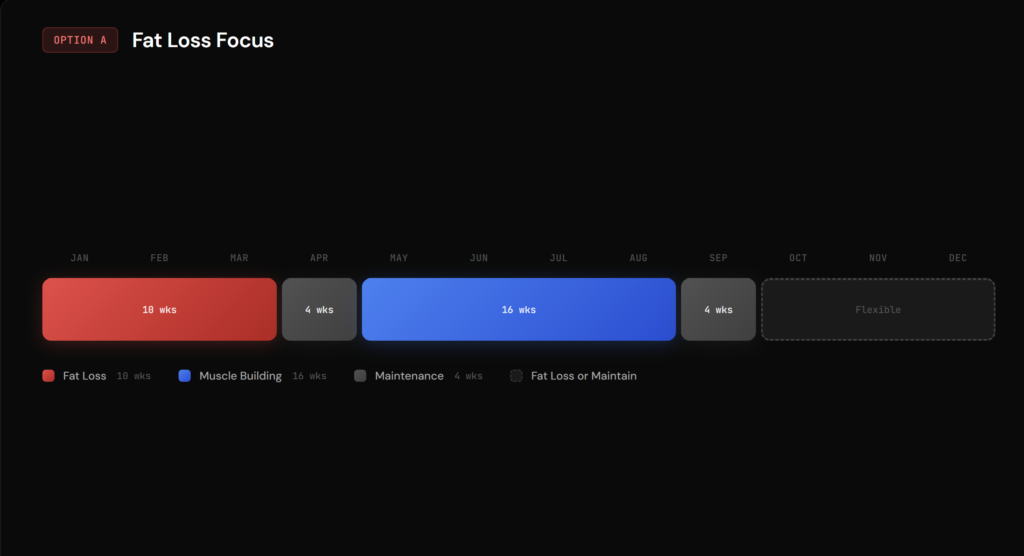
Option A: Fat Loss Focus
- January to March: Fat loss phase (10 weeks)
- April: Maintenance (4 weeks)
- May to August: Muscle building phase (16 weeks)
- September: Maintenance (4 weeks)
- October to December: Second fat loss phase or maintain new physique
Option B: Muscle Building Focus
- January to April: Muscle building phase (16 weeks)
- May: Maintenance (4 weeks)
- June to August: Fat loss phase (10 weeks)
- September: Maintenance (4 weeks)
- October to December: Second building phase or maintain
The specific structure depends on your goals. But the principle stays the same – plan for the long haul.
The Compounding Effect of Consistency
Here’s the counterintuitive bit: with a longer timeline, the work doesn’t even need to be as intense.
Training over time is like investing in a pension. Each session builds on the last. Each week of decent nutrition compounds into months of progress. Small, sustainable efforts stack into dramatic results. This is why slower training progress builds bigger muscle gains.
With less effort spread over more time, you can achieve something far more impressive than any January blitz.
“But I Want Results Now”
I hear this a lot. The response goes something like: “If I went all out now, I could get good results fast.”
Sure. But then what?
If your goal is to build muscle, do you really think five weeks of hard training means you’ll never need to go to the gym again? The gym has to become part of your life. Something you look forward to, not something you dread.
Same with nutrition. Dieting hard for five weeks might shift some weight – but if you go straight back to family bags of Doritos, you’ll be right back where you started by May.
Change means sustained change. Whatever you do to hit your goal, you’ll need to keep doing some version of it to maintain that goal.
So you might as well build habits you can actually live with.

Key Takeaways
- Think in years, not weeks. Your body changes slowly. Plan accordingly.
- Aim for 1% body weight per week for fat loss. Faster than that and you risk rebounding.
- Expect around 1% body weight per month for muscle gain. Patience pays off.
- Build in maintenance phases. Your body needs breaks between pushes.
- Consistency beats intensity. Showing up regularly matters more than occasional heroics.
- Whatever you achieve, you need to keep. Build habits that last.
These are the physiological limits of how bodies work. I don’t make the rules. But if you plan this way, you’ll get far better returns on your year.
You’ll be much closer to hitting your 2026 fitness resolution than any short-term blast could ever take you.
If you want help mapping out your year, book a free consultation and we can build a plan that fits your life.