
Most people assume doing cardio is essential for losing fat. The reality is quite different – and understanding it could save you hours of wasted effort. In this blog we’ll look at what cardio actually does, when it’s worth doing, and the easier ways to get the results you want.
The best reason to do cardio is for heart health and sport performance.
TL;DR
- Cardio is brilliant for heart health and sport performance.
- For fat loss, you’ll get better results by sorting your nutrition than grinding through cardio sessions.
- High- and low-intensity cardio burn similar calories, but leave you feeling very different.
- Focus on nutrition and daily movement — same results, far less hassle.
Cardio has become the default
Cardio for fat loss – Not the tool people think
Ask most people how to lose fat and they’ll default to “Do more cardio.” Treadmills, spin bikes, bootcamp classes – these are some of the most common solutions.
The surprising truth is that cardio isn’t nearly as effective for fat loss as you’d assume. But before we look at why, let’s be fair and look at what cardio actually does well.
The strongest reason to do cardio is long-term health. Regular aerobic activity improves your heart, lungs, and circulation. According to the NHS, it can cut your risk of coronary heart disease by up to 35%.
What cardio is actually good for
The best reason to do cardio is long-term health. Regular aerobic work improves your heart, lungs, and circulation. According to the NHS it can cut your risk of coronary heart disease by up to 35%.
But the threshold for these benefits is lower than most people think. You don’t need to run for hours every week. Both the NHS and World Health Organisation recommend either:
- 150 minutes of moderate activity per week (brisk walking), or
- 75 minutes of vigorous activity per week (running).

That’s three 20–30 minute sessions. Beyond that, cardio makes sense if you want to get better at doing that type of cardio – running, rowing, football, Hyrox, whatever. If you enjoy those things and want to get better at them, do as much as you like. Knock yourself out.
The pastry problem
However, when you look at cardio as a calorie burner, the juice isn’t quite worth the squeeze.
If you run at a steady pace for 30 minutes, you can expect to burn around 300-400 calories. That sounds pretty good at first, but do you know what else is 300-400 calories?
A croissant.
Which is easier – slogging through half an hour of running, or dodging one pastry on your way to work?
This is the fundamental nature of the imbalance. Cardio burns calories, sure, but a few missteps nutritionally and you’re at square one.
Or, to take a more positive view, a few good nutritional swaps and the run becomes unnecessary.
That’s why intensity can trick you. Sprint a kilometre in bursts and you’ll be wrecked. Walk the same kilometre and you’ll feel fine. The calorie difference? Around 20. That’s less than half a biscuit. For cardio fat loss efforts, that trade-off just isn’t worth the fatigue.
Effort doesn’t equal calories
HIIT studios and bootcamps usually make more ambitious claims about calorie burn in the realm of 600 or 700 calories in a class.
I worked in a HIIT gym years ago that tracked calorie burn. Most 45-minute sessions came in closer to 350–500 calories.

People would be jumping, burpeeing, sprinting, and generally came away with a feeling like they’d kicked arse. But the numbers didn’t really match that feeling. They didn’t look that different from the same time spent jogging. But why?
A calorie is a unit of energy – 4.184 kilojoules. You might remember from secondary school science that energy use is about the work done (force × distance). It’s about the force you apply and the distance you move. How knackered you feel doing it doesn’t actually come into it.
This is unintuitive, so here’s an example.
Sprint a kilometre as fast as you can. You’ll probably need to do it by sprinting in bursts, with pauses in the middle to recover. By the end you’ll most likely feel wrecked.
Compare that to walking a kilometre. Sure, it’ll take longer, but before, during and afterwards you’ll feel totally fine. No short breath, no crash out at the end, no fatigue the day after.
The calorie difference between these two? About 20 kcal. To put that in perspective that’s less than half a biscuit.
Now imagine yourself sweating and struggling for breath after sprinting that kilometre, and imagine asking yourself if that felt worth half a biscuit for the extra effort? Thought not.
Non-exercise activity (NEAT) — the walking, fidgeting, lifting, and moving you do all day.
How to get the same results with less effort
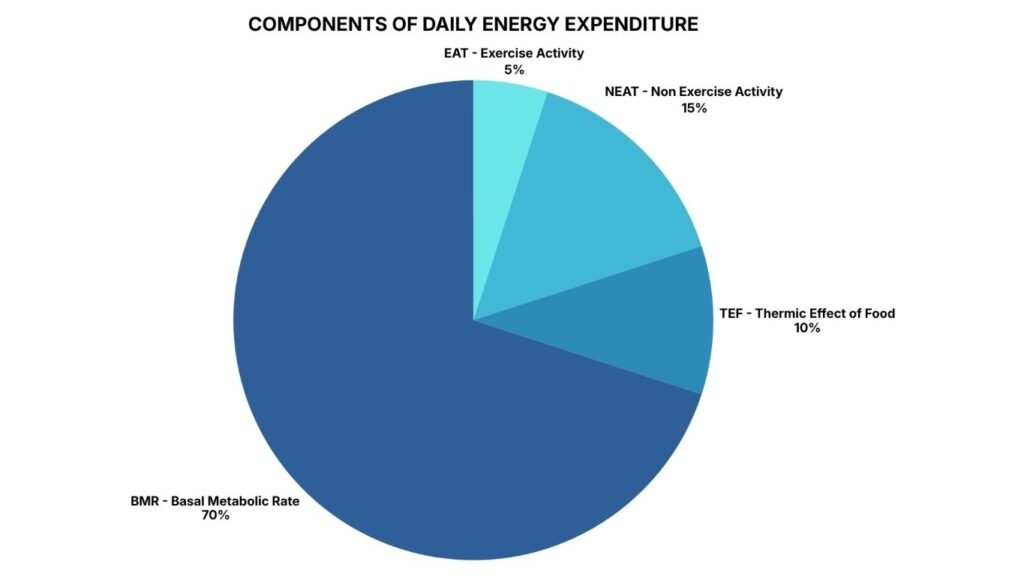
Most of your daily calorie burn doesn’t come from workouts. It comes from:
- Basal metabolic rate (BMR) – the energy your body burns at rest, just keeping you alive, about 60–70%.
- Non-exercise activity (NEAT) – walking, fidgeting, lifting, moving throughout the day. Most of the remainder
- A small slice from formal exercise.
People ignore NEAT because it feels less dramatic than a workout. But it has two big advantages: it stacks up, and it doesn’t create any fatigue.
- A few extra walks.
- Doing DIY or gardening.
- Playing with your kids.
- Taking the stairs instead of the lift.
These don’t feel like much — but they add up. Adding 5,000 steps a day burns roughly 200 extra calories. Over a week, that’s about 0.2 kg of fat. Keep it up and you’re close to a kilo a month, without punishing workouts.
A clear example of this is bodybuilders. Now you might never want to look like a bodybuilder at competition, but the fact remains their entire sport is based around losing body fat. Their choice of cardio for fat loss? Running? HIIT? No. Just walking.

Make fat loss simpler
What to do instead
- Use cardio for health or sports, not as your main cardio for fat loss strategy.
- For fat loss, focus on nutrition first.
- Build NEAT into your day: extra steps, chores, activities you enjoy.
You don’t need to run yourself into the ground. When it comes to cardio for fat loss, smart and consistent actions beat exhaustion every time.
Get a plan that works
If you’re in Deptford, SE8, or South East London and want a plan that works without wasted effort, book a consultation below.