
No one likes counting calories. I’m a big proponent of it, and even I don’t enjoy it. As a result, anyone marketing a new diet app, plan, or approach can get a lot of positive attention by making calorie counting the enemy.
You see this play out in a lot of different diets. But we’ve seen this in particular in the case of nutrition personality and creator of the Zoe app, Tim Spector.

I’m not a personal fan of Tim Spector. I do think paying £600 a year for a blood glucose monitor probably isn’t the best use of your resources if you want to improve your nutrition.
I can, however, recognise that he and people like him have some valid criticisms of calorie counting. The issue is – they’re solving for the wrong problem.
The main criticism is that calorie counting is imperfect. However, calorie counting does not have to be perfect in order to work effectively. And by worrying about perfectly tracking calories, they miss the real mechanism that makes calorie counting effective.
The Problems with Calorie Counting
The basic idea of calorie counting comes back to the concept of calories in, calories out – often called CICO. Essentially, the fundamental truth that in order to lose weight, we need to be putting out more energy than we’re taking in.
Here’s where the criticism starts to come in.
We Don’t Really Know What We’re Taking In

If you want to find out what calories are in a food, you’ll normally go to a nutrition label. However, nutrition labels are not as accurate as you might imagine.
The FDA, for example, allows a 20 percent margin of error on calorie declarations. So a food that’s labelled as 100 calories could easily actually contain 120.
This isn’t a major issue with one food on its own, but these errors can compound when multiple different foods are taken into account.
An additional criticism is that calories can vary depending on how a food is cooked, as the bioavailability of the nutrients in that food changes. For example, a raw chicken celery stick only contains 6 calories, but a cooked one contains 36 calories. This isn’t a trivial error – it could really throw you off when tracking your food.
One other thing worth mentioning is that most people are also woefully bad at tracking. Studies have found that members of the general public can be off by up to 400 calories in their measurements. And even registered dietitians can be off by around 200.
All three of these factors together can result in someone being majorly off in what they think their calorie intake is.
We Don’t Know What We’re Putting Out Either
Most calorie calculations are based on approximations of your basal metabolic rate (BMR), based on height, weight, age, and sex. We have no real, actually accurate way of knowing what this number is for most of the general population.
In addition to this, it’s very hard for us to accurately track the calories you expend through activity. This is especially true if you don’t formally exercise – activities like fidgeting and unconscious movement contribute to the energy you burn each day in ways you might not perceive or think about.
These points come together into a fairly strong criticism: we don’t know what you’re putting out, or what you’re taking in. How are you supposed to monitor and manage that?
Valid criticism. Here’s how.
The Counter-Argument: Here’s What Tim Spector and Similar People Are Missing
Calorie counting doesn’t rely on being perfectly accurate. All it needs to be is functional.
While we don’t know the exact calories that you’re taking in and putting out on a day-to-day basis, we do understand the relationship between calories and weight change fairly well.
We know that a 7,000 calorie difference equals approximately one kilogram change in weight.
This relationship holds true even if your numbers are sloppy.
But here’s the real mechanism – here’s how we really make use of this: the feedback loop.
We don’t rely on getting the numbers right from the start. That would be impossible. Instead, we observe what happens and adjust accordingly.
The Feedback Loop: A Step-by-Step Guide
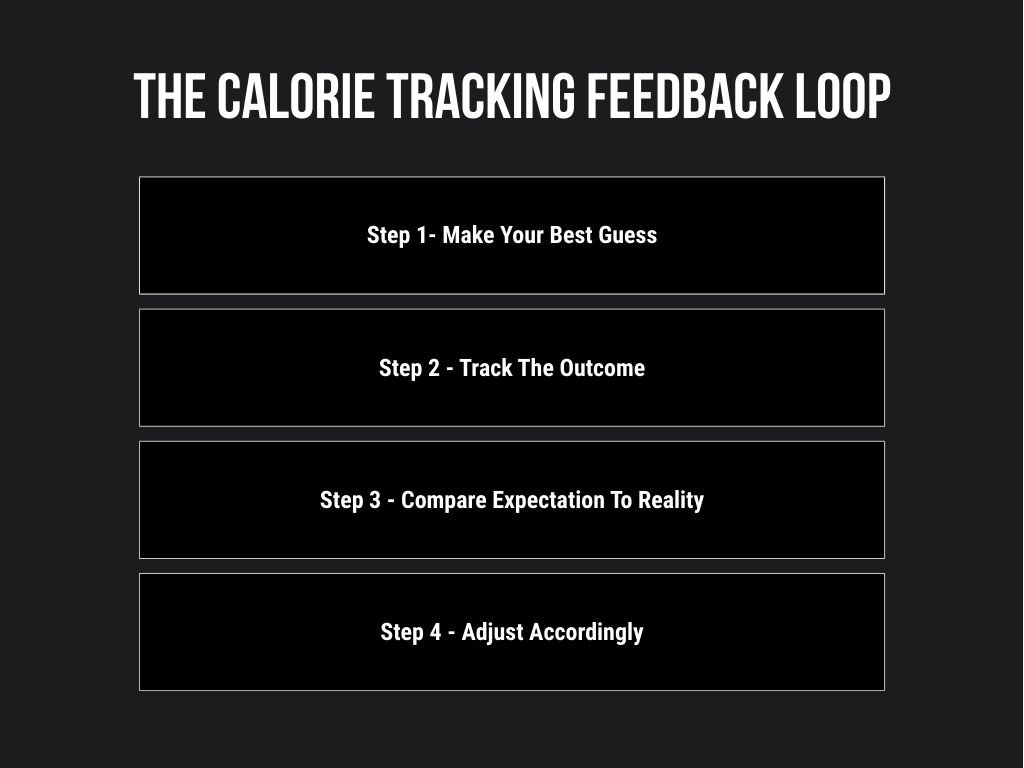
Here’s a step-by-step on how we would work this in practice.
Step 1: Make Your Best Guess on Your Calorie Expenditure
Use a standard calorie calculator to estimate your total daily calorie needs. And then calculate and set your target calories from that.
For example, a calculator might tell you that your total daily energy expenditure is 2,500 calories. So to lose half a kilo a week, you need to eat 2,000 calories a day.
This doesn’t need to be perfectly accurate. It just needs to be reasonable enough for us to get started.
Step 2: Track Your Food and Track the Outcome
Track your food as well as possible. Try to be accurate, but don’t lose your head too much over whether you’re doing it perfectly.
From there, you also want to track your weight. You don’t want to do this obsessively, but you want to do it enough that you can get an average week to week – so think three times a week on Monday, Wednesday, and Friday.
Step 3: Compare Reality to Expectation
Say, for example, you expected to lose 0.5 kilos per week. But when you check your weight change, it turns out you’ve actually lost 0.2 kilos per week.
The gap tells you something. That your actual deficit is smaller than you thought. Maybe you’re putting out less energy. Maybe your total calorie needs per day are lower. Maybe you’re underestimating the amount of food you eat. Maybe it’s a bit of both.
Either way, we know the magnitude that we’re off by. And we can change things accordingly.
Step 4: Adjust and Repeat
Reduce your calories by two to three hundred per day. Repeat the same tracking process you were doing before, and then retest in one to two weeks.
You should now be losing closer to your target rate. If not, you can always adjust again.
This is a self-correcting system that can refine over time to make sure that you end up on target.
Practical Example
- Let’s say you’re a 90kg person trying to lose fat
- You estimate your TDEE at 2,400 calories and aim for 0.5kg/week loss (200 calorie deficit)
- So you eat 2,200 calories per day
- After two weeks, you’ve only lost 0.2kg instead of the expected 1kg
- That’s a gap of roughly 200 calories per day (0.3kg per week missing = 200 calorie gap)
- So you adjust: drop to 2,000 calories per day
- Two weeks later, you’re right on track
- Did your original estimate matter? Not really. What mattered was that you adjusted based on feedback
The beauty of this approach is it doesn’t require perfect tracking or perfect initial estimates. Even if your tracking is off by 20 to 30 percent, the feedback loop corrects for that.
We can never fully accurately know what you’re taking in or putting out. But we do understand the relationship between calories and weight loss. And we can use real-world results to dial in what your actual body needs.
Conclusion
So, does calorie counting work? Yes – just not for the reason most people think.
It works by creating a feedback loop, not through estimating everything perfectly.
If you want help with setting this feedback loop up for yourself, contact me below for a free consultation.